.
Class 4 EVS Chapter 1 Living Together Question Answer
Living Together Class 4 EVS Question Answer
Our Wondrous World Class 4 EVS Chapter 1 Question Answer – Class 4 EVS Living Together Question Answer
Write (Page 4)
Question.
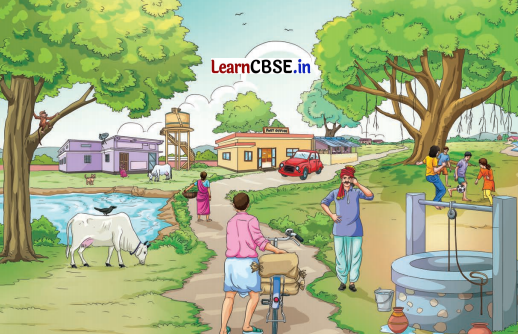
Look at the picture of Chandan’s village. What do you see in the picture? Describe below.
Answer:
In the picture of Chandan’s village, I see a big open field. There is a banyan tree at the corner where elders sit and talk. Children are playing football. There are houses, a post office, a pond, a car, a well, bucket, earthen pots, overhead water tank, a shop, man with bicycle, woman, few animals, trees, etc. The road connects all the places. The village looks clean, green, and happy.

Activity 1 (page 4)
Question.
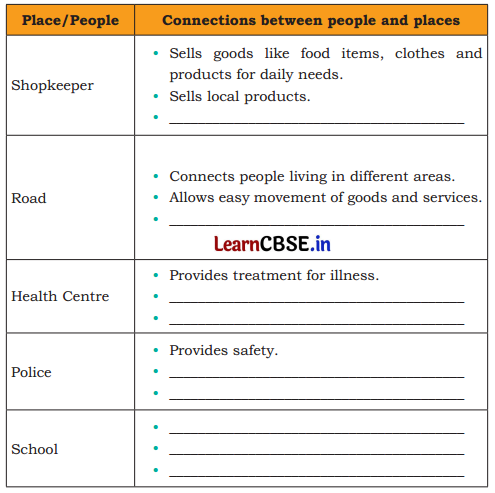
Explore your locality; observe the people and places around you. Write your observations about how the people and places you see are connected to each other in the table given below.
Answer:
| Place/ People | Connections between people and places |
| Shopkeeper | • Sells goods like food items, clothes, and products for daily needs. • Sells local products. • Helps people get things they need every day. |
| Road | • Connects people living in different areas. • Allows easy movement of goods and services. • Helps people go to school, markets, and hospitals. |
| Health Centre | • Provides treatment for illness. • Gives first aid in emergencies. • Keeps people healthy. |
| Police | • Provides safety. • Maintains law and order. • Helps in emergencies and accidents. |
| School | • Provides education to children. • Helps children develop life skills and values. • Prepares students for careers and life. |
Discuss (Page 5)
Question 1.
Why do you think it is important to have places like parks, schools, hospitals and bus stops in your locality?
Answer:
It is important to have places like parks, schools, hospitals and bus stops near our locality because these places help us in different ways.
- Parks are for playing and relaxing.
- Schools are for learning new things.
- Hospitals help us when we are sick.
- Bus stops help us travel easily.
Question 2.
How would life be different if one or more of these places in your locality did not exist?
Answer:
Life would be difficult if one or more places in our locality did not exist.
- Without parks, we would not have a place to play or exercise.
- Without schools, children would not have a place to learn, meet friends, or get an education.
- Without hospitals, people would not get proper treatment when they are sick.
- Without bus stops, it would be hard for people to travel.
Question 3.
What can you do to keep these places clean and safe?
Answer:
The following things can be done to keep the places, such as parks, schools, hospitals and bus stops, clean and safe.
- Do not litter in these places.
- Do not write on walls of schools or bus stops.
- Plant trees in the parks and take care of them.
- Stay quiet and calm in hospitals. Do not run or play inside the hospital.
Activity 2 (Page 6)
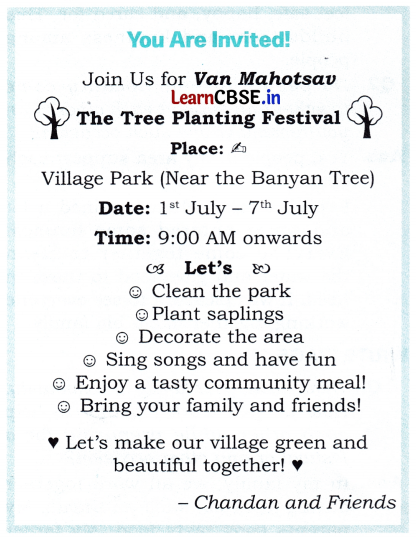
Let us create a colourful poster to help Chandan and his friends invite people from their neighbourhood to participate in the Van Mahotsav.
Answer:
Students can create a poster like given below.
Activity 3 (Pages 7-8)
Question 1.
Identify the people who help in maintaining your locality. What are their occupations?
Answer:
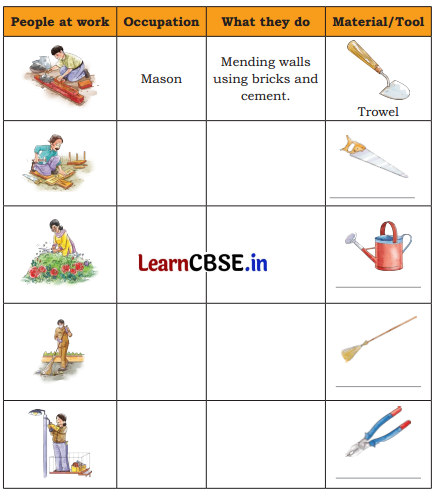
People who help in maintaining our locality are as follows:
- Shopkeeper: Sells goods like food items, clothes and products for daily needs.
- Teacher: Teaches children in school.
- Doctor/Nurse: Treats sick people at the health centre.
- Police Officer: Keeps us safe and maintains law and order.
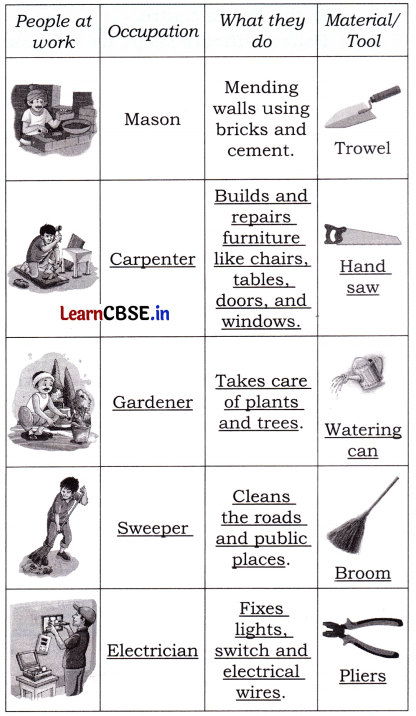
- Sweeper: Cleans roads and public places.
- Electrician: Fixes lights and electrical wires.
- Gardener: Takes care of plants and trees in the park.
- Carpenter: Repairs benches and wooden items.
- Mason: Builds or fixes walls and buildings.
- Plumber: Repairs pipes, taps, and drainage systems.
- Security Guard: Watches over buildings, parks, and entrances.
- Mechanic: Repairs vehicles like bikes, autos, and cars.
Question 2.
Look at the table below. List different kinds of work required for developing and maintaining the park. Also, mention the material, tools and skills
Answer:
Question 3.
Find out from your family members or neighbours about their work. What questions would you ask them? Here are some examples:
(a) What do you like the most about your work?
(b) What types of tools or things do you use?
(c) What challenges do you face?
Answer:
Hint: I would ask the following questions to my family members or neighbours about their work:
(a) What do you like the most about your work?
(b) What types of tools or things do you use in your work?
(c) What challenges do you face?
(d) What made you choose this job?
(e How does your work help others?
Discuss (Page 10)
Question 1.
It is important for communities to come together in times of need. What do you think about this statement?
Answer:
Yes, I agree with this statement. When people help each other during hard times, it becomes easier to solve problems. It also makes everyone feel safe, happy, and cared for. This builds trust and kindness among people.
Question 2.
Do people in your locality come together and support each other? Can you remember one such occasion?
Answer:
Yes, people in my area support each other.
I recall a time when it rained a lot and water entered some houses. Everyone come together to clean the water and gave food to those in need. It was pleasant to see everyone working together like a big family.
Write (Page -11)
Question.
Think about your family or community. How do you work together to help each other while preparing for a
festival or any other occasion?
Answer:
In my family, we all work together during festivals, such as Diwali. My parents cook tasty food. My father
puts up lights and decorations. I help by cleaning the house and arranging things. My sister makes beautiful rangoli. We also invite our neighbours and share sweets with them. Everyone helps, and it becomes a fun and happy time for all of us.
Discuss (Page 13)
Question 1.
What are some of the ways by which we can take care of nature and our neighbourhood? List a few.
Answer:
We can take care of nature and our neighbourhood in the following ways.
- Plant more trees and water them.
- Do not spit or litter on the road.
- Use dustbins to keep the area clean.
- Save water and electricity.
- Take care of the plants and animals around us.
Question 2.
How does helping others and working together make our community better?
Answer:
Helping others and working together makes our community stronger, kinder, and more peaceful. When we help each other and work together, things become easier and faster. People feel happy and safe. It builds friendship among the people of the community.
Let Us Reflect (Pages 13-16)
Our School, Our Team!
Question 1.
Write the different role people play in your school — teachers, students, caretakers, bus drivers, etc.
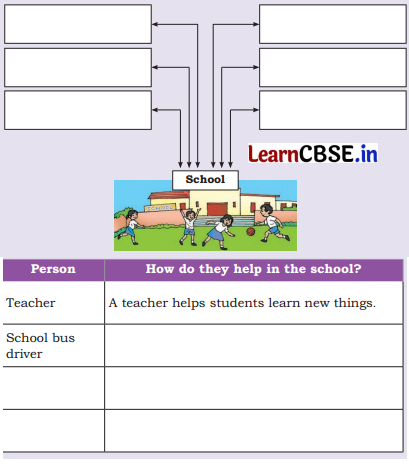
(a) Why is it important for everyone to work as a team in a school?
(b) What is your role as a member of your school community?
Answer:
Different roles that people play in my school are as given:
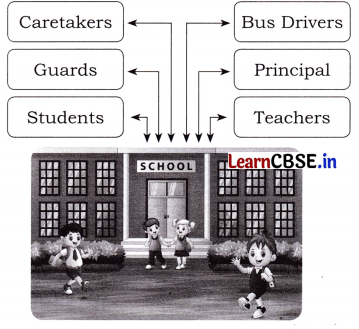
(a) When teachers, students, and staff work together, the school becomes a happy and safe place to learn and grow. It also teaches us respect, cooperation, and how to share responsibilities.
(b) My role as a student is to listen to my teachers, do my work, help others, keep the school clean, and be kind to everyone.
| Person | How do they help in the school? |
| Teacher | A teacher helps students learn new things. |
| School bus driver | A school bus driver takes children safely to and from school. |
| Student | A student learns, laws. and takes part in school activities. |
| Caretaker | A caretaker takes care of children and keeps the school clean and tidy. |
| Principal | A principal manages the school and takes important decisions. |
| Guard | A guard keeps the school safe and checks who enters and leaves. |
Question 2.
Form small groups of 4 – 5 students.
Choose one fun activity to perform from the list below:
(a) Tree plantation
(b) Cleanliness drive
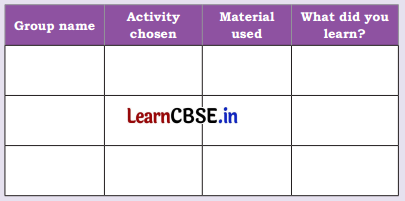
(c) Making artefacts with materials from nature (something useful like a leaf-plate or a decorative item like a garland). After the activity, fill out this table:
Answer:
The complete table is as follows:
| Group name | Activity chosen | Material used | What did you learn? |
| Green Warriors |
Tree Plantation |
San lines. water, shovel |
We learned how to plant trees and take care of nature. |
| Clean Champs | Cleanli ness Drive | Brooms. dustbins, eloves | We learned the importance of keeping our surroundings clean. |
| Nature Artists | Makine Artefacts | Leaves, flowers, thread | We learned to make useful and pretty things from nature. |
Question 3.
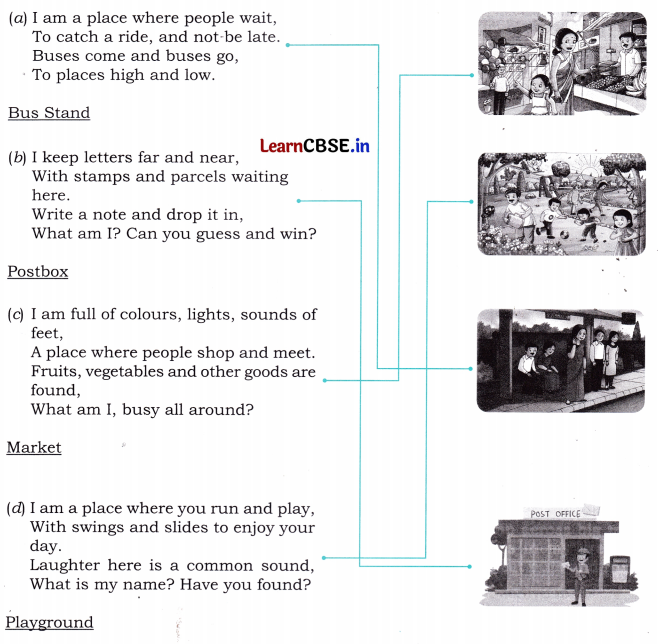
Match the riddles with their solutions hidden in the pictures.
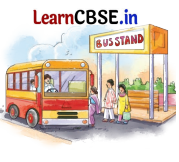
(a) I am a place where people wait,
To catch a ride and not be late.
Buses come and buses go,
To places high and low.
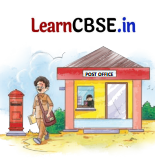
(b) I keep letters far and near,
With stamps and parcels waiting here.
Write a note and drop it in,
What am I? Can you guess and win?
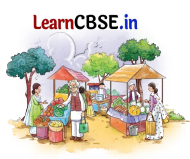
(c) I am full of colours, lights, sounds of feet,
A place where people shop and meet.
Fruits, vegetables and other goods are found,
What am I, busy all around?
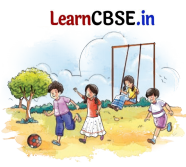
(d) I am a place where you run and play,
With swings and slides to enjoy your day.
Laughter here is a common sound,
What is my name? Have you found?
Choose a public place of your interest, and create a similar riddle about it for your friends to solve.
Answer:
Riddle:
It’s where we go to learn and grow,
With books, blackboards, and minds that glow.
Teachers guide us every day,
What is this place? Can you say?
Answer:
School
(Students can create riddle of their own.)
Question 4.
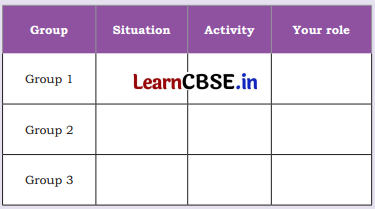
Create three groups in the class. Each group would think about a situation in their locality that needs to be improved. Identify activities that can make a difference to the situation. This could be related to cleaning,
helping others, organising an event, etc. Complete the table below.
After completing the table, discuss and answer the following questions:
(a) Do you think working together can make your activities more useful? Give reasons.
(b) How will your involvement in these activities help the community?
Answer:
The complete table is given below.
| Group | Situation | Activity | Your role |
| Group 1 | Dirty park in the locality | Cleaning the park and planting trees | Picking up litter and watering plants |
| Group 2 | Some families need warm clothes | Collecting and donating clothes | Requesting neighbours to donate their few warm clothes |
| Group 3 | School walls are dull | Painting and decorating school walls | Helping in painting and in making posters |
(a) Yes, working together makes the activity faster, easier and more fun. When we work as a team, we can share ideas, divide the work, and finish tasks faster. Everyone brings different skills, so the results are usually better. It teaches us cooperation, patience, and respect for others opinions.
(b) My involvement in these activities will help the community by making it cleaner, safer, and more friendly. When I help others, share ideas, or work as a team, it encourages others to do the same and builds a strong and caring community.
Question 5.
Ask your family about any one special skill or craft (for example — basket making, wall painting, pottery) that is famous in your region.
Answer:
Do it yourself
Did this chapter match your syllabus?