.
Class 4 EVS Chapter 3 Nature Trail Question Answer
Nature Trail Class 4 EVS Question Answer
Our Wondrous World Class 4 EVS Chapter 3 Question Answer – Class 4 EVS Nature Trail Question Answer
Write (Page 37)
Question.
Can you think of rules that should be followed while you are in a zoo or a forest?
For example,
(a) We should not feed birds.
(b) ——————–
(c) ——————–
(d) ——————–
Answer:
The following rules should be followed while we are in a zoo or a forest:
(a) We should not feed birds and animals.
(b) We should not tease animals.
(c) We should not damage trees and flowers.
(d) We should not damage public utilities.
(e) We should be careful in a new place.
(f) We should not bring pets, firearms, or any kind of weapons.
(g) We should not litter here and there.

Discuss (Page 37)
Question.
Why are these rules important to be followed?
Answer:
These rules are important to be followed because they help to keep us safe in the forest or zoo. They also protect the animals, birds and plants. By following the rules, we take care of nature and keep the forest clean and beautiful.
Activity 1 (Page 39)
Animals in the Forest
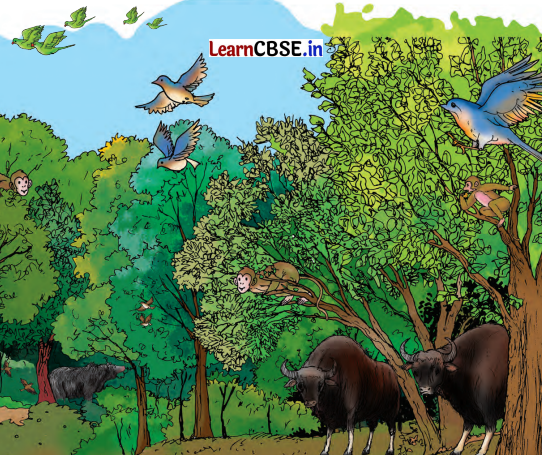
Look closely at the picture and identify the animals. You may take help from your teacher.
Divide them into two categories:
1. Animals on land:
…………………………………..
2. Birds in the sky:
……………………………………
Answer:
1. Animals on land: Indian Bison, Spotted deer, Sambar deer, Monkeys, Bear
2. Birds in the sky: Indian roller, Parrots, Sparrows
Write (Page 40)
Question.
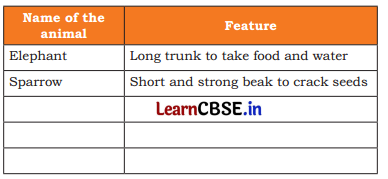
Name some animals including the birds that you have seen. Write any one feature of each of them.
Answer:
| Name of the animal | Feature |
| Elephant | Long trunk to take food and water |
| Sparrow | Short and strong beak to crack seeds |
| Dog | Sharp sense of smell to find things |
| Cat | Sham claws to catch prey |
| Parrot | Curved beak to eat fruits and nuts |
(Page 40)
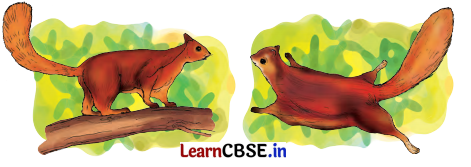
Indian Giant Squirrel is a big, red-coloured squirrel found in Pachmarhi and some other places.
Write
Compare its features with the squirrels you see in your area.
Answer:
The Indian Giant Squirrels are much bigger than the squirrels in my area.
They are reddish-brown, while the squirrels in my area are grey with white stripes on their backs. Both squirrels have long tails, but the Indian Giant Squirrels have thicker and bushier tails. Indian Giant Squirrels can jump across big trees, while the squirrels in my area run faster and love to eat nuts and fruits.
Activity 2 (Page 43)
Question 1.
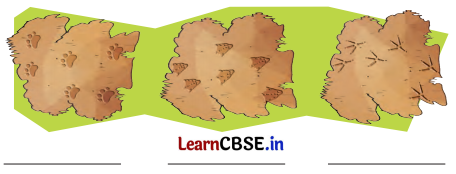
Look at the footprints and guess the name of the animals that you think must have come to the pond to drink water.
Answer:
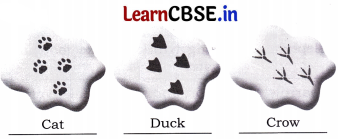
Question 2.
Observe and draw the footprint of any animal in the space given here.
Answer:
Do it yourself
Write (Page 44)
Question.
Name the birds shown below.
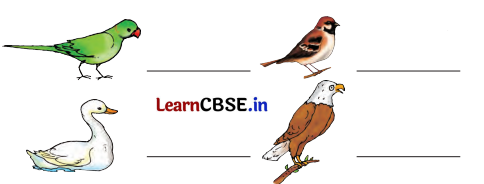
Answer:
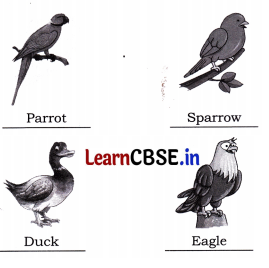
Activity 3 (Page 45)
Question.
Take different food items like grains, berries, fruits, nuts, etc, in a plate.
Try to pick these food items using a spoon, a toothpick or a pair of sticks. Fill the table below with appropriate tool(s) for picking each of these food items.
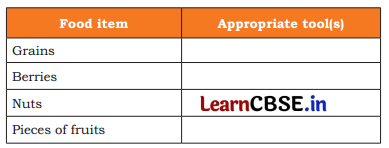
Answer:
| Food item | Appropriate tool(s) |
| Grains | Spoon |
| Berries | Spoon/Toothpick |
| Nuts | Pair of sticks / Spoon |
| Pieces of fruits | Spoon /Toothpick |
Activity 4 (page 47)
Question 1.
Bird Diary
(a) Go near a tree.
(b) Close your eyes and listen to the sounds of different birds.
(c) Now open your eyes and focus on one bird at a time.
(d) Observe how it moves, what it eats, and where it sits.
(e) Write your observations in a Bird Diary!
For each bird, note the following:
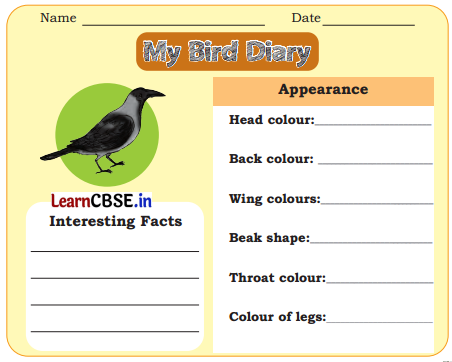
Answer:
Do it yourself
Question 2.
List the animals which live in and around water bodies. Fill in the table given below.
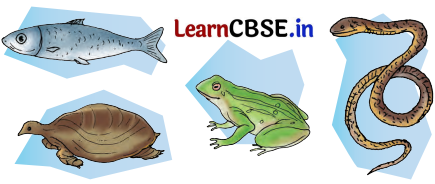
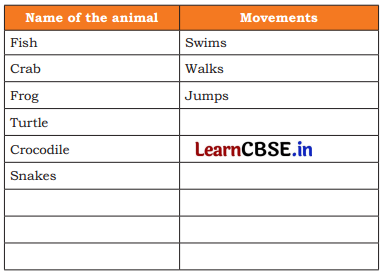
Answer:
| Name of the animal | Movements |
| Fish | Swims |
| Crab | Walks |
| Frog | Jumps |
| Turtle | Swims |
| Crocodile | Crawls / Swims |
| Snakes | Slither |
| Duck | Walks and swims |
| Peneruin | Waddles and swims |
| Octonus | Swims |
Write (Page 49)
Question 1.
What are the insects that you find at your home and in your surroundings?
Answer:
I find various insects around my home and nearby places like ants, house flies, moquitoes, bees, butterflies, cockroaches, and grasshoppers.
Question 2.
Name the insects shown below.
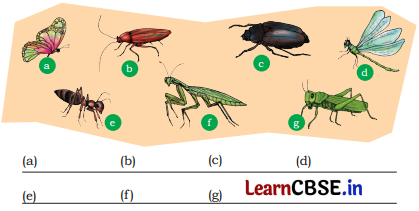
Answer:
(a) Butterfly
(b) Cockroach
(c) Beetle
(d) Dragonfly
(e) Ant
(f) Praying mantis
(g) Grasshopper
Activity 5 (Pages 50-51)
Question 1.
During the visit to the nature trail, students collected leaves from different plants. Help them identify the plants based on the pictures of the leaves given below.
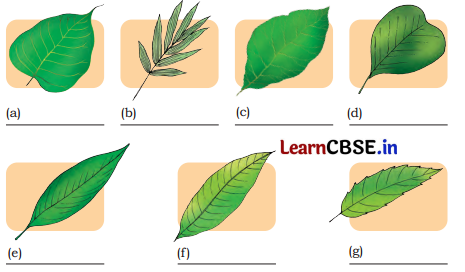
Answer:
(a) Peepal leaf.
(b) Bamboo leaf
(c) Guava leaf
(d) Banyan leaf
(e) Eucalyptus leaf/ gum leaf
(f) Mango leaf
(g) Neem leaf
Question 2.
Observe the leaves of different plants in your neighbourhood and fill the table.
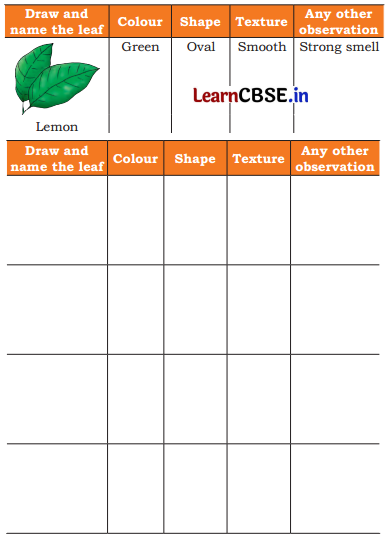
Answer:
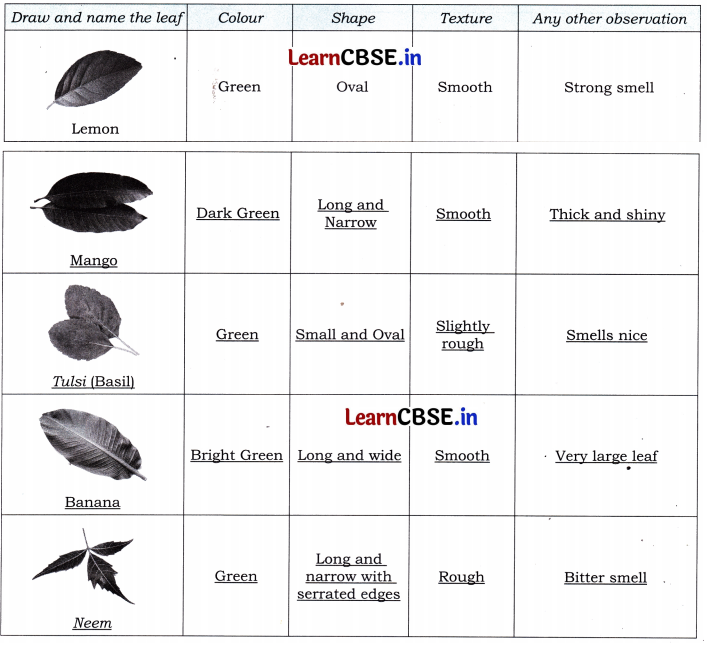
Activity 6 (Page 52)
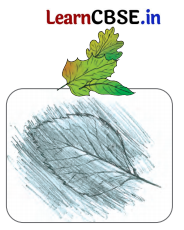
Leaf Autograph
Question.
Place a leaf on a notebook with the rough, vein-side facing up. Cover it with a plain sheet of paper. Rub a crayon over the paper, and watch the leafs shape appear like magic! Try this with different leaves and see how each one has its own unique pattern. Name the plant or tree to which the leaf belongs.
Let Us Reflect (Pages 55-56)
Question 1.
Which animal would you love to be? What special abilities would it give you?
Answer:
I would love to be an eagle. It would give me the special ability to fly high in the sky and see everything from above with my sharp eyesight. I could explore mountains, forests and rivers from the sky.
Question 2.
How do you think different plants and animals are dependent on each other?
Answer:
Animals depend on plants for food and oxygen, while plants need animals for carbon dioxide and to spread their seeds. Some animals eat plants and others eat animals. For example, deer eat grass and tigers eat deer. If one of them is missing, it affects the others. This shows that all living beings are connected and depend on each other to live and grow.
Question 3.
What is the role of a nature scientist?
Answer:
A nature scientist studies plants, animals and the environment to understand how nature works. They help us understand how living things live, grow and stay safe. They also guide people on how to protect nature and not harm forests, animals or plants.
Question 4.
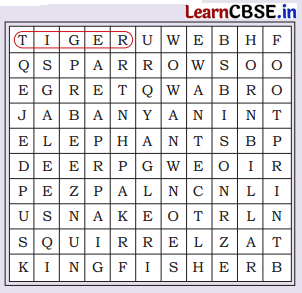
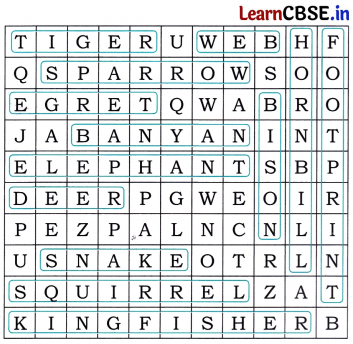
Solve the puzzle.
Find the treasures of the forest.
Answer:
Question 5.
Take on the challenge Plan a nature walk with your family or friends in a nearby park. To prepare yourself as a guide, identify few plants and animals, and study their features and interesting facts which you can explain during the walk.
Answer:
Do it yourself
Question 6.
Do an art activity
Role-play: Create a scene of a forest in your classroom where students can perform roles of plants and animals, and of visitors. While enacting the play, focus on our role to protect animals and plants.
Answer:
Do it yourself
Question 7.
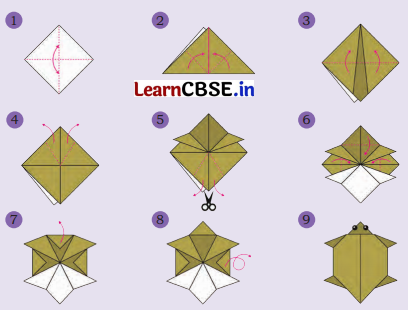
Let us make a paper turtle! Try using an old newspaper or used paper.
Answer:
Do it yourself
Question 8.
Find out
Write the name of your state animal bird, and plant.
Answer:
Do it yourself
Did this chapter match your syllabus?