.
Class 5 EVS Chapter 9 Rhythms of Nature Question Answer
Rhythms of Nature Class 5 EVS Question Answer
Our Wondrous World Class 5 EVS Chapter 9 Question Answer – Class 5 EVS Rhythms of Nature Question Answer
Write (Pages 147-148)
Question.
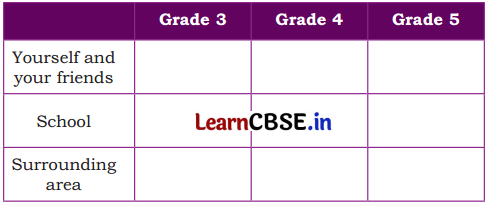
Try to remember the time you were in Grades 3 and 4. Think and write about the changes that you have noticed in yourself and your friends, in your school, and in your environment.
Answer:
(Answers may vary)
| Grade 3 | Grade 4 | Grade 5 | |
| Yourself and your friends | Mv friends and I were shorter. | I grew taller and some of my friends started wearing glasses. | Now we are more confident and some my friends have opted for music classes. |
| School | Classroom had blackboards and old benches. | Some new swings were installed in the garden. | Smart boards are installed in all the classes. |
| Surrounding area | Fewer trees and roads were broken. | Some trees were planted along the roadside. | A big snorts stadium is under construction. |
Write (Pages 148-149)
Question 1.
Can you think of something that takes a really long time to change, maybe over years?
Answer:
Mountains, rivers, and forests take many years to change. A person growing old happens slowly over a lifetime. Even the size of a city changes slowly.

Question 2.
What about something that changes within just a few years?
Answer:
A child growing up or a new building being built, a sapling can grow into a young tree in 2-3 years.
Question 3.
Are there changes that happen every year, again and again?
Answer:
Yes, there are changes that happen every year, again and again. For example, flowers bloom in spring, and trees shed their leaves in autumn. Birds fly from colder regions to warmer places during winter. Rivers get filled with water during the rainy season, and snowfall happens in winter.
Question 4.
Can you name something that changes in just a few minutes or even seconds?
Answer:
Weather, clouds in the sky, the popping of a balloon, lightning during a storm, and turning a light on and off are a few examples of changes that happen in just a few minutes or even seconds.
Intext (Page 149)
Question.
What causes day and night?
Answer:
Day and night are caused by the rotation of the Earth on its axis. As it rotates, the part of the Earth that faces the Sun has day and the part that is away from the Sun has night.
Activity 1 (Page 150)
To demonstrate day and night using torchlight and globe.
Do it yourself.
Intext (Page 150)
Question.
Did you notice how the light made day on one side of the globe and night on the other?

Answer:
Yes, I noticed that the side of the globe facing the torch (light), is having day. The side away from the torch (in shadow) was dark, is having night. This simple activity helps us understand how day and night happen on the Earth due to its rotation.
Find Out (Page 151)
Question.
Study the globe and write in the space given below, when it is day time in India, which countries will have night?
Answer:
When it is daytime in India, the Sun is shining on our side of the Earth. At the same time, countries like the United States, Brazil, Canada, etc., have night because they are on the opposite side of the Earth, and do not receive sunlight.
Intext (Pages 153-154)
Question.
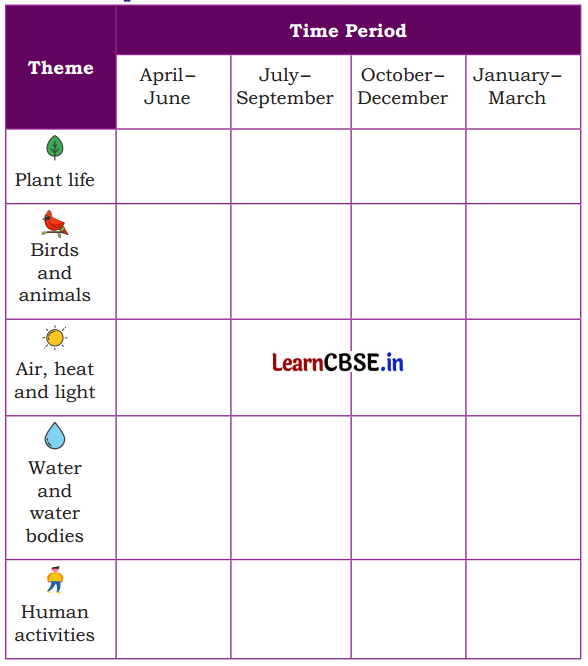
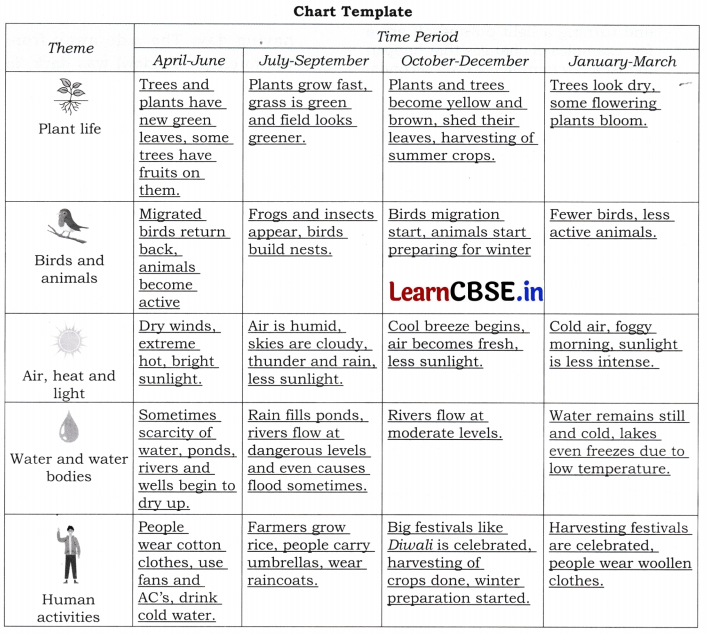
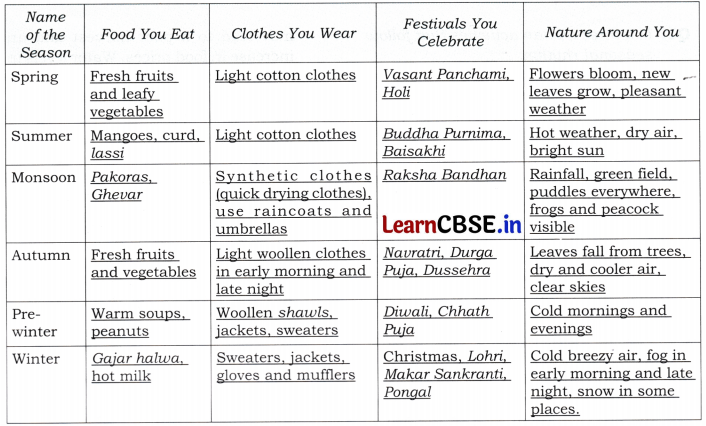
Fill the chart with the changes observed across different time periods during the year.
Chart Template
Answer:
Intext (Page 155)
Question.
What are the seasons called in your region?
Answer:
(Answers may vary)
In my region, the seasons are called:
- Spring : Basant
- Summer : Garmi
- Monsoon : Barsaat
- Autumn : Patjhad
- Pre-winter : Hemant
- Winter : Jaada
Intext (Page 156)
Question.
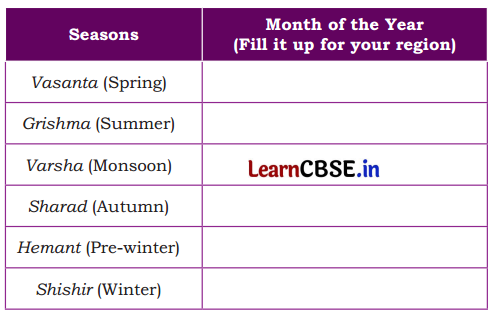
Do you know how many seasons we have in India?
.
Answer:
We experience six seasons based on how nature changes in every few months in India.
| Seasons | Month of the year (Fill it up for your region) |
| Vasanta (Spring) | February to March |
| Grishma (Summer) | April to June |
| Varsha (Monsoon) | July to September |
| Sharad (Autumn) | October to November |
| Hemant (Pre-winter) | Mid November to Mid December |
| Shishir (Winter) | Mid December to January |
Write (Page 157)
Question.
How do you feel when the season changes? Would you prefer one season to continue throughout the year? Give the reasons for your answer.
Answer:
I feel excited when the season changes. I like to enjoy different things in each season. Each season has something special like mangoes in summer or cool weather in winter. I also like to play in the rain which mostly comes in the rainy season. No, I would not prefer one season to continue all year. If we had only one season, life would be different, as many natural things would not happen. Crops would not grow, and birds would not migrate. Each season is important and special in its own way. The change in seasons brings a variety, balance, and beauty to nature and our lives.
Discuss (Page 157)
Question.
Winter in Kerala is different from winter in Kashmir valley. Monsoon in Assam is different from Rajasthan. Why do you think it is so?
Answer:
Different places in India have different climates, land, heights of places. That is why the same season feels different in different regions. Winter in Kerala is not very cold because it is near the sea and it stays warm even in winter, but Kashmir is in the mountainous region and gets snow. Assam gets heavy rain due to its hills and forests, while Rajasthan is a desert, so it gets very little rain.
Intext (Page 157)
Question.
In India, we have many songs associated with seasons. Do you know any? Find out some songs.
Answer:
Do it yourself.
Intext (Page 157)
Question.
With the help of your teacher and elders, name the crops that grow in summer and winter in your region.
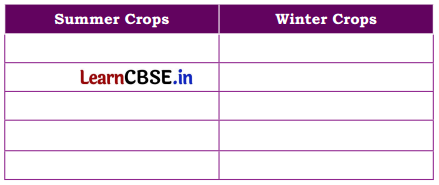
Answer:
| Summer Crops | Winter Crops |
| Watermelon | Wheat |
| Muskmelon | Bariey |
| Cucumber | Mustard |
| Pulses (Urad, Moong) | Peas |
| Maize | Chickpea |
Intext (Page 158)
Question.
Many of our festivals are connected with seasons. See if you can match these festivals to the season they are celebrated in!
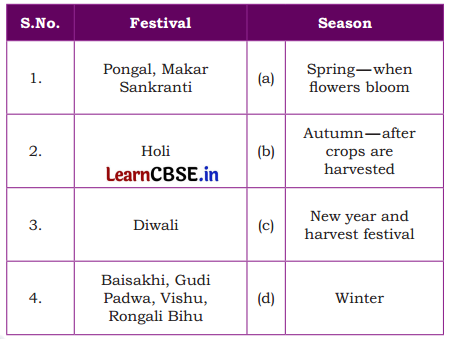
Answer:
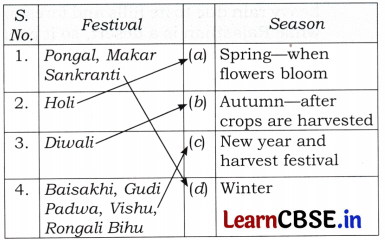
Let Us Reflect (Pages 159-160)
Question 1.
Narrate your experiences about the season changes.
Answer:
(Answers may vary)
I love watching how nature changes with each season. In summer, I feel hot, so I wear cotton clothes. I also eat mangoes and drink cold water to stay cool.
During the rainy season, I use an umbrella when I go outside, and enjoy playing in puddles with my friends. In autumn, the weather becomes cooler, and I see some trees losing their leaves. The festivals like Dussehra, Diwali make this season very joyful.
In winter, I wear woollen clothes and like sitting in the Sun during daytime. Each season feels different and exciting, and brings a sense of freshness.
Question 2.
Ask your family members and write about seasons. Do you find any major differences in the patterns or changing seasons? What could be possible reasons for these differences?
Answer:
I asked my parents about the seasons. They told me that, when they were young, summers were not very hot and winters lasted longer. It also used to rain more during the rainy season. But today, we see that summers are extremely hot, and the temperature is reaching new highs every year.
Winters are shorter and not as cold as before. Rain does not occur at the right time, which leads to the loss of crops. The main reasons behind this imbalance are the cutting down of trees on a large scale, pollution, and global warming.
Question 3.
Seasons have local names. Find out and write the seasons mentioned below are called in your region, and your local language.
(a) Spring: ……….
(b) Summer: ………..
(c) Monsoon: ………..
(d) Autumn: ……….
(e) Pre-winter: ………..
(f) Winter: ………..
Answer:
(Answers may vary)
(a) Spring : Basant
(b) Summer Garmi
(c) Monsoon : Barsaat
(d) Autumn : Patjhad
(e) Pre-winter : Hemant
(f) Winter : Jaada
Question 4.
Fill the table below based on your observations and experiences.
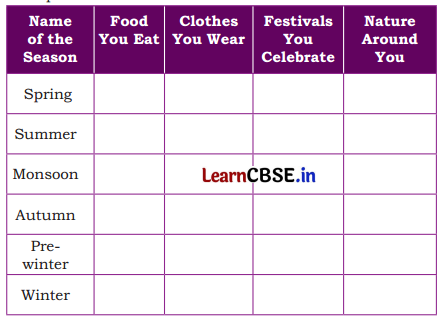
Answer:
Question 5.
Share your experience of seasons’ journaling.
Answer:
(Answers may vary) I really enjoyed doing the seasons’ journaling activity. It helped me observe how plants, animals, and even people change their habits in each season. I noticed new flowers blooming in spring, heavy rains in monsoon, and cold foggy mornings in winter. Writing and drawing these changes in my journal made me feel more connected to nature. I also had fun discussing my observations with friends in class.
Question 6.
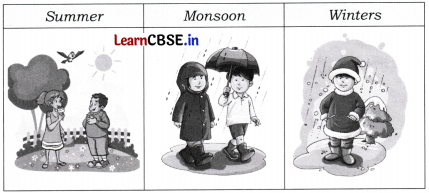
Make a comparative drawing of the three major seasons.
Answer:
Did this chapter match your syllabus?