NCERT Class 8 Maths Chapter 3 A Story of Numbers Solutions Question Answer
Ganita Prakash Class 8 Chapter 3 Solutions A Story of Numbers
NCERT Class 8 Maths Ganita Prakash Chapter 3 A Story of Numbers Solutions Question Answer
3.1 Reema’s Curiosity
Figure It Out (Page 54)
Question 1.
Suppose you are using the number system that uses sticks to represent numbers, as in Method 1. Without using either the number names or the numerals of the Hindu number system, give a method for adding, subtracting, multiplying, and dividing two numbers or two collections of sticks.
Solution:
Suppose there are two groups of sheep.
The first group has 6 sheep and the second has 4 sheep.
We have counted using pebbles.
To add, put all pebbles in the same pouch.
To subtract, take out as many pebbles as in the pouch having fewer pebbles from the pouch having more pebbles.
Now, suppose we wish to know how many sheep will be twice the number in the first group.
For this, we count twice using pebbles and put all the pebbles in the same pouch.
Suppose we have 12 pebbles and want to divide them into three equal groups.
We put them one by one in three bowls till we exhaust all. The number of pebbles in each bowl gives the quotient.
Question 2.
One way of extending the number system in Method 2 is by using strings with more than one letter — for example, we could use ‘aa’ for 27. How can you extend this system to represent all the numbers? There are many ways of doing it!
Solution:
a, b, c, …, z are 26 numbers
aa, bb, …, zz are 26 more numbers.

Question 3.
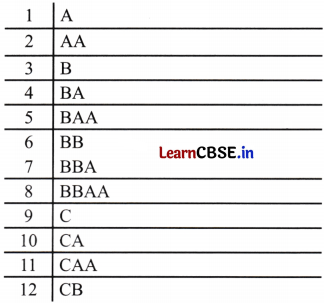
Try making your own number system.
Solution:
Let base be 3
Then 30 = 1 = A, 31 = 3 = B, 32 = 9 = C….,
3.2 Some Early Number Systems
Figure It Out (Pages 59)
Question 1.
Represent the following numbers in the Roman system.
(i) 1222
(ii) 2999
(iii) 302
(iv) 715
Solution:
(i) MCCXXII
(ii) MMCMXCIX
(iii) CCCII
(iv) DCCXV
Figure It Out (Pages 60-61)
Question 1.
A group of indigenous people in a Pacific island uses different sequences of number names to count different objects. Why do you think they do this?
Solution:
Counting in twos is more efficient in representing numbers than, for example, a tally system.
Question 2.
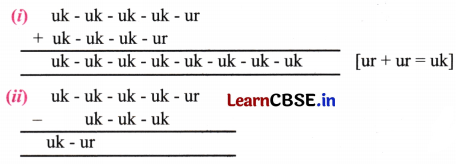
Consider the extension of the Gumulgal number system beyond 6 in the same way of counting by 2s. Come up with ways of performing the different arithmetic operations (+, -, ×, ÷) for numbers occurring in this system, without using Hindu numerals. Use this to evaluate the following:
(i) (ukasar-ukasar-ukasar-ukasar-urapon) + (ukasar-ukasar-ukasar-urapon)
(ii) (ukasar-ukasar-ukasar-ukasar-urapon) – (ukasar-ukasar-ukasar)
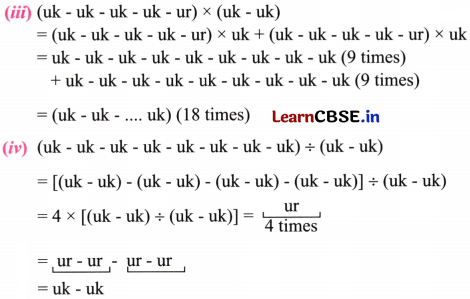
(iii) (ukasar-ukasar-ukasar-ukasar-urapon) × (ukasar-ukasar)
(iv) (ukasar-ukasar-ukasar-ukasar-ukasar-ukasar-ukasar-ukasar) ÷ (ukasar-ukasar)
Solution:
Question 3.
Identify the features of the Hindu number system that make it efficient when compared to the Roman number system.
Solution:
Hindu numbers have ‘0’ and a place value system, which Roman numerals do not have.
The Hindu number system is a positional system, whereas the Roman system is not.
Question 4.
Using the ideas discussed in this section, try refining the number system you might have made earlier.
Solution:
Try it yourself.
3.3 The Idea of a Base
Figure It Out (Page 62)
Question 1.
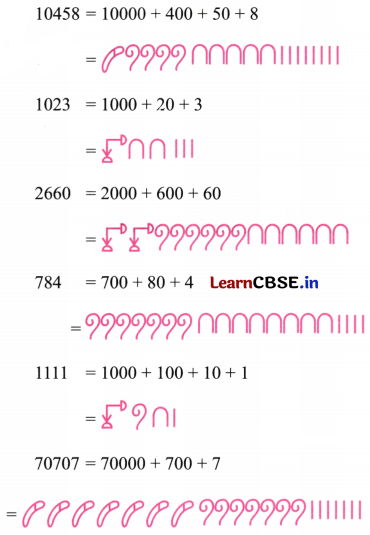
Represent the following numbers in the Egyptian system:
10458, 1023, 2660, 784, 1111, 70707
Solution:
Question 2.
What numbers do these numerals stand for?
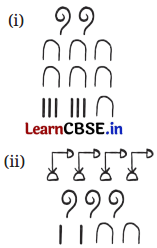
Solution:
(i) 100 + 100 + 10 + 10 + 10 + 10 + 10 + 10 + 6 + 10
= 200 + 70 + 6
= 276
(ii) 1000 + 1000 + 1000 + 1000 + 100 + 100 + 100 + 1 + 1 + 10 + 10
= 4000 + 300 + 20 + 2
= 4322
Figure It Out (Page 63)
Question 1.
Write the following numbers in the above base-5 system using the symbols in Table 2: 15, 50, 137, 293, 651.
Solution:
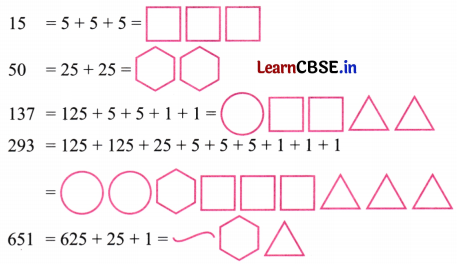
Question 2.
Is there a number that cannot be represented in our base-5 system above? Why or why not?
Solution:
Yes. Zero (0) cannot be represented in our base-5 system as there is no symbol for it.
Question 3.
Compute the landmark numbers of a base-7 system. In general, what are the landmark numbers of a base-n system?
Solution:
70 = 1, 71 = 7, 72 = 49, 73 = 343, 74 = 2401
Hence, 1, 7, 49, 343, 2401 are landmark numbers of base 7.
The landmark numbers of a base-n number system are the powers of n starting from n0 = 1, n, n2, n3,…
Figure It Out (Page 65)
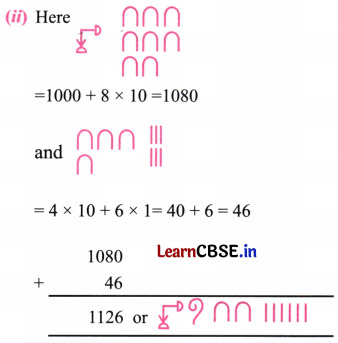
Question 1.
Add the following Egyptian numerals:
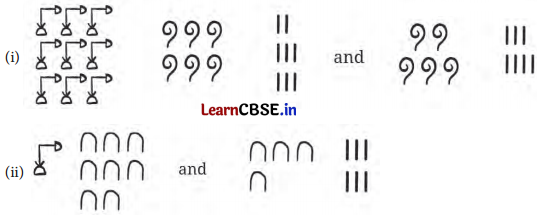
Solution:
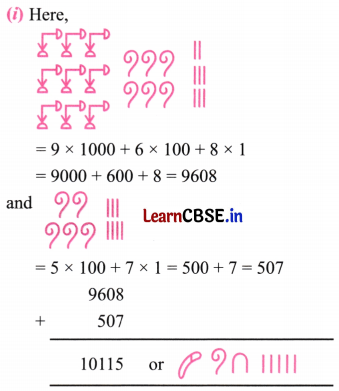
Question 2.
Add the following numerals that are in the base-5 system that we created:

Remember that in this system, 5 times a landmark number gives the next one!
Solution:
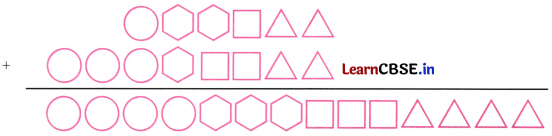
Figure It Out (Pages 69-70)
Question 1.
Can there be a number whose representation in Egyptian numerals has one of the symbols occurring 10 or more times? Why not?
Solution:
No, ten times any landmark number will give the next landmark number.
Question 2.
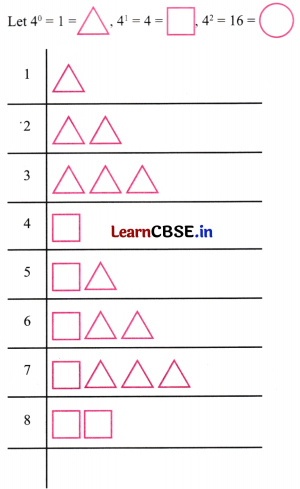
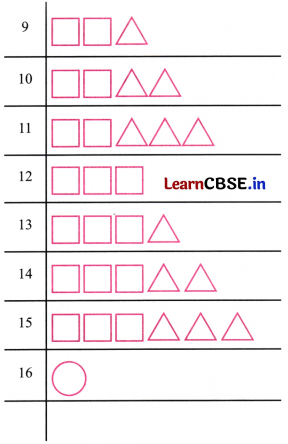
Create your own number system of base 4, and represent numbers from 1 to 16.
Solution:
Question 3.
Give a simple rule to multiply a given number by 5 in the base-5 system that we created.
Solution:
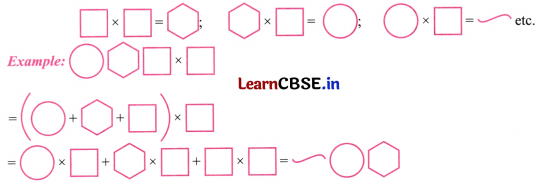
Rule: The Product of a landmark number with another landmark number gives a landmark number.
3.4 Place Value Representation
Figure It Out (Page 73)
Question 1.
Represent the following numbers in the Mesopotamian system:
(i) 63
(ii) 132
(iii) 200
(iv) 60
(v) 3605
Solution:
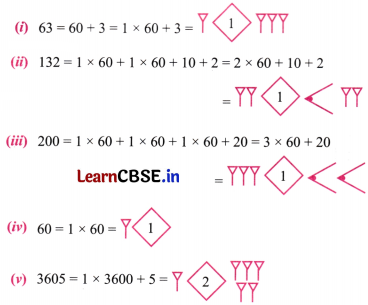
Figure It Out (Page 80)
Question 1.
Why do you think the Chinese alternated between the Zong and Heng symbols? If only the Zong symbols were to be used, how would 41 be represented? Could this numeral be interpreted in any other way if there is no significant space between two successive positions?
Solution:
The most appropriate reason seems to be that they wanted to avoid misinterpretation while reading the number, as all numerals are represented by rods.
Using only Zong symbols, 41 will be written as | | | |
This can easily be misinterpreted as 5 if no significant space is left between successive positions.
Question 2.
Form a base-2 place value system using ‘ukasar’ and ‘urapon’ as the digits. Compare this system with that of the Gumulgal’s.
Solution:
Let 20 = 1 = A, 21 = 2 = B, 22 = 4 = C, 24 = 16 = D,….
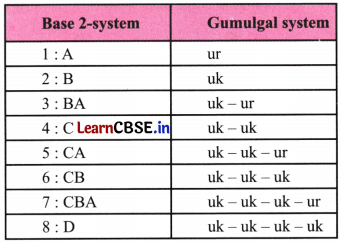
Both have the same base 2, but the base 2 system has many landmark numbers, whereas the Gumulgal system has only two landmark numbers.
Question 3.
Where in your daily lives, and in which professions, do the Hindu numerals, and 0, play an important role? How might our lives have been different if our number system and 0 hadn’t been invented or conceived of?
Solution:
They are useful wherever we have to read unit numbers or do any calculation.
In case ‘0’ was not there, all the above would have become much tedious and cumbersome.
Also, there would have been no computers.
Question 4.
The ancient Indians likely used base 10 for the Hindu number system because humans have 10 fingers, and so we can use our fingers to count. But what if we had only 8 fingers? How would we be writing numbers then? What would the Hindu numerals look like if we were using base 8 instead? Base 5? Try writing the base-10 Hindu numeral 25 as base-8 and base-5 Hindu numerals, respectively. Can you write it in base-2?
Solution:
For base 8, the numerals would have been: 0, 1, 2, 3, 4, 5, 6, 7
For base 5, the numerals would have been: 0, 1, 2, 3, 4
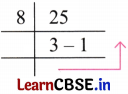
2510 = 318
25 can be written as 31 in base 8.
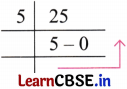
2510 = 505
25 can be written as 50 in base 5.
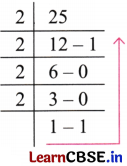
2510 = 110012
25 can be written as 1101 in base 2.
Did this chapter match your syllabus?