Class 8 Science Chapter 6 Pressure, Winds, Storms, and Cyclones Question Answer
Science Class 8 Chapter 6 Question Answer Pressure, Winds, Storms, and Cyclones
Pressure, Winds, Storms, and Cyclones Class 8 Question Answer (InText)
Question 1.
Why do fall leaves rise in the air or trees bend when a strong wind blows? (Page 81)
Answer:
The force exerted by the wind creates wind pressure, which causes fallen leaves to rise in the air and the bending or swinging of trees when a strong wind blows.
Question 2.
Can the shape or size of the straps make a difference, provided both bags are equally heavy? (Page 81)
Answer:
When we carry a bag, we feel its weight because of the force of gravity acting on our shoulders. The weight of the bag with narrow straps acts on a smaller area of our shoulders, whereas the weight of the bag with broad straps is spread over a larger area of our shoulders. Although both bags have equal weight, we feel more comfortable carrying a bag with broad straps. Broad straps reduce the pressure exerted by the bag on the shoulders.

Question 3.
(a) Why are overhead tanks kept at a height?
(b) Suppose you are living on the second floor of a three-story building and an overhead tank is placed on the top floor. Will you or your friend on the first floor receive a more powerful stream of tap water? Give reasons. (Page 84)
Answer:
(a) Overhead tanks are placed at a height so that the pressure in the taps is increased, resulting in a good stream of water from the taps.
(b) Pressure exerted by water increases with the increase of height of the liquid column. Suppose I live on the second floor of the building that has three floors, and the overhead tank is installed on the top floor. The pressure of water and hence the power of water stream from the taps will depend on the height of the overhead tank above the taps of the second floor. My friend living on the first floor will have a longer distance from the taps to the overhead tank, which means the height of the water column above his taps will be more compared to my water taps on the second floor. Therefore, my friend will receive more powerful stream of tap water.
Question 4.
Why does water spurt out like a fountain from leaking joints or holes in water pipes? (Page 85)
Answer:
Water in water pipes has long water columns, as the water tanks to which the water pipes are connected are placed at heights. The pressure inside the pipes is high. The water exerts pressure in all sides of the container including the bottom and walls of the pipe. When this water exerting pressure on all sides, finds a narrow opening like a hole or a leaking joint, it spurts like a fountain.
Question 5.
What happens when an inflated balloon is kept without closing its mouth? (Page 86)
Answer:
The inflated balloon has air inside, which exerts pressure on the walls of the balloon, resulting in expansion of the balloon on all sides. The elastic walls of the balloon exert equal but opposite pressure on the air. When we keep the inflated balloon without closing its mouth, the air from within the balloon escapes through its mouth from high pressure inside the balloon to low pressure outside the balloon.
Question 6.
Does the difference in air pressure have anything to do with the formation of winds? (Page 88)
Answer:
Air moves from a high-pressure region to a low-pressure region. Moving air is called wind. Thus, it is the difference in air pressure that results in the formation of wind.
NCERT Class 8 Science Chapter 6 Question Answer Pressure, Winds, Storms, and Cyclones (Exercise)
Keep the Curiosity Alive (Pages 94-96)
Question 1.
Choose the correct statement:
(i) Look at the Figure carefully. Vessel R is filled with water. When pouring of water is stopped, the level of water will be _________
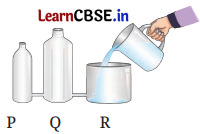
(a) the highest in vessel P
(b) the highest in vessel Q
(c) the highest in vessel R
(d) equal in all three vessels
Answer:
(d) equal in all three vessels
(ii) A rubber sucker (M) is pressed on a flat smooth surface, and an identical sucker (N) is pressed on a rough surface.
(a) Both M and N will stick to their surfaces
(b) Neither M nor N will stick to their surfaces
(c) M will stick, but N will not stick
(d) M will not stick, but N will stick
Answer:
(c) M will stick, but N will not stick
(iii) A water tank is placed on the roof of a building at a height ‘H’. To get water with more pressure on the ground floor, one has to
(a) Increase the height ‘H’ at which the tank is placed.
(b) Decrease the height ‘H’ at which the tank is placed.
(c) Replace the tank with another tank of the same height that can hold more water.
(d) Replace the tank with another tank of the same height that can hold less water.
Answer:
(a) increase the height ‘H’ at which the tank is placed.
(iv) Two vessels, A and B, contain water up to the same level as shown in the Figure. PA and PB are the pressures at the bottom of the vessels. FA and FB are the forces exerted by the water at the bottom of the vessels A and B.
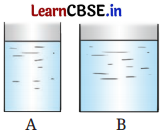
(a) PA = PB, FA = FB
(b) PA = PB, FA < FB
(c) PA < PB, FA = FB
(d) PA > PB, FA > FB
Answer:
(b) PA = PB, FA < FB
Question 2.
State whether the following statements are True (T) or False (F).
(i) Air flows from a region of higher pressure to a region of lower pressure.
(ii) Liquids exert pressure only at the bottom of a container.
(iii) The weather is stormy at the eye of a cyclone.
(iv) During a thunderstorm, it is safer to be in a car.
Answer:
(i) True
(ii) False (liquids exert pressure in all directions, including on the walls of the container.)
(iii) False (it is calm at the eye of a cyclone.)
(iv) True.
Question 3.
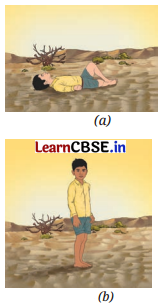
Figure (a) shows a boy lying horizontally, and Figure (b) shows the boy standing vertically on a loose sand bed. In which figure does the boy sink more into the sand? Give reasons.
Answer:
The boy in Figure (b) will sink more. The weight of the boy is the same, but in Fig. (a), the force (of the weight) is acting on a large area. The pressure in this case is less. In Fig. (b), the same force (of the weight) is acting on a small area. The pressure, therefore, is more. The boy will sink more into the sand in this case.
Question 4.
An elephant stands on four feet. If the area covered by one foot is 0.25 m2, calculate the pressure exerted by the elephant on the ground if its weight is 20000 N.
Answer:
Force (the weight) of the elephant acting on the ground = 20000 N
Area on the ground covered by the four feet of the elephant = 4 × 0.25 m2 = 1 m2
Pressure exerted by the elephant on the ground = \(\frac {Force}{Area}\)
= \(\frac{200000 \mathrm{~N}}{1 \mathrm{~m}^2}\)
= 20000 Pa
Question 5.
There are two boats, A and B. Boat A has a base area of 7 m2, and 5 persons are seated in it. Boat B has a base area of 3.5 m2, and 3 persons are seating in it. If each person weighs 700 N, find out which boat will experience more pressure on its base and by how much?
Answer:
Force of the weight of 5 persons acting on the base of boat A = 5 × 700 N = 3500 N
Base area of boat A = 7 m2
Pressure exerted on the base of boat A = \(\frac {Force}{Area}\)
= \(\frac{3500 \mathrm{~N}}{7 \mathrm{~m}^2}\)
= 500 Pa
Force of the weight of 3 persons acting on the base of boat B = 3 × 700 N = 2100 N
Base area of boat B = 3.5 m2
Pressure exerted on the base of boat B = \(\frac {Force}{Area}\)
= \(\frac{2100 \mathrm{~N}}{3.5 \mathrm{~m}^2}\)
= 600 Pa
Therefore, boat B will experience more pressure on its base by 100 Pa.
Question 6.
Would lightning occur if air and clouds were good conductors of electricity? Give reasons for your answer.
Answer:
In case the air and the clouds were good conductors of electricity, the charges could not accumulate in the clouds (because they would flow into the air), there would be no charge buildup, which is necessary for lightning to occur. Therefore, if air and clouds were good conductors of electricity, lightning would not occur.
Question 7.
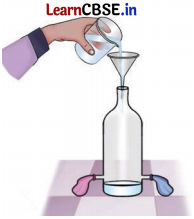
What will happen to the two identical balloons A and B as shown in Figure when water is filled into the bottle up to a certain height? Will both the balloons bulge? If yes, will they bulge equally? Explain your answer.
Answer:
When water is filled into the bottle up to a certain height (sufficiently above the level of the entry points of water from the bottle) both the balloons will bulge. The entry points of water from the bottle to the balloons are at the same height. The balloons, being elastic, exert some force on the water. Assuming that the balloons are equally elastic, both balloons will bulge equally.
Question 8.
Explain how a storm becomes a cyclone.
Answer:
Cyclones are large storms that form over warm ocean waters.
- As the ocean water gets heated, the air above it becomes moist and warm and rises to a height where water vapor condenses to form raindrops.
- Condensing water vapor releases heat back into the atmosphere.
- This further warms the ascending air, leading to its further rise, creating an even lower pressure.
- Air from the surrounding regions rushes in, and it also starts rising.
- The moving air starts to spin under the influence of the Earth’s rotation.
- This cycle is repeated, resulting in the creation of a very low-pressure area with high-speed winds revolving around it.
- This spinning system of clouds, winds, and rain is called a Cyclone.
Question 9.
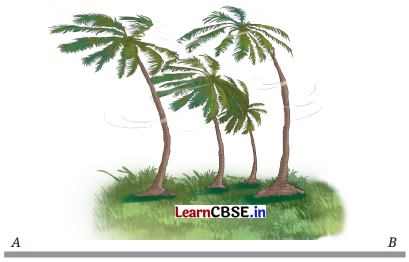
The figure shows trees along the sea coast on a summer afternoon. Identify which side is land – A or B. Explain your answer.
Answer:
During the daytime on a summer afternoon, there is a sea breeze that blows from sea to land. This happens because the land gets heated faster and the air above land rises resulting in low-pressure region over land. Cooler air over sea moves from high- pressure region towards the land. The bending of trees due to wind, as shown in the figure, suggests that wind is blowing in the direction from B to A. This suggests ‘A’ side is land.
Question 10.
Describe an activity to show that air flows from a region of high pressure to a region of low pressure.
Answer:
Activity to show that air flows from a region of high pressure to a region of low pressure.
Materials required: Two similar balloons made of thin rubber, a drinking straw, and some thread.
Procedure:
- Insert one end of the straw into one balloon and secure it with the thread.
- Inflate the second balloon and insert the free end of the straw into the neck of the inflated balloon, and secure it with the thread. (Ensure that the air from the inflated balloon does not leak.)
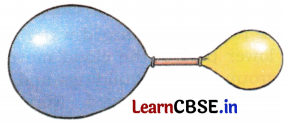
Observations: Some air moves from the inflated balloon to the uninflated balloon, and the sizes of both balloons change. After some time, both the balloons attain almost the same size, and the flow of air stops.
Conclusion: The inflated balloon has higher pressure inside it, and the uninflated balloon has low pressure inside. When the two balloons are connected through a straw, air moves from the high-pressure area (inside the inflated balloon) to the low-pressure area (inside the uninflated balloon).
Question 11.
What is a thunderstorm? Explain the process of its formation.
Answer:
(i) During the rainy season, when land gets heated in hot, humid, and tropical regions of India, the warm and moist air being lighter rises, thus creating a low-pressure area. Cooler air from surrounding high-pressure areas flows to take its place. This air again gets heated and rises, thereby resulting in a continuous process of wind circulation. As the rising air expands, it cools and moisture in it condenses to form water droplets forming clouds. The water droplets merge to form heavier drops, which come down as rain, hail, or snow. The strong winds accompanied by rain are called a storm.
(ii) During a storm formation, under certain conditions, warm air rises to great heights, and the low temperature there changes water droplets into ice particles. Strong winds blowing upwards and downwards result in rubbing between water droplets and ice particles. This generates electric charges within clouds. Ice particles are positively charged, and they move upwards in the upper part of the clouds. Water droplets are negatively charged and occupy the lower part of the clouds.
When negatively charged water droplets in the lower part of the cloud move closer to the ground, trees, buildings, and the ground become positively charged. Normally, air acts as an electrical insulator and does not let opposite charges meet. This insulating property of the air breaks down when the build-up charges becomes very large. A sudden flow of charges takes place, resulting in a bright flash of light called lightning. Lightning can occur as opposite charges collide within a cloud, between clouds, or between clouds and the ground. Lightning rapidly heats the air around it. This results in expansion of air to produce a loud sound called thunder. A storm accompanied by lightning and thunder is called a thunderstorm.
Question 12.
Explain the process that causes lightning.
Answer:
During a storm formation, under certain conditions, warm air rises to great heights, and the low temperature there changes water droplets into ice particles. Strong winds blowing upwards and downwards result in rubbing between water droplets and ice particles. This generates electric charges within clouds. Ice particles are positively charged, and they move upwards in the upper part of the clouds. Water droplets are negatively charged and occupy the lower part of the clouds. When negatively charged water droplets in the lower part of the cloud move closer to the ground, the trees, buildings, and the ground become positively charged. Normally, air acts as an electrical insulator and does not let opposite charges meet. This insulating property of the air breaks down when the build-up charges becomes very large. A sudden flow of charges takes place, resulting in a bright flash of light called lightning. Lightning can occur as opposite charges collide within a cloud, between clouds, or between clouds and the ground. Lightning rapidly heats the air around it. This results in expansion of air to produce a loud sound called thunder.
Question 13.
Explain why holes are made in banners and hoardings.
Answer:
Holes made in banners and hoardings save these from blowing off with high-speed winds. High-speed winds are accompanied by a reduced pressure. If there are no holes in the banners or hoardings, they block the wind, but the wind blows on the sides of these banners and hoardings. This forms low-pressure area on sides and opposite side of the banners/hoardings. There remains a high-pressure area on the side of the banner or hoarding that faces the direction from which wind is blowing. When the pressure difference is large the banners or the hoardings are blown away. With the holes in the banners or hoardings, the wind blows through these holes, and the pressure difference is minimised, keeping them intact.
Did this chapter match your syllabus?