Class 8 Social Science Chapter 1 Question Answer Natural Resources and Their Use
NCERT Class 8 Social Science Chapter 1 Natural Resources and Their Use Questions and Answers Solutions
Natural Resources and Their Use Class 8 Question Answer (In-Text)
The big Questions (page 1)
Question 1.
How do we categorise natural resources?
Answer:
Natural resources are elements found in the environment that humans use for various purposes. They can be categorised based on their use and renewability. By use, natural resources are divided into essential resources like air, water, and soil, which are crucial for life; material resources like wood, coal, and metals, used to create products; and energy resources like solar, wind, and fossil fuels, which are used for generating electricity and powering industries. By renewability, they are classified as renewable resources, such as timber, water, and solar energy, which can regenerate over time and non-renewable resources, like coal, petroleum, and minerals, which are limited and take millions of years to form, making them hard to replace, once used.
Question 2.
What is the connection between the distribution of natural resources and different aspects of life?
Answer:
The distribution of natural resources impacts various aspects of life, including human settlements, trade, and international relations. Areas rich in resources tend to attract industries, which fosters economic growth and creates job opportunities. However, unequal distribution can lead to conflicts over access to resources, such as water or minerals, both within countries and between nations. It also shapes the development of infrastructure and can create disparities in quality of life, with some regions benefiting more from their resources than others.

Question 3.
What are the implications of unsustainable use/over exploitation of natural resources?
Answer:
When natural resources are used unsustainably or over-exploited, it can lead to severe long-term consequences. Resources may become depleted, and ecosystems suffer damage, affecting biodiversity and natural habitats. The excessive use of renewable resources, like water or soil, can prevent them from regenerating, leading to shortages. Similarly, overuse of non-renewable resources, may exhaust them, leaving fewer options for future generations. This disruption not only harms the environment but can also negatively impact the livelihoods of communities dependent on these resources. Over-exploitation often contributes to broader issues, such as climate change and pollution, and can provoke conflicts over the remaining resources.
Let’s Explore
Question 1.
Identify human actions in your surroundings that result in Nature losing her ability to restore and regenerate. What types of interventions can be undertaken to restore Nature’s cycle? (Page 7)
Answer:
Human activities such as cutting down trees faster than they can grow back, polluting rivers with industrial and domestic waste, over-extracting groundwater, and excessive use of chemical fertilisers and pesticides disturb Nature’s ability to restore and regenerate itself.
These actions disrupt natural cycles, leading to soil degradation, water contamination, and loss of biodiversity. To help restore Nature’s balance, we can take steps like planting native trees to rebuild forests, practising sustainable water management such as rainwater harvesting, reducing pollution by properly treating waste before disposal, and using organic farming methods that avoid harmful chemicals. These measures support natural restoration and regeneration, allowing ecosystems and resources to recover over time.
Question 2.
Take up a small research study to assess the types of renewable resources in your region; you may discuss with your teacher the geographical area of your study and sources to access information that you may need. What has been the change in their status over time? Make a small report that identifies the reasons for the change and what may be done. (Page 8)
Answer:
(Suggestive Answer) In my region, Delhi, the primary renewable resources are solar energy, wind energy, and biomass. Solar energy has grown with government incentives, but adoption is limited by high costs and space constraints. Wind energy is underdeveloped due to the city’s flat terrain, and biomass remains untapped due to inefficient waste management. Delhi is working to increase its renewable energy capacity through initiatives like rooftop solar panels and projects such as a 1,000 MW solar plant and a 111 MW wind power plant.
The status of these resources has changed due to urbanisation and rising energy demand. While solar energy is growing, pollution and overcrowding reduce its efficiency. Wind energy has not progressed, and biomass potential remains unused. To improve, Delhi needs stronger policies for solar adoption, better waste-to-energy systems, and urban planning focused on renewable energy.
Question 3.
What are the non-renetvable resources that you use daily, directly or indirectly? What are the possible renewable substitutes? What are some of the steps we can take to transition to renewables? (Page 8)
Answer:
Non-renewable resources that we use daily, either directly or indirectly, include coal, petroleum, natural gas, and metals like iron and copper. These are used for electricity, transportation, heating, and manufacturing many products. Possible renewable substitutes include solar energy, wind energy, hydropower, biofuels, and sustainably managed timber. To transition to renewable resources, we need to increase the use of clean energy sources, improve energy efficiency, develop better energy storage, promote electric vehicles and public transport, and protect natural ecosystems. Additionally, raising awareness and supporting government policies that encourage sustainable use of resources are vital to ensure this transition is successful.
Question 4.
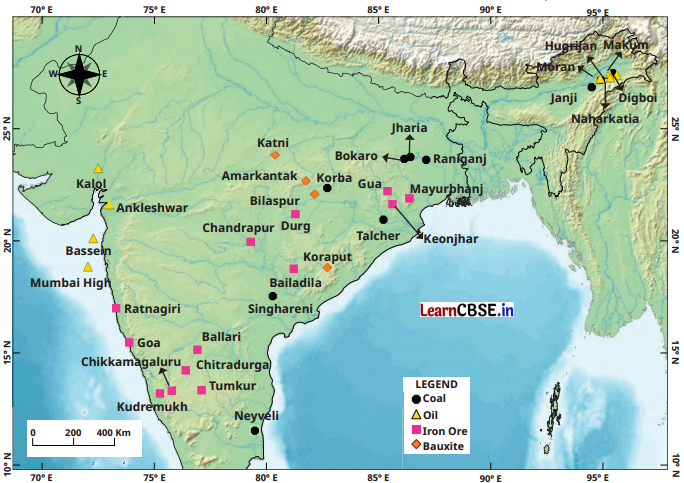
Observe the map in Figure Notice the uneven distribution of important minerals. What types of resources are available in your region? How are they distributed? (Page 9)
Answer:
(Suggestive Answer) The map shows that minerals are unevenly distributed across India. Coal is mainly found in eastern and central regions like Jharia, Raniganj, and Korba, as well as in the south at Neyveli and Singareni. Iron ore is abundant in central, eastern, and southern parts, including Bailadila and Mayurbhanj. Bauxite deposits are mostly in central and eastern India, such as Katni and Koraput in southern Odisha. Petroleum and natural gas fields are located along the western coast near Mumbai High and Ankleshwar, and in the northeast at Digboi. This uneven distribution reflects India’s varied geology, with certain regions rich in specific minerals.
In my region, Jharkhand, several important minerals are found. The state is especially rich in coal, with major coalfields located in Jharia, Bokaro, and Dhanbad. Iron ore is another key resource, mainly found in the Singhbhum district. Jharkhand also has deposits of bauxite, copper, mica, and uranium, spread across different parts of the state. These minerals are mostly located in the eastern and central parts of Jharkhand, making it one of India’s most resource-rich areas. The distribution of these resources supports many industries and plays a vital role in the state’s economy.
Question 5.
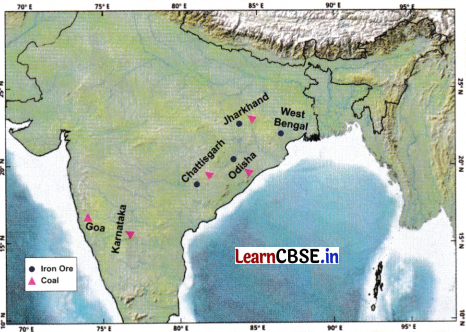
Select any two natural resources. Gather information about their availability across different parts of India. Mark them on a map. What do you observe about their distribution? What are the types of economic actimties connected with them? (Page 10)
 Img- 1
Answer:
Coal and iron ore are two important natural resources found in different parts of India. Coal is mainly found in Jharkhand, Chhattisgarh, Odisha, and West Bengal, while iron ore is mostly found in Odisha, Jharkhand, Chhattisgarh, Karnataka, and Goa. Their distribution is uneven, with large deposits located in the eastern and southern regions. This has led to the growth of mining and related industries in these areas. Coal is used mainly for electricity generation and in industries, while iron ore is used to make steel, supporting construction and manufacturing activities.
Question 6.
Discuss the implications of extracting the natural resources in those parts for current and future generations. Suggest ways in which we can use Nature’s gifts in responsible ways. (Page 10)
Answer:
The extraction of natural resources brings economic benefits but often leads to the displacement of communities, loss of cultural heritage, and environmental damage. Over time, it depletes resources, harms ecosystems, and creates sustainability challenges for future generations.
To use Nature’s gifts responsibly, it is essential to adopt sustainable extraction methods, prioritise renewable energy, and implement effective resource management. Supporting policies that promote conservation and respect local communities’ rights is crucial. Encouraging a circular economy, where resources are reused and recycled, helps reduce waste and ensures long-term sustainability. Educating future generations on the importance of preserving natural resources is key to safeguarding the Earth for the future.
Question 7.
Find out about such a conflict in the international context? Discuss your findings in the class. (Page 10)
Answer:
(Suggestive Answer) An international example of a conflict over natural resources is the ongoing tension between Ethiopia, Egypt, and Sudan regarding the Nile River. Ethiopia has constructed the Grand Ethiopian Renaissance Dam (GERD) to generate electricity, but Egypt and Sudan, situated downstream, are concerned that the dam could reduce their access to essential water supplies, with Egypt relying on the Nile for nearly 90% of its water. Despite numerous rounds of negotiations, a permanent solution has not been reached. This situation highlights how shared natural resources, such as rivers, can lead to significant disputes between countries.
Question 8.
What do you think are the different inputs required to enable the use of the natural resources available in different geographical areas? (Page 11)
Answer:
To make the best use of natural resources in different geographical areas, several key inputs are needed. These include skilled people with the right knowledge to manage and develop the resources efficiently, good governance to ensure fair use and prevent corruption, and proper planning to avoid overdependence on a single resource. Investment in infrastructure such as roads, electricity, and transport is essential, along with the use of modern technology to extract and process resources safely and effectively. Environmental care and respect for local communities are also important to ensure sustainability. Finally, access to markets allows countries to sell resources and products at fair prices, helping to turn natural wealth into long-term development.
Think About It
Question 1.
Take a pause. Look at yourself and the things around you. What is the origin of each of them? At some point they all lead to Nature; even the plastic button on your shirt. (Page 3)
Answer:
Everything around us, from our clothes to the technology we use, originates in nature. Even a plastic button on our shirt comes from fossil fuels, such as petroleum and natural gas. Fabrics like cotton and wool are from plants and animals, while buildings are made of timber stone, and metals mined from the Earth. The energy we rely on, whether coal, wind, or sunlight, also comes from nature.
In short, everything we use connects back to nature. This reminds us of the importance of using natural resources wisely and sustainably for future generations.
Question 2.
What might be the different criteria we can use to categorise natural resources? (Page 4)
Answer:
Natural resources can be categorised in many ways. They may come from living things, called biotic resources, like plants and animals, or from non-living things, including water, air, and minerals. One key way to divide them is into renewable types like sunlight and wind, and non-renewable ones like coal and oil. They can also be classified by where they are found. For example, coal and oil exist only in certain places, while sunlight and wind are available almost everywhere. Another way to categorise them is by how easy they are to access. Surface minerals are easy to get, while oil deep under the ocean requires special technology. Finally, some hold cultural or religious importance, such as sacred rivers or forests.
Don’t miss Out
Question 1.
Do you know ofpractices that reflect this? (Page 3)
Answer:
Yes, many traditional practices show respect for Nature as sacred. In India, sacred groves are protected forest areas where cutting trees or harming wildlife is not allowed, as they are believed to be home to gods or spirits. Rivers like the Ganga are worshipped and seen as holy. Certain trees, such as the peepal and banyan, are also considered sacred and are not cut down. Indigenous groups in other countries, like Native Americans and Aboriginal Australians, hold similar beliefs and perform rituals to honour nature. These practices reflect care for the environment and a deep respect for natural resources.
Question 2.
Do you know of other traditional practices that help the ecosystem to stay in balance? (Page 6)
Answer:
Yes, there are several traditional practices that help keep the ecosystem in balance. In India, farmers have long used crop
rotation and mixed cropping to keep the soil healthy and reduce pests without chemicals. In many villages, stepwells and community ponds were built to store rainwater and recharge the groundwater naturally. In the Northeast, people practise jhum cultivation (shifting farming), where they leave the land to rest for a few years after growing crops so that the forest and soil can recover. Tribal communities also follow seasonal rules for hunting, fishing, and gathering, taking only what they need and allowing nature to renew itself. These practices are based on traditional knowledge and help protect the environment in a natural and sustainable way.
Class 8 SST Chapter 1 Natural Resources and Their Use Question Answer (Exercise)
NCERT Questions and Activities (Page 19)
Question 1.
What can make what is today a renewable resource non-renewable tomorrow? Describe some actions that can prevent this from happening.
Answer:
A renewable resource can become non-renewable if its consumption rate exceeds its natural regeneration rate, such as overfishing, deforestation, or excessive groundwater extraction. For example, when water is taken from underground reserves faster than it can be naturally replenished, the resource is depleted.
To prevent this, adopting sustainable management practices is essential. Controlled water harvesting, reducing waste, and using resources efficiently are key steps. Restoration efforts, such as reforestation or implementing water conservation technologies, can also play a vital role in maintaining balance. By prioritising responsible practices in areas like agriculture and resource management, the regeneration of these resources can be safeguarded for future generations.
Question 2.
Name five ecosystem functions that serve humAnswer:
Answer:
Ecosystems provide several crucial functions that directly support human life and well-being. These include:
- Pollination: Insects such as moths, flies, and other pollinators help in the reproduction of many crops and plants, supporting food production.
- Water Purification: Ecosystems like wetlands and forests naturally filter and clean water, ensuring access to clean resources.
- Climate Regulation: Ecosystems absorb carbon dioxide and produce oxygen, helping to regulate the climate and maintain environmental stability.
- 4. Soil Fertility: Processes like decomposition and nutrient cycling in ecosystems support soil formation and fertility, which is essential for agriculture.
- Provision of Food: Ecosystems provide diverse food sources, including plants, animals, and fish, which are vital for human nutrition and survival.
Question 3.
What are renewable resources? How are they different from non-renewable ones? What can people do to ensure that renewable resources continue to be available for our use and that of future generations? Give two examples.
Answer:
Renewable resources are natural materials that regenerate over time, such as sunlight, wind, water, and wood. Unlike non-renewable resources like fossil fuels and minerals, they are not exhausted when used responsibly, as they replenish naturally. Non¬renewable resources, however, are limited and cannot be restored within a human timescale.
To keep renewable resources available for the future, they must be managed with care. This involves using clean energy sources such as solar energy and wind power, minimising waste, and adopting sustainable practices like responsible forestry. For instance, installing solar-powered street lighting helps reduce dependence on fossil fuels. Second example is to replant trees after timber harvests ensures forest renewal.
Question 4.
Identify cultural practices in your home and neighbourhood that point to mindfulness in the use of natural resources.
Answer:
In our home and neighbourhood, several cultural practices reflect a mindful approach to using natural resources. Firstly, certain trees such as the peepal and banyan are regarded as sacred and are never cut down, promoting tree conservation. Secondly, forest patches known as sacred groves are preserved due to their spiritual significance, helping protect biodiversity.
Thirdly, traditional festivals involve the use of eco-friendly materials, for example, banana leaves for serving food, clay for making idols, and natural dyes for decoration. Additionally, water bodies like ponds and wells are cleaned and honoured through rituals, encouraging water conservation. Lastly, practices such as fasting and simple living during religious observances help reduce unnecessary consumption and promote sustainability.
Question 5.
What are some considerations to keep in mind in the production of goods for our current use?
Answer:
In producing goods for current use, it’s essential to prioritise sustainability by using renewable resources and eco-friendly materials. Energy efficiency should be considered to minimise carbon footprints, which refers to the amount of harmful gases, like carbon dioxide, released into the air from activities such as production and transportation. Waste can be reduced by recycling and reusing materials. Ethical sourcing ensures that materials are obtained responsibly, while goods should be designed for durability to reduce the need for frequent replacements. Additionally, production should support local communities and reduce transportation emissions, contributing to both environmental and social sustainability.
Did this chapter match your syllabus?