Class 8 Social Science Chapter 5 Question Answer Universal Franchise and India’s Electoral System
NCERT Class 8 Social Science Chapter 5 Universal Franchise and India’s Electoral System Questions and Answers Solutions
Universal Franchise and India’s Electoral System Class 8 Question Answer (In-Text)
The Big Questions (Page 117)
Question 1.
What is universal adult franchise?
Answer:
Universal Adult Franchise is the right of all adult citizens (above 18 years of age) to vote in an election, regardless of their caste, gender, role, creed, religion, economical, educational or social status.
Question 2.
What is an electoral system?
Answer:
An electoral system is the method and rules used for electing representatives in a democracy. It explains how people vote, how the votes are counted, and how winners are chosen. It helps make elections fair and lets people take part in choosing their leaders.

Question 3.
How does India’s electoral system work?
Answer:
India’s electoral system works through free and fair elections where representatives are chosen by the people using secret ballots, based on the principle of Universal Adult Franchise which means every adult citizen has the right to vote. This system ensures that elections are fair and everyone’s vote is kept secret.
Let’s Explore
Question 1.
India changed the minimum age for voting from 21 to 18 in 1988. Discuss whether this was a good move. (Page 118)
Answer:
The decision to lower the voting age in India from 21 to 18 in 1988 was a significant step towards a more inclusive democracy. It gave young adults the right to participate in elections, recognising them as capable of making decisions that affect their future. This move aligned India with global standards and allowed millions of young people to have a voice in shaping policies on issues like education and employment! Although concerns about political maturity were raised, the long-term benefits of engaging youth in the democratic process far outweighed these concerns, making it a positive change for India’s democracy.
Question 2.
In 1947, our literacy rate was about 14 per cent, only about 8 per cent among women. Some argued that the right to vote
should be given only to literate people. Discuss in your group why the Constitution makers may have decided on universal franchise from the time of Independence itself. (Page 120)
Answer:
The Constitution makers may have decided on Universal Adult Franchise from the time of independence to:
- Ensure equality and fairness by giving every adult citizen, regardless of caste, gender, creed, religion, income, or education, the right to vote.
- Strengthen democracy by involving all citizens in the decision-making process.
- Break social hierarchies and promote social justice in a diverse country like India.
- Show the world that India believes in inclusive and participatory governance right from the start.
Question 3.
Discuss in Groups (Page 121)
(a) What role do such measures play in a democracy?
Answer:
These measures ensure that every eligible citizen, including the elderly, disabled, and those in remote areas, can participate in the electoral process. This helps uphold the principle of Universal Adult Franchise and strengthen democracy by making it inclusive.
(b) Do you know of anyone who benefitted from these improved accessibility measures?
Answer:
(Suggestive Answer) Yes, I know of an elderly neighbour who was able to vote from home during the 2024 general elections using the postal voting option.
(c) How might they increase voter partic¬ipation in your neighbourhood?
Answer:
These measures can encourage more people, especially those with physical limitations or mobility issues, to vote by making the process easier and more accessible.
(d) How can technology assist?
Answer:
Technology can assist by providing braille-enabled voter cards, mobile apps to request assistance, and ensuring polling stations are equipped with tools like ramps and support for disabled. This helps remove barriers and enables more inclusive participation.
Question 4.
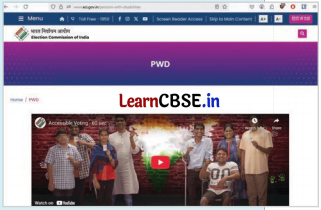
If you have access to the internet, visit the ECI website (https:// www.eci.gov.in/persons- -with-disabilities.) Read and identify the various interventions that the ECI has taken to facilitate voting by people with disabilities. (Page 121)
Answer:
The Election Commission of India is dedicated to making voting accessible for persons with disabilities (PwDs). PwD voters are registered under four categories: visual impairment, speech and hearing disability, locomotor disability, and others. They can register online, at service centres, or via the Saksham app. Key initiatives to assist PwDs include:
- Mapping PwDs polling station wise for better support
- Ensuring polling stations are on the ground floor.
- Providing PwD-friendly facilities and separate queues.
- Offering optional home voting.
- Issuing voter ID cards and slips in Braille.
- Adding Braille features on voting machines.
- Providing wheelchairs, ramps, and free pick-and-drop transport.
Question 5.
(a) About 34 per cent of eligible voters did not exercise their right to vote in the 2024 elections. Why do you think this is so? (Page 123)
Answer:
The 34 per cent of eligible voters who did not vote may have faced voter apathy due to a lack of awareness, disinterest in politics, or the belief that their vote would not make a difference. Additionally, practical difficulties such as long distances to polling stations, health issues, or lack of proper ID may have also prevented them from voting.
(b) What are some challenges people face in exercising their rights?
Answer:
Some challenges that people face in exercising their rights are:
- Physical disabilities or old age.
- Inaccessible polling stations.
- Lack of Voter ID or registration issues.
- Low awareness about voting procedures.
- Poor transportation in remote areas.
- Work or family commitments on voting day.
(c) Design and conduct a short survey among adults in your family and neighbour hood to answer these questions. Analyse the data and write a report with suggestions on how it may be possible to ensure everyone votes.
Answer:
The survey revealed that many participants faced transportation issues and long wait times at polling booths. Additionally, some lacked sufficient information about candidates and the voting process. Based on this, suggestions include arranging mobile polling booths for remote areas to ensure accessibility, launching awareness campaigns to educate voters, and encouraging civic responsibility through community programs. Extended voting hours and providing better transportation options would also help increase voter participation. Making polling stations more accessible to people with disabilities would further ensure that everyone has the opportunity to vote.
Question 6.
What are the most important aspects of the election process in this caselet? (Page 125)
Answer:
The most important aspects of the election process in this caselet are:
- Free and fair election without any influence or pressure.
- Every student had right to vote which shows equality.
- Secret ballot to protect voter privacy.
- Independent election officer to conduct and oversee election.
- Another teacher was called to witness the counting process which shows transparency and accountability.
- Voter awareness and participation.
Question 7.
Why was it important to have a secret ballot? (Page 125)
Answer:
A secret ballot ensures that voters can make their choices freely without fear, pressure, or influence from others. It protects the privacy of the voter and helps maintain the fairness and integrity of the election.
Question 8.
What considerations might the students have had while exercising their choice? (Page 125)
Answer:
While exercising their choice, the students might have considered the following:
- The candidate’s background and honesty.
- Issues that the candidates promised to resolve.
- Personal beliefs or values.
Question 9.
Do you think the students have any responsibility after Gurmat was elected as the class rep? If yes, what are they? (Page 125)
Answer:
Yes, the students have a responsibility now that Gurmat has been elected as the class representative. They should cooperate with her in fulfilling the promises she made during her campaign, even if they did not vote for her. By supporting her efforts, all the students stand to benefit not just those who voted for her.
Question 10.
What was the role that Ms. Usha played? Why was it important? (Page 125)
Answer:
Ms. Usha was appointed as the Election Officer for the annual class representative election. It was essential to ensure that the election process was fair, transparent, and conducted in strict accordance with the rules, without any bias.
Question 11.
Why was it important for Ms. Usha to organise braille ballot paper for Neha? (Page 125)
Answer:
It was important for Ms. Usha to arrange braille ballot papers for Neha, as she was visually impaired. Without them, Neha would not have been able to cast her vote. In a democracy, every eligible individual has the right to vote. Since Neha was a student in that class and met the criteria, she was eligible. If Ms. Usha had not made the necessary arrangements, Neha would have been unfairly excluded from the voting process.
Question 12.
What would happen if many students in the class chose not to mark a preference? (Page 125)
Answer:
If many students choose not to mark a preference during the election, it could lead to several consequences. The number of valid votes would decline, potentially undermining the credibility of the election results. The elected representative might secure victory by a narrow margin, which raises concerns about whether they truly represent the majority’s choice.
A high level of non-participation may reflect disinterest or apathy towards the election, which could discourage future candidates and weaken overall student engagement in class affairs. Additionally, students who abstain from voting miss the opportunity to influence the- outcome, which may result in dissatisfaction with the chosen representative.
Question 13.
Identify teachers in your school or vicinity who may have performed election duty. invite them to your class to share their
experiences. (Page 128)
Answer:
(Suggestive Answer) We invited two teachers from our school, Mrs. Sunita Sharma and Mr. Rajesh Kumar, who were part of election duty during the 2024 general elections, to speak to our class. Mrs. Sharma was posted at a rural polling booth and shared how she was trained to use EVMs and WPATs. She spoke about the challenges of reaching remote areas and ensuring that eveiy voter could take part.
Mr. Kumar worked at a booth in the city and explained how the team made sure everything ran smoothly. He also mentioned about the special help given to elderly and disabled voters, like ramps and braille slips. Both teachers said the work was tiring but gave them a sense of pride. Their experiences helped us understand how important and well-organised the voting process is in our democracy.
Question 14.
Why do you think these might be violations of the code of conduct? (Page 131)
Answer:
These actions are violations of the Model Code of Conduct because:
- Sarees distributed: Giving gifts or freebies to voters is considered bribery, which is unfair and influences voters’ choices.
- Abusive language against another candidate: Using foul or disrespectful language goes against the principle of respectful campaigning and can incite hatred or violence.
- Government officials working for ruling party candidate: Government officers must remain neutral during elections. Their involvement supports unfair advantage and undermines free and fair elections.
- 500 bundles found in car: Carrying large sums of unaccounted cash during elections suggests an attempt to buy votes, which is illegal and unethical.
These practices go against the spirit of fairness, transparency, and equality that elections must follow in a democracy.
Question 15.
When is the next election in the region where you are located? Is it to the state, urban local body or panchayat? (Page 132)
Answer:
(Suggestive Answer) In my region i.e., Delhi the next election will be held to Municipal Corporation of Delhi in 2027. This will be an urban local body election.
Question 16.
Who are the MP and MLA / MLAs of the constituency you are located in? (A Lok Sabha constituency may have two or more assembly constituencies.) (Page 134)
Answer:
(Students to rewrite answer after finding their local MLAs and MP). In my constituency, which is the Gurugram Lok Sabha constituency in Haryana, we are represented by Rao Inderjit Singh of the Bharatiya Janata Party (BJP), elected in the 2025 General Elections. This parliamentary constituency includes nine assembly segments. Some key MLAs (2025) are Mukesh Sharma from Gurgaon, Rao Narbir Singh from Badshahpur, Bimla Chaudhary from Pataudi (SC), and Tejpal Tanwar from Sohna.
Question 17.
Which party does each of them belong to? (Page 134)
Answer:
All the representatives of the Gurugram Lok Sabha constituency, including the Member of Parliament (MP) and the Members of the Legislative Assembly (MLAs), belong to the Bharatiya Janata Party (BJP). This includes Rao Inderjit Singh, the MP, along with the MLAs from the Gurgaon, Badshahpur, Pataudi (SC), and Sohna assembly segments. The entire representation at both the national and state levels is from the BJP.
Question 18.
What are the concerns of the MP and MLA, respectively? (Page 134)
Answer:
The concerns of an MP and MLAs differ in scope. An MP focuses on national issues, such as passing laws, representing the region in Parliament, and addressing broader topics like infrastructure, economic growth, and national policies. MLAs, however, concentrate on local matters like improving roads, water supply, healthcare, education, and ensuring that state policies benefit their communities. While the MP deals with national governance, MLAs focus on the development and needs of their constituencies.
Think About It
Question 1.
Why do you think the I above group of people is not •involved in electing the President of India? Why are the common people not involved in the election of the president? (Page 136)
Answer:
The group of people mentioned is not involved in electing the President of India because they are not directly elected by the public. Nominated members, such as those in the Rajya Sabha or State Legislative Assemblies, are chosen for their expertise or by the President, not through popular votes. The President represents the entire country, so only directly elected representatives, like MPs and MLAs, take part in the election.
This ensures the process is democratic and reflects the will of the people. Common people don’t vote for the President directly because the role is largely symbolic and ceremonial. The election is done through an electoral college to maintain balance and ensure the President has support from both central and state governments.
Don’t miss
Question 1.
Imagine if a student did not want to vote for any of the candidates Ahmed, Gurmat, or Ravi. What option would they
(Page 125)
Answer:
If a student did not want to vote for any of the candidates Ahmed, Gurmat, or Ravi they would have the option to choose NOTA (None Of The Above).
Question 2.
The legislative assembly is called by several names in regional languages, for example, Vidhan Sabha and Niyama Sabha. What is it called in your state? (Page 133)
Answer:
In my region, West Bengal, the legislative assembly is called the Vidhan Sabha.
Class 8 SST Chapter 5 Universal Franchise and India’s Electoral System Question Answer (Exercise)
NCERT Questions and Activities (Page 138)
Question 1.
Why is universal adult franchise important for a healthy democracy?
Answer:
Universal adult franchise (UAF) means that every adult citizen has the right to vote, regardless of caste, gender, religion or wealth. It is important for a healthy democracy because it ensures equal participation, represents all sections of the society and holds leaders accountable to the people.
Question 2.
What is the meaning of‘secret ballot’? Why is this important in a democracy?
Answer:
A secret ballot means voting in private so that no one knows who a person has voted for.
It is important in democracy as it protects voters from pressure or threats and ensures free and fair elections by allowing people to vote without fear or influence.
Question 3.
Give examples of direct and indirect elections.
Answer:
In a direct election, citizens vote directly for the candidates they wish to elect. For example, elections to the Lok Sabha, State Legislative Assemblies, Gram Panchayats, and Municipal Corporations are all direct elections. Here, the voters choose their representatives themselves through universal adult franchise.
In contrast, an indirect election is when elected representatives vote to choose a leader or representative. Examples of indirect elections in India include the election of the President, Vice President, and members of the Rajya Sabha. In these cases, Members of Parliament (MPs) or Members of Legislative Assemblies (MLAs) cast votes on behalf of the people.
Question 4.
How is the election of members to the Lok Sabha different from that to the Rajya Sabha?
Answer:
Members of the Lok Sabha are elected through direct elections. All citizens aged 18 and above vote directly for their representatives in their constituencies. The candidate with the most votes becomes a Member of Parliament (MP). On the other hand, Rajya Sabha members are chosen through indirect elections. They are elected by the MLAs (Members of State Legislative Assemblies), not by the public. Some members are also nominated by the President for their special contributions to society.
Question 5.
What, in your view, are the advantages of the EVM over ballot papers?
Answer:
Advantages of EVM (Electronic Voting Machine) over ballot papers are:
- Faster Counting: Results can be declared quickly as counting is done electronically.
- Cost-effective: Saves paper, printing and transportation costs.
- Reusable: EVMs can be used multiple times, they have to be only calibrated as per the requirement
- Reduces Errors: Minimises human errors in counting.
- Eco-friendly: No need of paper, so it helps save trees
- Prevents Fraud: Reduces chances of invalid or tampered votes.
Question 6.
Voter turnout has been declining in some urban areas of India. What could be the reasons for this trend, and what steps can be taken to encourage more people to vote?
Answer:
Voter turnout has been declining in some urban areas of India due to several reasons. These include voter apathy, lack of awareness, busy lifestyles, and a sense of disillusionment with political candidates or the electoral process. Some people also feel that their single vote will not make a difference.
To encourage more people to vote, steps like increasing voter awareness through campaigns, making the voting process easier with facilities like online registration and better access to polling booths, and encouraging youth participation through educational programs can be helpful. Additionally, ensuring transparency and accountability in politics can help build trust and motivate citizens to take part in elections..
Question 7.
Why do you think a proportion of seats in the Lok Sabha is reserved for scheduled castes and scheduled tribes? Write a short note.
Answer:
A proportion of seats in the Lok Sabha is reserved for Scheduled Castes and Scheduled Tribes to ensure their adequate representation in Parliament. These communities have faced historical discrimination and social disad¬vantage, which limited their participation in politics. Reservation helps give them a voice in the law-making process, promotes equality, and supports their inclusion in the democratic system.
Question 8.
Social media is changing the way we experience elections from catchy campaign reels and live speeches to political debates on Instagram and Twitter. But is this strengthening democracy or confusing it? Discuss in pairs: What are the benefits,
Question 9.
what are the challenges, and what might the future of elections be in a digital age?
Answer:
Benefits of Social Media in Elections and Democracy are:
- Wider reach and engagement: Social media allows political messages to reach a vast and diverse audience quickly and at a low cost.
- Increased Political Participation: More people, especially youth, are engaging in political discussions and campaigns through platforms like Instagram and Twitter.
- Real-Time Communication: Politi cians can communicate directly with the public, bypassing traditional media filters.
- Transparency and Accountability: Social media can expose corruption or misinformation and hold politicians accountable through viral content.
Challenges of Social Media in Elections and Democracy are:
- Misinformation and Fake News: False information can spread quickly, influencing voters based on lies or half¬truths.
- Trolling and Harassment: Online discussions can become toxic, deterring meaningful engagement.
- Manipulation: Interference of groups with vested interests or automated accounts can sway public opinion and spread propaganda.
Future of Elections in Digital Age
- Online Voting: Elections might become more digital, offering secure online voting to increase turnout.
- AI and Data Analytics: Campaigns may rely more on data to target voters with personalised messages.
- Greater Regulation: There may be stronger rules to manage political ads, misinformation, and digital campaigning.
- Hybrid Campaigning: A mix of digital and traditional methods will likely shape future elections, blending technology with grassroots methods.
Question 9.
Visit the website https://www. indiavotes. com, and choose a parliamentary constituency election from any year and explore its results.
Do the same for an assembly election in your state.
Answer:
I visited www.indiavotes.com and explored election results from both a parliamentary and a state assembly constituency. For the parliamentary election, I reviewed the Bolangir Lok Sabha constituency in Odisha during the 2024 general elections. In this election,
Sangeeta Kumari Singh Deo of the BJP won by a margin of over one lakh votes, defeating Surendra Singh Bhoi of the BJD. For the state assembly election, I looked at the Bhabanipur constituency in the 2021 West Bengal Assembly elections. In this election, Mamata Banerjee of the Trinamool Congress (TMC) secured a strong victory against Priyanka Tibrewal of the BJP, reaffirming her position as the Chief Minister. These examples highlight how Indian citizens take part in both national and state-level elections through direct voting, helping shape the country’s democratic leadership.
Did this chapter match your syllabus?