Banks and the Magic of Finance Questions and Answers Class 7 SST Part 2 Chapter 8
Banks and the Magic of Finance Class 7 Question Answer (In-Text)
The Big Questions (Page 193)
Question 1.
What is financial infrastructure, and what does it comprise?
Answer:
Financial infrastructure is the system that supports the flow of money in an economy. It includes banks, payment systems, ATMs, post offices, stock markets, and other institutions that help people save, borrow, and transfer money.
Question 2.
What are the main functions performed by banks and how do they impact people’s lives?
Answer:
Banks perform many important functions such as accepting deposits, giving loans, and offering payment services. They keep people’s money safe, encourage regular savings, and allow easy withdrawal through ATMs, debit cards, online payments or cheques. Banks also help businesses by giving loans for starting and expanding their work.

Question 3.
How does financial infrastructure contribute to a nation’s progress?
Answer:
Financial infrastructure encourages saving and investment. It helps businesses get loans, supports digital payments, and makes financial transactions quick and secure. When people and businesses use financial services effectively, the country’s economy becomes stronger and grows faster.
Let’s Explore
Question 1.
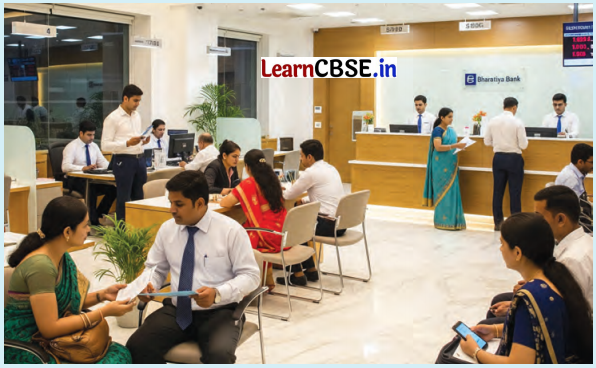
This picture is from a bank. What do you think the people are doing? Ask your family members if they have visited a bank and learn more about the activities there. (Page 194)
Answer:
I think people in the bank are completing different activities such as depositing money, withdrawing cash, filling in forms, collecting passbooks, and in availing other banking services.
I asked my family members about their visits to a bank, and they said they have visited several times for activities such as depositing money, withdrawing cash, and making payments.
Think About it
Question 1.
Why does Navdeep think that saving at the bank is better than keeping cash at home? (Page 196)
Answer:
Navdeep thinks saving money in a bank is safer than home because it cannot be easily lost or stolen from the bank. The bank also pays interest, which helps his money grow over time.
Question 2.
Can Navdeep and Rima lend to each other directly without the bank? What could happen in that case? Discuss. (Page 196)
Answer:
They can lend money to each other directly, but it may be risky. There may be no proper agreement, and one person might not be able to pay back the money on time. Banks follow proper rules and ensure safety for both depositors and borrowers.
Question 3.
How does one track so many transactions of deposits and withdrawals? (Page 198)
Answer:
The bank provides the account holder passbook that records every deposit and withdrawal. By checking the passbook regularly, a person can easily keep track of all their financial transactions. Nowadays it is also available’ online.
Question 4.
Look at the passbook in Fig. 8.7. Observe all the particulars under the expenses (debit) and income (credit). Why is keeping records of financial transactions important? Discuss in the class. (Page 198)
Answer:
Keeping financial records and checking them regularly is important because it helps people know where their money is spent, avoid confusion or mistakes, and detect any incorrect or suspicious entries in their account.
Question 5.
Why do companies issue shares, and why do people buy them? Are there any benefits of owning shares? (Page 209)
Answer:
Companies issue shares to raise money for expanding their business. People buy shares to invest their savings and earn a profit if the share price rises. Owning shares may be beneficial if the company in which one has invested makes a profit, resulting in increase in stock price. Moreover, company may give dividends in the future.
Banks and the Magic of Finance Class 7 Solutions (Exercise)
Question 1.
What is financial infrastructure? How does it complement physical infrastructure?
Answer:
Financial infrastructure is the system of institutions and tools that support all money-related activities, such as banks, ATMs, UPI, insurance, and the stock market. It complements physical infrastructure because just as roads and railways help people move from place to place, financial infrastructure helps money move quickly and safely among people, businesses, and the government.
Question 2.
How does having a bank account help people? Should everyone be required to have a bank account?
Answer:
A bank account helps people keep their money safe, receive and send payments easily, earn interest, and access services such as loans and digital payments. Although it is not compulsory for everyone to have a bank account, it is beneficial because it gives people financial security and helps them participate in the modern economy.
Question 3.
What could be the possible advantages and disadvantages of compound interest for savers and borrowers?
Answer:
Compound interest is helpful for savers because it allows their money to grow faster over time as interest is added to the previous interest. It can be a disadvantage for borrowers because if they delay repayment, the interest amount keeps increasing, making the loan costlier.
Question 4.
How does financial infrastructure enable the flow of money between households and businesses? Can you think of how the government can facilitate this flow?
Answer:
Financial infrastructure enables money to flow by allowing households to deposit their savings in banks, which then lend this money to businesses for their activities. The government can facilitate this flow by creating digital systems like UPI, setting banking rules through the RBI, providing subsidies, and ensuring financial services reach rural and urban areas.
Question 5.
What could be the reason for the higher interest rate earned on fixed deposits as compared to a savings account?
Answer:
Fixed deposits earn higher interest because the money is locked in for a fixed period and cannot be withdrawn immediately. This allows the bank to use the money with greater certainty, so it offers a higher interest rate in return.
Question 6.
Sahil received ₹ 10,000 as a prize in a poster-making competition. His father promises to pay him 12 per cent interest per year if he does not spend the amount. After 3 years, how much money would Sahil have?
Answer:
Sahil received ₹ 10,000 as a prize. His father promised to give him 12% interest per year if he does not spend the money.
If it is simple interest: Each year, Sahil will earn 12% of ₹ 10,000, which is ₹ 1,200 . Over 3 years, he will earn
₹ 1,200×3= ₹ 3,600 as interest. Adding this to his original ₹ 10,000, he will have a total of ₹ 13,600 after 3 years.
If it is compound interest: With compound interest, the interest earned each year is added to the total amount, so the next year’s interest is calculated on a slightly larger amount. After 3 years of adding interest in this way, Sahil will have
After 1st year =10,000+1200=₹ 11,200
After 2nd year =11,200+(12 % on 11,200=1344)=₹ 12,544
After 3rd year =12,544+(12 % on 12,544=1505.28)=₹ 14,049.28
Question 7.
How does the stock market help mobilise the savings of individuals? In what ways do companies benefit by issuing shares to people?
Answer:
Stock exchanges help mobilise people’s savings by giving them a place to invest their money in shares. This helps savings grow and supports economic activity. Companies benefit by issuing shares because they receive money from investors, which they can use to expand production, start new projects, and improve their business activities.
Question 8.
How can we balance the convenience of digital payments with the risk of cyber fraud?
Answer:
We can balance convenience and safety while making digital payments by using strong passwords, keeping our PIN and OTP private, avoiding unknown links, checking messages carefully, and reporting any suspicious activity immediately to the cybercrime helpline. By following these safety steps, digital payments remain both easy and secure.
Question 9.
Ask your family members or neighbours about-
- how they save money?
- whether they use UPI, ATM or cheques, the kinds of transactions they perform through UPI; do they find UPI better than using cash or not, and why.
- if they or their acquaintance have experienced digital fraud, for instance, through a fake call or message asking for bank details. What did they do when they realised it was a scam, and what did they learn from that experience?
Summarise your findings in a table or short report. Share one surprising insight with your class.
Answer:
I asked my parents and neighbours about their money habits. Most of them save money through bank accounts, fixed deposits, or digital wallets. They use UPI for quick payments because it is faster and easier than cash.
Some people prefer ATMs for withdrawing money and use cheques for larger payments. One neighbour experienced a fake message asking for an OTP but did not share it and reported the number. The most surprising insight was that many people now prefer UPI over cash because it is more convenient and safer.
Question 10.
Create a Financial Safety Poster.
- Design a poster with dos and don’ts of digital banking safety (example, not sharing OTPs, reporting frauds).
- Include emergency numbers or websites like https://cybercrime.gov.in or 1930 helpline.
- Hang the posters in school corridors or the library.
Answer:
Students to do themselves, as directed.
Question 11.
Cheques are often used to pay utility bills. Ask your parents to allow you to fill out the cheques for a few monthly payments.
Answer:
Fill a few sample cheques under the guidance of a parent. While filling out the cheques, I wrote the date clearly, entered the name of the person or company receiving the payment, and wrote the amount in both words and figures. I also signed the cheque in the space provided. This activity helped me understand that cheques must be filled carefully to avoid mistakes and ensure proper payment.
Question 12.
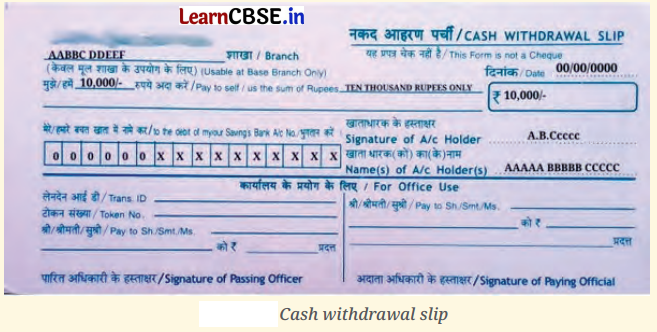
Suppose you have to withdraw ₹10,000 from your bank account, how would you fill out the cash withdrawal slip at your bank? Let us try below!
Answer:
Observe the sample withdrawal slip and fill the details.
To fill a cash withdrawal slip, I would write my name, account number, date, and the amount I want to withdraw, which is ₹ 10,000. I would also write the amount in words, sign the slip, and attach it with my passbook before giving it to the bank cashier. The cashier would verify my details and then pay the amount in cash to me.