.
Class 5 EVS Chapter 8 Clothes How Things are Made Question Answer
Clothes How Things are Made Class 5 EVS Question Answer
Our Wondrous World Class 5 EVS Chapter 8 Question Answer – Class 5 EVS Clothes How Things are Made Question Answer
Discuss (Page 133)
Question.
Have you seen products woven out of natural material at home or elsewhere? What are they?
Answer:
Yes, I have seen many things woven out of natural materials. At home, there are rugs and mats made from jute, coir or seagrass. People also make baskets from bamboo, and bags from jute. I have also seen fans made from palm leaves and sheets made from coconut fibres. These things are strong and useful. Lampshades made from bamboo and palm leaves, and shawls made from cotton, silk, and wool can be seen commonly.

Activity 1 (Page 133)
Do it yourself.
Think (Page 134)
Question.
What can you find in your classroom that is woven? If we weave with threads instead of paper strips, it becomes cloth.
Answer:
In my classroom, I can find things like baskets or mats that are woven. The fabric used in school bags, table covers, and decoration materials are also woven. When we weave with threads instead of paper strips, it becomes cloth, which is used to make different fabrics.
Activity 2 (Page 134)
Question.
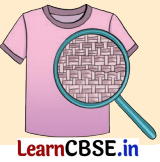
Look at a piece of cloth through a magnifying glass or by using zoom on a mobile phone camera. It could be a shirt or something you are wearing. Can you see the amazing criss-cross pattern?
Answer:
When we look closely at a piece of cloth through a magnifying glass or by zooming in with a phone camera, we can see the criss-cross pattern. This pattern is made by threads that go over and under each other, woven together to make the fabric. It is like a tiny grid that holds the cloth together and makes it strong.
Intext (Page 135)
Question.
We have seen how threads can be woven together to form a cloth. But how are threads made?
Answer:
Threads are made from fibres. Fibres are twisted together by spinning to make long threads.
Activity 3 (Page 135)
Do it yourself.
Activity 4 (Page 138)
Question.
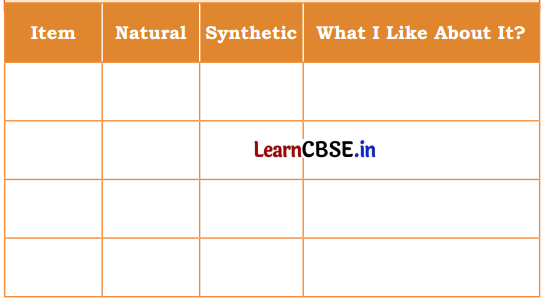
Look at some clothes, bags or other things you use every day. List some of the materials that you have used. Are they made from natural or synthetic fibres? Then, write one thing you like about it in the table below.
Answer:
| Item | Natural | Synthetic | What I Like About It? |
| Cotton shirt | Cotton | It is soft and comfortable to wear. | |
| School bag | Polyester, Nylon |
It is strong and carries all my books. | |
| Socks | Cotton | Nylon | They protect our feet from dust and dirt. |
| Bedsheet | Cotton | It feels soft and helps us sleep better. |
Activity 5 (page 139)
Do it yourself.
Activity 6 (page 139)
Question.
Have you ever tried stitching? You will need a needle and thread to stitch a piece of fabric together. Can you fix a tear or sew a button? Let us learn simple stitching.
Answer:
Yes, I have tried stitching. For, this we need a needle and thread to sew pieces of cloth together. We can fix a tear by sewing it, and we can also sew a button to keep it from falling off. Stitching is easy to learn and helps to repair clothes, so that we do not have to throw them away.
Think (page 139)
Question 1.
Have you ever seen someone stitching at home or in your neighbourhood? What were they making or fixing?
Answer:
Yes, I have seen my mother stitching at home. She was fixing a tear in my shirt. I have also seen my neighbour sewing a button on his jacket. They were repairing the clothes, so that it can look nice again and fixing things that were torn.
Question 2.
Look at your shirt or school bag. Can you find where the pieces have been stitched together?
Answer:
When I look at my shirt or school bag, I can see the stitches where different pieces of cloth are joined together. The stitches are along the edges of the sleeves and on the seams of the bag. These stitches keep the clothes and bag strong and help them stay in shape.
Activity 7 (page 140)
Do it yourself.
Activity 8 (Pages 140-141)
Question 1.
Where else can we use running stitches in daily life?
Answer:
We can use running stitches in many ways in daily life. For example, we use running stitches to sew clothes, fix torn fabric, sew buttons, and even make things like bags or mats.
Question 2.
If one thread breaks in your stitching, what do you think will happen to the rest of the stitches?
Answer:
If one thread breaks in our stitching, the rest of the stitches may open up because the thread holds everything together. So, it is important to stitch carefully and make sure the thread is strong.
Let Us Reflect (Pages 143-144)
Question 1.
Have you ever reused or recycled an old piece of cloth? What did you or your family make from it?
Answer:
Yes, I have reused old pieces of cloth before. My family made a beautiful quilt by sewing together small pieces of old cloth. Sometimes, they also use old clothes to make cleaning rags or small bags. Recycling clothes helps us use things again instead of throwing them away, which is good for the environment.
Question 2.
If one thread breaks in a stitched cloth or in a woven mat, what might happen? Why is each thread important?
Answer:
If one thread breaks in a stitched cloth or a woven mat, the rest of the threads might start to come apart too. This can make the cloth tear or the mat lose its shape. Each thread is important because they all work together to hold the fabric or mat strong and keep it from falling apart. So, every thread helps to keep the whole thing strong and maintain its shape.
Question 3.
Visit a tailor’s shop or a handloom store with an adult. What tools or machines did you see being used there?
Answer:
At a tailor’s shop, we might see needles, threads, scissors, measuring tape, and a sewing machine. At a handloom store, we might see a loom to weave cloth and a spinning wheel to make thread. These tools help make and fix clothes.
Question 4.
Find out what kind of weaving or stitching work is famous in your area or state. Name it.
Answer:
(Answer may vary)
In my area, Phulkari embroidery is famous. It is a traditional stitching work from Punjab, where colourful threads are used to make beautiful flower patterns on cloth.
Question 5.
We should not throw the old clothes away. Why?
Answer:
We should not throw old clothes away because they can be reused or recycled to make new things. This helps us save resources and reduce waste, which is good for the environment. We can also give old clothes to people who need them.
Question 6.
Below are the jumbled-up steps of the life cycle of a moth. Read and number them from 1 to 6 in the correct order.
- Adult moth comes out of the cocoon.
- Eggs hatch into tiny caterpillars.
- Silk moth lays eggs.
- The cycle begins again.
- Caterpillars eat mulberry leaves and grow big.
- Caterpillars spin cocoons around themselves.
Answer:
The correct order of the life cycle of a moth is as follows:
- Silk moth lays eggs.
- Eggs hatch into tiny caterpillars.
- Caterpillars eat mulberry leaves and grow big.
- Caterpillars spin cocoons around themselves.
- Adult moth comes out of the cocoon.
- The cycle begins again.
Question 7.
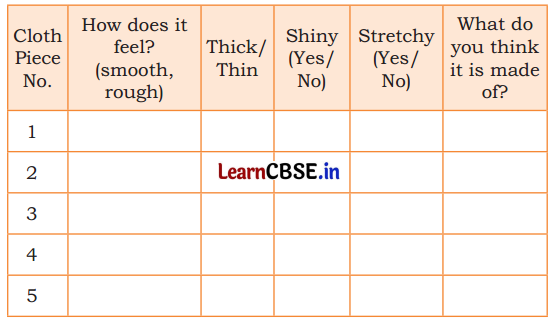
Bring 5-6 pieces of different types of clothes from home or nearby tailors (leftover scraps). Observe the material closely and complete the table. Ask an elder or search in your book to find out whether it is made from cotton, wool, silk, jute, polyester or nylon.
Answer:
| Cloth Piece No. | How does it feel? (smooth, rough) | Thick/Thin | Shiny (Yes/No) |
Stretchy (Yes/No) |
What do you think it is made oP |
| 1 | Smooth | Thin | No | No | Cotton |
| 2 | Rough | Thick | No | No | Jute |
| 3 | Smooth | Thin | Yes | No | Silk |
| 4 | Smooth | Thick | No | No | Wool |
| 5 | Smooth | Thin | Yes | Yes | Polyester |