.
Class 5 EVS Chapter 7 Energy How Things Work Question Answer
Energy How Things Work Class 5 EVS Question Answer
Our Wondrous World Class 5 EVS Chapter 7 Question Answer – Class 5 EVS Energy How Things Work Question Answer
Intext (Pages 114-115)
Question 1.
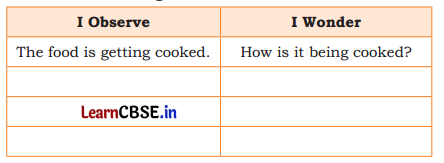
Let us observe a kitchen for some time. Write your observations and the questions that come to your mind in the table given below.
Answer:
| I Observe | I Wonder |
| The food is getting cooked. | How is it being cooked? |
| The mixer makes a loud sound. | Why does it make a sound while working? |
| The refrigerator keens things cool. | Why are things cool inside the refrigerator? |
| The gas flame is | What kind of fuel is |
| burning on the stove. | used to make the flame burn? |

Question 2.
From your observation write down at least three things that you have noticed:
– Moving
……………………………………………………..
– Providing light
……………………………………………………..
– Making a sound
……………………………………………………..
– Making things cool
……………………………………………………..
– Making things hot
……………………………………………………..
Answer:
– Moving
Pinwheel, Water wheel and Motor wheel
– Providing light
Sunlight, LED bulbs and Lamps (diya)
– Making a sound
Thunder, Speaker and Vehicle horns
– Making things cool
Breeze, Refrigerator and Air conditioner
– Making things hot
Sunlight, Gas stove and Solar cooker
Discuss (Page 115)
Question.
What makes these things move, shine, make a sound or get warm and cold?
Answer:
Energy makes these things move, shine, make a sound or get warm and cold.
Activity 1 (Page 116)
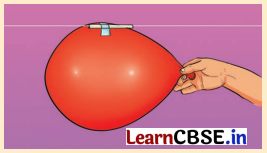
Balloon Air Rocket
Do it yourself.
Think (Page 116)
Question.
What would you change in the activity to make the toy move faster or slower?
Answer:
To make the toy move faster, I would use a bigger balloon filled with more air and a smooth, tight string so it can move easily.
To make the toy move slower, I would use a smaller balloon with less air and a rough or loose string to slow it down.
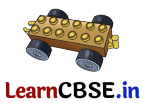
Activity 2 (Page 117)
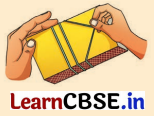
Rubber Band Guitar
Do it yourself.
Think (Page 117)
Question.
What happens if you use thinner or thicker rubber bands? Do they sound different?
Answer:
Yes, thinner rubber bands vibrate more easily when plucked and produce a higher sound, while thicker rubber bands produce a lower sound.
Activity 3 (Page 117)
Sun-powered Water Warmer
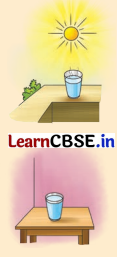
Do it yourself.
Think (Page 119)
Question.
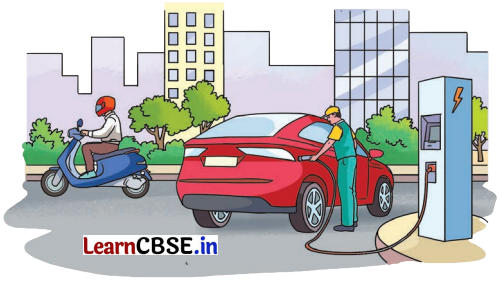
What do cars and scooters need to keep running?
Answer:
Cars and scooters need fuel like petrol or diesel to keep running.
Write (Page 119)
Question.
How is food cooked in your house?
Answer:
In my house, food is cooked using cooking gas. In some places, people use wood or coal to cook food.
Discuss (Page 120)
Question 1.
What kind of fuel do you use at home for cooking?
Answer:
We use cooking gas, wood, or coal at home for cooking.
Question 2.
What are the problems using too much wood or coal?
Answer:
Using too much wood or coal causes smoke and air pollution, which can harm our health and the environment.
Activity 4 (Page 120)
Understanding How Fuel Works
1. Place two diyas (lamps) on a flat surface.
2. In Diya 1 – place a cotton wick without any oil, and in Diya 2 place a cotton wick and pour some oil around it.
3. Light the wicks in both the diyas under adult supervision.
4. Observe what happens to the diyas.
(a) Which diya burns longer? Why?
(b) What is acting as a fuel here?
Answer:
(a) Diya 2 burns longer because it has oil, and the oil helps the wick to keep burning.
(b) The oil is acting as the fuel.
Intext (Page 121)
Question.
What are the things in your home that need electricity to work?
Answer:
Devices like the fan, bulbs, TV, AC, fridge, mixer, etc. need electricity to work.
Activity 5 (Page 121)
Question.
Walk around your home or classroom. Identify five things that run on electricity. Fill in the following table.
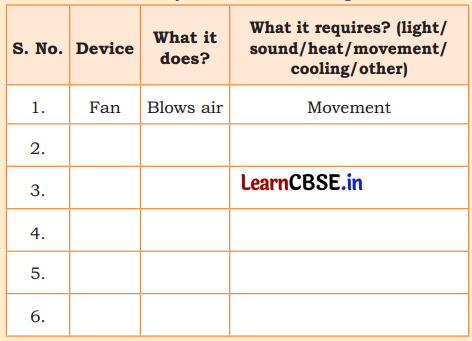
From the above examples, did you notice that electricity can be used for movement, and producing sound, light and heat?
| S.No | Device | What it does? | What it requires? (light/ sound/heat/ movement/ cooling/other) |
| 1. | Fan | Blows air | Movement |
| 2. | Bulb | Gives light | Light |
| 3. | TV | Shows pictures and plays sound | Light and sound |
| 4. | Fridge | Keeps food cool and fresh | Cooling and light |
| 5. | Iron | Removes wrinkles from clothes | Heat |
| 6. | Mixer | Grinds food | Movement and sound |
Yes, from the above examples, we notice that electricity can be used for movement (fan, mixer), light (bulb, TV), sound (TV, mixer), heating (iron), and cooling (fridge).
Think (Page 122)
Question.
What would your day be like if there was no electricity at all?
Answer:
Electricity makes our life easy at home, in schools, and in factories. Without electricity, machines like fans, bulbs, TV, and other machines would not work, and life would become difficult.
Think (Page 123)
Question.
Place a small damp cloth in the Sun. Keep another damp cloth in the shade. Which one do you think will dry first? Why?
Answer:
The cloth placed in the Sun dries first because the Sun gives heat, which helps the damp cloth to dry.
Activity 6 (Pages 123-124)
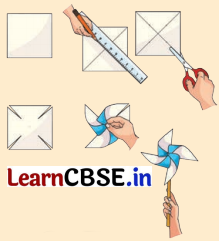
Pinwheel
1. Take a square piece of paper.
2. Draw its two diagonals with the help of a ruler.
3. Now, you have four equal parts.
4. Cut halfway along each of the four lines.
5. Fold each corner and pin it to the stick as shown in the image.
6. Now, hold your pinwheel in the wind. If there is no wind, hold it up and run with it.
What happens to your pinwheel?
Answer:
The pinwheel starts rotating when wind blows on it. If there is no wind, it rotates when we run with it because the moving air makes it rotate.
Activity 7 (Page 124)
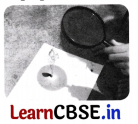
Sunlight in Focus
1. Take a piece of paper and a magnifying glass.
2. Place the paper in direct sunlight and use the magnifying glass to focus the light on it.
Tip: The activity has to be done under adult supervision.
Question 3.
What happens to your paper?
Answer:
The paper starts burning because the magnifying glass focuses sunlight on it, and sunlight gives heat.
Activity 8 (Page 124)
Water Wheel
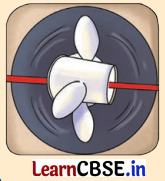
1. Take an empty paper cup and five spoons.
2. Make five holes around the cup and insert the spoons.
3. Then, insert a pencil or straw through the bottom of the cup.
4. Observe that the cup moves around the pencil like a wheel.
5. Balance your wheel on a container as shown in the image.
6. Now, pour water onto your wheel.
7. Does the water make the wheel move?
Answer:
Yes, water makes the wheel spin because the water pushes the wheel with force and helps it to spin.
Think (Page 125)
Question. Have you ever seen papads being dried in the sunlight and clothes hung out to dry?
Answer:
Yes, the Sun’s heat helps them dry faster.
Write (Page 125)
Question.
Can you think of more examples where we use the Sun, the wind or the flowing water?
Answer:
We use the Sun for drying clothes, growing crops, providing heat, cooking food in a solar cooker, and generating electricity using solar panels.
Wind is used for sailing boats, flying kites, drying crops, and generating electricity with windmills.
Flowing water is used for turning water wheels, generating electricity, and playing with toy boats in a stream.
Intext (Page 127)
Question.
Did you know that even our vehicles can run on electricity?
Answer:
Yes, some vehicles like cars, buses, and scooters run on electricity. They use batteries to store energy and do not cause as much pollution as petrol or diesel vehicles.
Write (Page 127)
Energy All Around Us
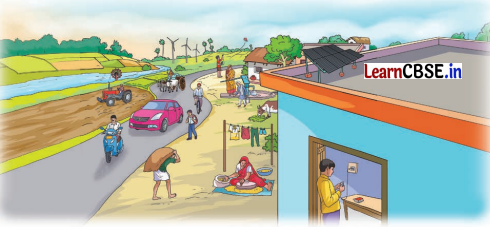
List actions that you see in the picture above and fill in the following table.
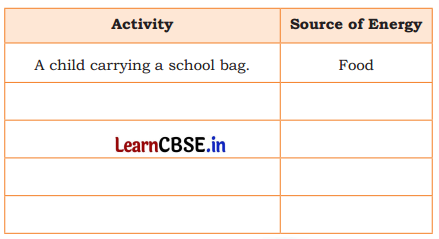
Answer:
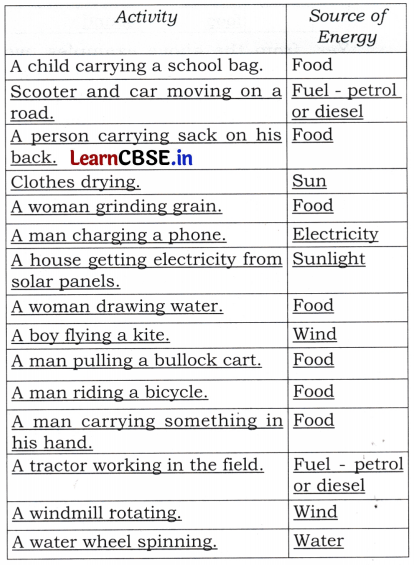
Activity 9 (Page 128)
Energy Flow Game
Do it yourself.
Let Us Reflect (Page 130)
Question 1.
What will happen if there is no electricity in your house for a day?
Answer:
If there is no electricity in my house for a day, electrical appliances such as fans, lights, TV, and the fridge will stop working. Life will become difficult without electricity.
Question 2.
Why is it better to use solar or wind energy instead of coal?
Answer:
It is better to use solar and wind energy because they do not cause pollution and are clean sources of energy.
Question 3.
Give two examples where you have seen energy being stored.
Answer:
Energy is stored in batteries and in our body as food.
Question 4.
What is the one thing you can do at home to save energy?
Answer:
I can switch off lights and fans when not in use to save energy.
Question 5.
Find out how many kilometres a vehicle travels per litre of petrol or diesel. Ask about different vehicles. How will you compare them?
Answer:
(Answer may vary)
Different vehicles travel different distances using one litre of petrol or diesel. For example:
- A scooter travels about 40 to 70 km per litre.
- A car travels between 10 to 20 km per litre.
- A bus travels about 3 to 6 km per litre.
(Note: The distance may vary depending on the model and condition of the vehicle.)
Question 6.
Look around your home or classroom. List any three objects that use energy and mention their source of energy. For example:
Object: Fan → Energy Source: Electricity
Answer:
| Object | Energy Source |
| Bulb Car Solar light |
Electricity Fuel (Petrol/Diesel) Sun (Solar energy) |
Question 7.
Create and share:
(a) Draw or make a simple plan of a ‘clean energy home’ that uses solar, wind or any such source of energy.
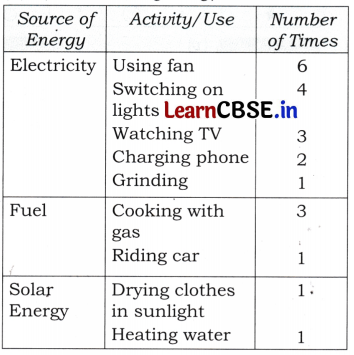
(b) Make ‘my energy diary’ for one day, record the number of times you have used the electricity fuel and so on.
Answer:
(a) Clean Energy Home Using Solar Energy:
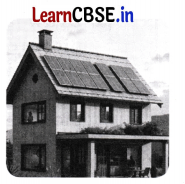
- Place solar panel on the roof.
- Solar panels capture sunlight from Sun and change it into electricity.
- This electricity runs lights, fans, TV, fridge and other machines in the house.
- Using solar panel reduces pollution because sunlight is a clean and natural source of energy.
(b) (Answer may vary)