.
Class 4 EVS Chapter 2 Exploring Our Neighbourhood Question Answer
Exploring Our Neighbourhood Class 4 EVS Question Answer
Our Wondrous World Class 4 EVS Chapter 2 Question Answer – Class 4 EVS Exploring Our Neighbourhood Question Answer
Activity 1 (Page 18)
Question 1.
Write a letter to a friend and post it.
Answer:
Do it yourself with the help of parents or teachers. One example has been shown for you.
Dear Shreya,
I hope you are doing well’ I am having a great time at school and wanted to share some exciting news with you. 14+ had a fun field trip last week and I cannot wait to tell you all about it.
I miss playing with you during recess.
I hope u are enjoying your time too. Let us plan to meet soon and have some fun together!
Take care and write to me soon,
Your friend,
Sunny.

Question 2.
Teacher can take students on a field trip to a post office, to explore various activities that take place there.
Answer:
Do it yourself along with your teachers.
Write (Page 19)
Question 1.
Have you or your family members ever sent, or received a letter or a parcel?
Answer:
Do it yourself with the help of your parents or teachers.
Question 2.
How does the post office help people stay connected with each other?
Answer:
The postman collects all the letters from the postbox and takes them to post office. In the post office, letters are sorted according to regions as per the address written and send them to their destinations. In this way, the post office helps people to communicate and stay connected with each other. Post offices offer a variety of other services too.
Activity 2 (Page No)
Interview with Elders
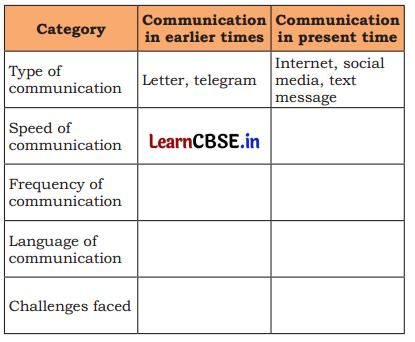
Discuss with the elders in your neighbourhood and find out how they communicated with each other when they were of your age. Compare their answers to how you and your friends communicate today, and fill in the table below:
Answer:
| Category | Communication in earlier times | Communication in the present time |
| Type of communication | Letter, telegram | Internet, social media, text message |
| Speed of communication | Very slow | Very fast |
| Frequency of communication | Less frequent | Very frequent |
| Language of communication | Mother tongue | Mostly English |
| Challenges faced | Not able to get immediate help in an emergency situation | Easy and fast but sometimes not a reliable resource |
Discuss (Page 21)
Question 1.
Letters took a long time to reach other persons. How do you think it affected communication between people in the past?
Answer:
In the past, sending letters took a long time because there were no fast ways to send messages like we have
today with mobile phones or the internet. This made communication slower and more thoughtful.People had to wait for days or even weeks to hear back from someone far away. This meant that if someone wanted to share important news or needed help in an emergency situation, they were not able to communicate faster. Sometimes, people did not know what was happening with their friends or family right away.
Question 2.
How is it different from the way people communicate now?
Answer:
In the past, writing letters was slow. It took days or weeks to send news. Today, we can use mobile phones, computers, and the internet to send messages quickly. Now, we can talk to friends and family anytime, anywhere.
Question 3.
Today quick messages make sharing the news easier, but sometimes wrong information spreads very quick too. How can we ensure the news we share is true?
Answer:
To make sure the news we share is true, we can follow these simple steps;
- Check the Source: Is it from a trusted source, reliable website or news outlet?
- Look for Evidence: Does the story provide facts or quotes from experts?
- Verify the Date: Is the information current, or is it outdated?
- Cross-Check: Can you find the same news on other reliable websites?
- Ask an Adult: If you are not sure, ask a parent, teacher, or another trusted adult.
By following these steps, we can help ensure that the news we share is accurate and trustworthy.
Write (Page 22)
Question 1.
Which mode of transportation do you use the most?
Answer:
Land transport
Question 2.
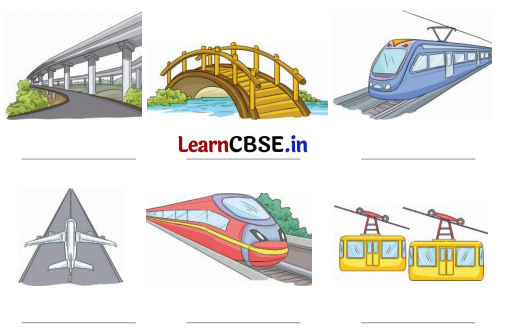
Can you identify the structures in the pictures, and explain how they have made travel faster and connectivity better?
Answer:
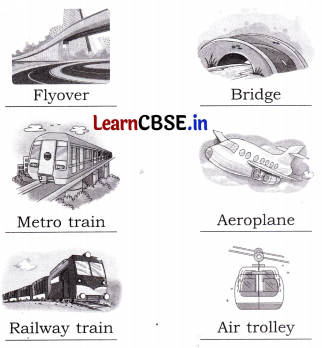
- Flyovers are high roads built above the ground, that help vehicles move over the busy roads and crossings. Thus, save time by avoiding traffic jams.
- Bridge connects the two opposite sides of the river. They help people and vehicles cross easily and quickly.
- Metro trains run on special tracks above or below the ground. They move very fast and help people travel across the city quickly. Railway trains run on separate tracks and help people travel long distances faster.
- Aeroplane and air trolley are type of air transport.
- Aeroplanes help people travel from one city or country to another in a few hours.
- Air trolleys move on wires in the air. They are useful for travel in hilly areas or across rivers.
Find Out (Page 23)
How did your parents and grandparents go to school or other places, when they were of your, age? Is it different from how you travel today? Note it down below.

Answer:
Do it yourself with the help of your parents and grandparents.
Write (Page 23)
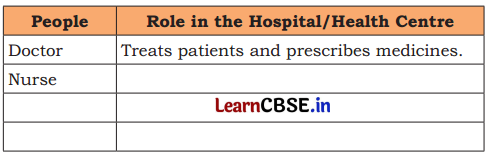
List the people who works at a hospital or a health centre, and write down their role in the following table. One example has been given in the table.
Answer:
| People | Role in the Hospital/ Health Centre |
| Doctor | Treats patients and prescribes medicines. |
| Nurse | Takes care of patients, gives medicine, helps doctors with treatment. |
| Lab technician | Tests samples like blood or urine to check for diseases. |
| Attendant | Helps patients by assisting with daily tasks and also helps hospital staff by cleaning and bringing necessary items. |
Discuss (Page 25)
Q. If you had to send money to someone, which method would you choose using a phone, Money Order or some other mode? Why?
Answer:
I will use mobile phone because it will make my payment faster and it is safe too. I will get the message confirmation immediately after sending the money.
Write (Page 25)
Question 1.
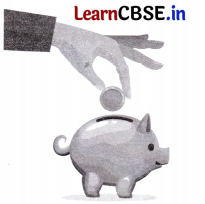
If you get pocket money, do you save it? If yes, where do you put your savings?
Answer:
Yes. I will save my money in a piggy bank (gullak).
Question 2.
Why do you think it is important to save money?
Answer:
It is important to save money for future use. Whenever we need money, we can use the saved money.
Question 3.
What are some things you could do to save more money?
Answer:
We can open an account in a bank, save money there, and invest it in fixed deposits, mutual funds, or the
stock market, etc., where our money can grow.
Question 4.
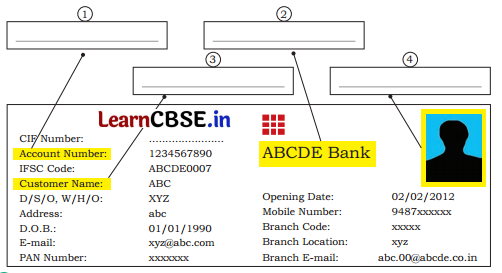
Request one of your family members to show you their bank passbook. Note the important elements given on the first page of the passbook.
Answer:
Do it yourself with the help of your family member.
- Account Number
- ABCDE Bank
- Customer Name
- Photograph of an account holder
Activity 3 (Page 26)
Question 1.
Visit a bank in your locality or find out from your elders about how it works.
After that, answer the following questions:
(a) Other than saving money, what else do people use banks for?
(b) What is an ATM and how does it help people?
Answer
(a) Bank is used for:
Transferring money
Taking loan
Keeping expensive items like gold, silver, diamond in lockers.
Investing money in fixed deposits, mutual funds, or the stock market, etc.
(b) ATM is a short form of ‘Automated Teller Machine’ which helps us to take out money anytime we need it. Some ATMs also allow to deposit cash in our bank account, instantly.
Question 2.
Take an Indian currency note. Look at it closely and answer the following questions:
(a) What is the value of the note?
(b) How many languages do you see on the note?
(c) What pictures or symbols are there on the note?
Answer:
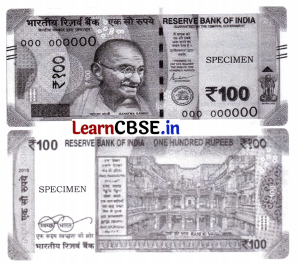
(a) ₹ 1oo
There are 17 languages on the Indian currency note including Hindi and English on front and backside of note:
- Assamese
- Bengali,
- Gujarati
- Kannad
- Kashmiri
- Konkani
- Malayalam
- Marathi
- Nepali
- Odia
- Punjabi
- Sanskrit
- Tamil
- Telugu
- Urdu
- English
- Hindi
(c) Pictures or symbols on note:
- Portrait of Mahatma Gandhi at the centre
- Ashoka Pillar Emblem on the right
- Swachh Bharat Logo with Slogan
- Motif of RANI Kl VAV
Write (Pages 28-29)
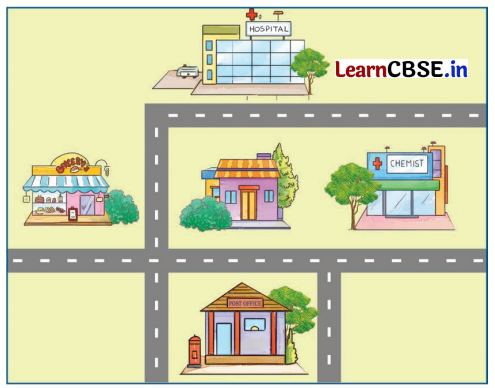
Question 1.
Look at the picture above, and write down the places located in the North, East, West, and South of Navya’s home.
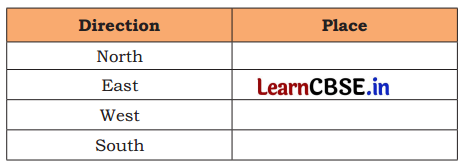
Answer:
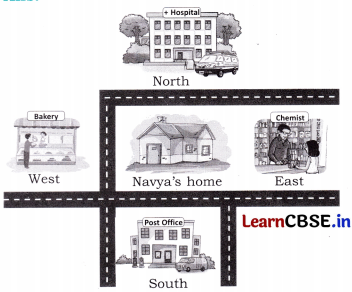
| Direction | Place |
| North | Hospital |
| East | Chemist |
| West | Bakery |
| South | Post Office |
Question 2.
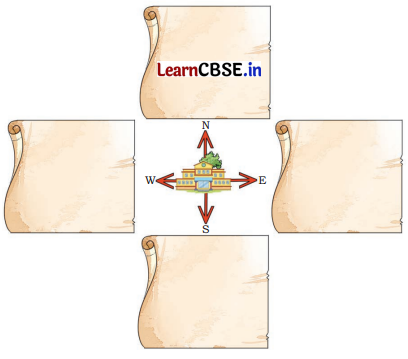
Look at the picture and imagine your school at the centre. Name the buildings or areas near your school and write the direction they are situated in the given spaces.
Answer:
Do it yourself with the help of your teacher.
Question 3.
Imagine you are giving directions to a friend to visit your favourite place near your school. How would you explain it using directions (left, right, forward, backward, etc.) and landmarks?
Place: _________
Instruction: ______
Answer:
Hints: Take one landmark and ask your friend to face it. That will be the forward direction. Her back will be the backward direction. Her right hand will show the right direction and her left hand will show the left direction. Do it yourself with the help of your parents or teachers.
Activity 4 (Page 30)
Draw a map showing the route from your school to the public library or any such place near your school. Identify landmarks like parks, shops, hospitals, bus stops. etc on the map.
Answer:
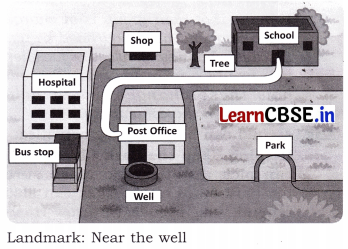
Let Us Reflect (Pages 31-32)
Question 1.
Imagine you have ₹ 100 to utilise in a month. Your task is to plan how to spend and save wisely. Think about your expenses for stationery, snacks, toys, etc. Decide how much you will save in your piggy bank and how much you will use for your expenses. After making this plan, think about how saving money could help you in the future.
Use the table below to create your budget:
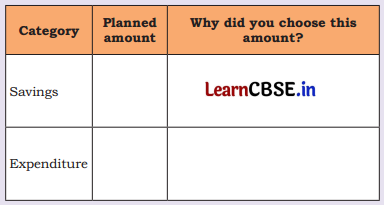
Answer:
Here is a simple plan to manage my ₹ 100 for the month:
| Category | Planned amount | Why did you choose this amount? |
| Savings | ₹ 30 | 30% is enough amount to save. |
| Expenditure | ₹ 30 | To buy stationery |
| ₹ 20 | To buy toys | |
| ₹ 20 | To buy snacks |
Future Benefit:
By saving money regularly, I can buy bigger things in the future, or even save for something important like a gift or a special outing! Saving helps me feel more prepared for surprises.
Question 2.
Imagine that your group is in charge of making your neighbourhood better. Discuss what new services or facilities you would add or improve. Present how these changes would help everyone in the community.
Answer:
A child can help in these activities:
Helping Keep the Park Clean: Kids can pick up litter and make sure the park stays clean. They can also remind their friends to throw trash in the bins.
Planting in the Community Garden:
Children can help plant flowers, vegetables, and water the plants. This helps make the neighbourhood greener and cleaner.
Organizing a Book Stall: Kids can collect old books from their homes and donate them to help poor children
and encourage them to study.
Participating in Clean-up Agenda:
Kids can join clean-up days by picking up trash in their neighbourhoods and keeping the area tidy.
Spreading Awareness: Children can encourage their friends and family to take care for the environment by
telling them about the importance of recycling or not wasting food. By helping with these activities, children can learn responsibility and teamwork while making their neighbourhood a better place.
Question 3.
As a class, take help of the elders around you to list people in your neighbourhood who helped the community during COVID-19. These could include doctors, nurses, garbage collectors, shopkeepers, teachers
and others. Discuss how they made the community safer and why it is important to thank them.
Answer:
During COVID-19, many people in our neighbourhood worked hard to keep us safe. Here are some of the people who helped:
- Doctors and Nurses: They kept us healthy by taking care of people who were sick and teaching everyone how to stay safe.
- Garbage Collectors: They helped by keeping the neighbourhood clean, which stopped the spread of germs.
- Shopkeepers: They helped by providing food, so families could stay home and be safe.
- Teachers: They made sure we could continue learning, even during difficult times.
- Delivery People: They kept us connected with essential goods and made sure we didn’t have to go outside.
It is important to thank these people because they worked hard to keep us safe and healthy, even when things were tough. They helped us stay calm and take care of each other. By thanking them, we show our appreciation for all their hard work. They are true heroes in our community!
Question 4.
Can you list out the people involved and vehicles used in each of these services in the boxes given below? An example has been given.
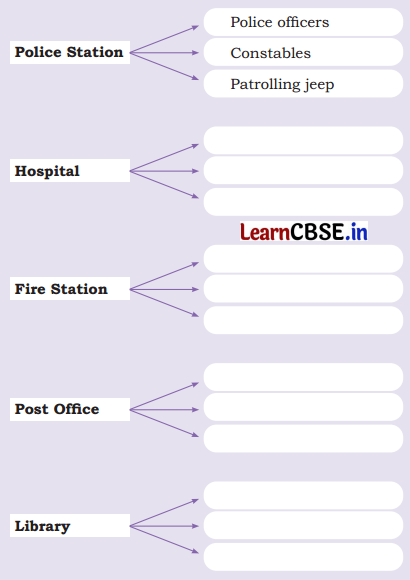
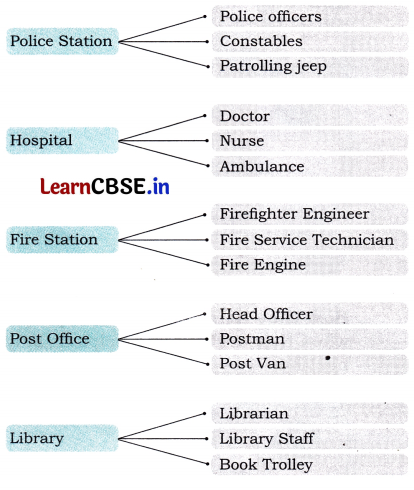
Answer: