Class 8 Science Chapter 3 Health: The Ultimate Treasure Question Answer
Science Class 8 Chapter 3 Question Answer Health: The Ultimate Treasure
Health: The Ultimate Treasure Class 8 Question Answer (InText)
NCERT Probe and Ponder Questions (Page 28)
Question 1.
How does your body respond to an infection such as the common cold?
Answer:
The body responds to a common cold (caused by viruses) through the immune system. Symptoms like a runny nose, sore throat, or cough occur as the body fights the infection. The immune system produces antibodies to neutralize the virus, and white blood cells attack infected cells. Rest, hydration, and sometimes medication (e.g., for fever) help recovery.
Question 2.
We rarely see cases of smallpox or polio these days, but diseases like diabetes and heart problems are more common. Why?
Answer:
Smallpox and polio have been nearly eradicated due to widespread vaccination programs (e.g., Edward Jenner’s smallpox vaccine, polio vaccines). In contrast, non-communicable diseases (NCDs) like diabetes and heart problems are increasing due to modern lifestyle factors such as unhealthy diets (e.g., processed and junk foods like pizza, burgers, etc.), lack of exercise, stress, and longer life expectancies.

Question 3.
Could climate change lead to new types of diseases?
Answer:
Yes, climate change can lead to new or increased disease risks. Warmer temperatures and changing weather patterns can expand the range of disease-carrying vectors like mosquitoes (e.g., malaria, dengue), alter water quality, and create conditions for new pathogens to emerge or spread more easily.
Question 4.
How do emotions like stress or worry affect us and make us sick?
Answer:
Stress or worry can weaken the immune system by releasing hormones like cortisol, making the body more susceptible to infections (e.g., colds). Chronic stress can also contribute to non-communicable diseases like high blood pressure or diabetes by affecting sleep, diet, and mental health.
Question 5.
Why do some groups of people get affected more than others during disease outbreaks?
Answer:
Some groups are more affected due to factors like weaker immunity (e.g., children, elderly), poor living conditions (e.g., lack of sanitation), malnutrition, or preexisting health issues. Social factors, such as crowded living spaces or limited healthcare access, also increase vulnerability.
NCERT Class 8 Science Chapter 3 Question Answer Health: The Ultimate Treasure (Exercise)
Keep the Curiosity Alive (Pages 42-45)
Question 1.
Group the diseases shown in the images as communicable or non-communicable.
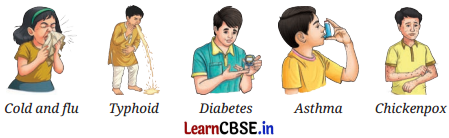
Answer:
Communicable Diseases
- Cold and Flu
- Typhoid Chickenpox
Non-communicable Diseases
- Diabetes
- Asthma
Question 2.
Diseases can be broadly grouped into communicable and non-communicable diseases. From the options given below, identify the non-communicable diseases.
(i) Typhoid
(ii) Asthma
(iii) Diabetes
(iv) Measles
(a) (i) and (ii)
(b) (ii) and (iii)
(c) (i) and (iv)
(d) (ii) and (iv)
Answer:
(b) (ii) and (iii)
Question 3.
There is a flu outbreak in your school. Several classmates are absent, while some are still coming to school coughing and sneezing.
- What immediate actions should the school take to prevent further spread?
- If your classmate, who shares the bench with you, starts showing symptoms of the flu, how can you respond in a considerate way without being rude or hurtful?
- How can you protect yourself and others from getting infected in this situation?
Answer:
- The school should close temporarily, sanitise classrooms, and encourage sick students to stay home to prevent further spread.
- You can politely suggest that your classmate see a doctor and take a rest at home, and offer to share notes with them.
- To protect yourself and others, wash your hands frequently, avoid close contact, and wear a mask.
Question 4.
Your family is planning to travel to another city where malaria is prevalent.
- What precautions should you take before, during, and after the trip?
- How can you explain the importance of mosquito nets or repellents to your sibling?
- What could happen if travellers ignore health advisories in such areas?
Answer:
- To protect our family from malaria during travel, focus on preventing mosquito bites and taking prescribed preventative medication.
- Before travel, consult a doctor, get necessary vaccinations, and pack mosquito repellent and protective clothing.
- During the trip, continue using repellent, wear long sleeves and pants, and sleep under mosquito nets.
- After returning, monitor for any symptoms like fever, and seek immediate medical attention if they occur.
- Explain to your sibling that mosquitoes spread malaria and that nets or repellents protect by blocking bites.
- If travellers ignore health advisories in such areas, they risk malaria infection, severe illness, or even death.
Question 5.
Your uncle has started smoking just to fit in with his friends, even though it is well known that smoking can seriously harm health and even cause death.
- What would you say to him to make him stop, without being rude?
- What would you do if your friend offered you a cigarette at a party?
- How can schools help prevent students from indulging in such harmful habits?
Answer:
- Dear Uncle, I care about your health and well-being, and I want to talk to you about smoking. It’s well-known that smoking can lead to serious health issues, including heart disease and lung cancer. Quitting smoking can greatly improve your health and quality of life.
- Politely decline the cigarette at the party and explain the health risks to your friend.
- Schools can help prevent students from indulging in such habits by educating them about the health risks and organizing awareness programs regularly.
Question 6.
Saniya claims to her friend Vinita that “Antibiotics can cure any infection, so we don’t need to worry about diseases.” What question(s) can Vinita ask her to help Saniya understand that her statement is incorrect?
Answer:
Why Saniya’s Statement is Wrong:
- Antibiotics only work against bacterial infections, not viral ones like the flu or common cold.
- Overuse or misuse of antibiotics can lead to antibiotic resistance, making them less effective in the future.
- Some diseases are caused by fungi, protozoa, or viruses, which require different treatments.
Vanita can ask Saniya, Did you know that antibiotics don’t work on viruses like the flu or measles? They’re only useful for bacterial infections. Also, if we take antibiotics when we don’t need them, they might stop working when we really do. That’s why doctors are careful about prescribing them.”
Question 7.
The following table contains information about the number of dengue cases reported in a hospital over one year:
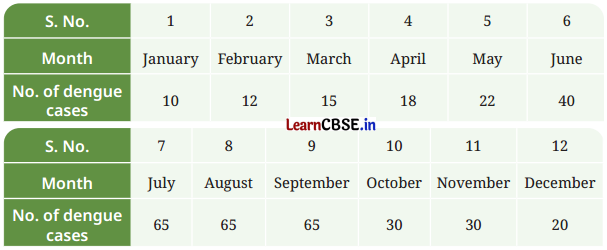
Make a bar graph of the number of cases on the Y-axis and the month on the X-axis. Critically analyse your findings and answer the following:
- In which three months were the dengue cases highest?
- In which month(s) were the cases lowest?
- What natural or environmental factors during the peak months might contribute to the increase in dengue cases?
- Suggest a few preventive steps that the community or government can take before the peak season to reduce the spread of dengue.
Answer:
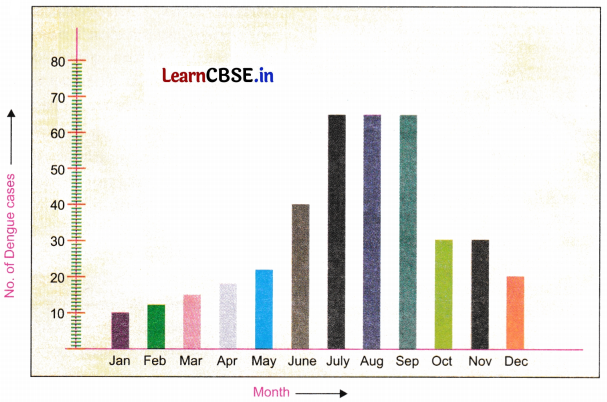
- The dengue cases were highest in July, August, and September.
- The cases were lowest in January.
- Natural or environmental factors during the peak months, such as the rainy season and standing water for mosquito breeding, might contribute to the increase in dengue cases.
- The community or government can take preventive steps like removing stagnant water, using mosquito nets, and spraying insecticides during this period regularly to reduce the spread of dengue.
Question 8.
Imagine you are in charge of a school health campaign. What key messages would you use to reduce communicable and non-communicable diseases?
Answer:
Key messages for a school health campaign to reduce communicable and non-communicable diseases include washing hands regularly, eating a healthy diet, exercising daily, getting vaccinated, and avoiding smoking.
Question 9.
It is recommended that we not take an antibiotic for a viral infection like a cold, a cough, or the flu. Can you provide the possible reason for this recommendation?
Answer:
The recommendation to avoid antibiotics for a viral infection like a cold, cough, or flu is because antibiotics do not work on viruses, which cause these illnesses.
Question 10.
Which disease(s) among the following may spread if drinking water gets contaminated by the excreta from an infected person?
Hepatitis A, Tuberculosis, Poliomyelitis, Cholera, Chickenpox.
Answer:
The diseases that may spread if drinking water gets contaminated by the excreta from an infected person are Hepatitis A, Poliomyelitis, and Cholera.
Question 11.
When our body encounters a pathogen for the first time, the immune response is generally low, but on exposure to the same pathogen again, the immune response by the body is much more compared to the first exposure. Why is it so?
Answer:
When our body faces a pathogen (like a virus or bacteria) for the first time, our immune system needs time to:
- Identify the invader
- Create specific antibodies
- Build memory cells that remember the pathogen
This first reaction is called the primary immune response, and it’s usually slow and weak.
When the same pathogen enters our body again:
- Our memory B cells quickly produce the correct antibodies
- Our memory T cells help destroy infected cells faster
This is called the secondary immune response, and it’s faster, stronger, and more effective.
Class 8 Health: The Ultimate Treasure Question Answer (Activities)
Activity 3.1: Let us Read (Page 29)
Question 1.
What was the cause of the boy’s health problems?
Answer:
The boy’s health problems were caused by a combination of loneliness, lack of social support (due to busy parents and no friends), and excessive screen time. His isolation and reliance on social media worsened his mental state, leading to physical symptoms like headaches, weight loss, and insomnia. The absence of a supportive environment and healthy coping mechanisms contributed significantly.
Question 2.
How did his habits and surroundings affect his well-being?
Answer:
- Habits: Spending excessive time on his phone and social media increased his loneliness and stress, disrupting his sleep and mental health. Avoiding social interaction further isolated him, impacting his emotional well-being.
- Surroundings: Moving to a new city with no friends and busy parents created an unsupportive environment, exacerbating his feelings of isolation. The lack of a social network and guidance affected both his mental and physical health negatively.
- Overall Impact: This led to a decline in his well-being, manifesting as physical symptoms (headaches, weight loss, sleeplessness) and emotional distress, aligning with the WHO definition of health as physical, mental, and social well-being.
Activity 3.3: Let us Compare (Page 31)
Question 1.
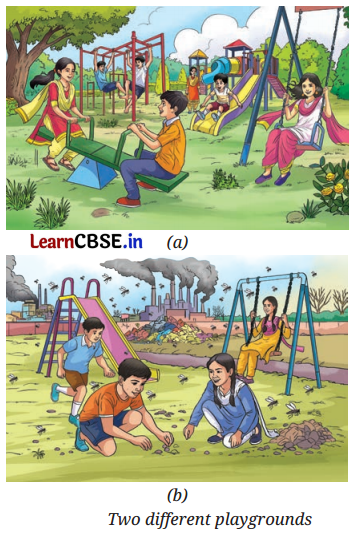
Look at Fig. (a) and Fig. (b). Which playground would you like to play in, and why?
Answer:
Preferred Playground: Most students would prefer to play in the playground shown in Fig. (a).
Reason:
- The text describes Fig. (a) as clean, well-maintained, and beautiful, making it a safe and enjoyable place to play.
- In contrast, Fig. (b) is described as polluted, dirty, unhygienic, and full of flies and mosquitoes, which can increase the risk of sickness and make it unpleasant.
- A clean environment, as highlighted in the text, supports health by reducing exposure to pathogens and pollutants, aligning with the chapter’s emphasis on environmental health.
Activity 3.6: Let us Read (Page 37)
Question 1.
What do you infer from this case study?
Ans.
- The case study shows that improving sanitation, such as building and using toilets, can greatly reduce open defecation and improve health, especially for children. The significant drop in diarrhoea and infections suggests that clean sanitation prevents the spread of communicable diseases caused by pathogens in contaminated environments (e.g., through water or soil)
- It highlights the importance of community effort and simple measures, aligning with the document’s emphasis on hygiene and clean surroundings as key to disease prevention.
- Inference: Better sanitation directly enhances physical health by reducing exposure to disease-causing agents, supporting the WHO definition of health as physical well-being.
Question 2.
Find out about such community campaigns held in your location. Share in your class and discuss with your peers about the impact of such initiatives.
Answer:
Finding Campaigns: (This depends on local context; example based on general knowledge and the document’s focus on India):
- Example campaigns might include the Swachh Bharat Abhiyan (Clean India Mission), a nationwide initiative to improve sanitation by building toilets and promoting hygiene, similar to the Odisha campaign. Local efforts might involve village clean-up drives or water purification projects.
- Students should research through local news, school resources, or community leaders to identify specific campaigns in their area.
Sharing and Discussion:
Impact: Share that such campaigns reduce diseases like diarrhoea, cholera, and typhoid by improving access to clean water and toilets. For instance, the Odisha campaign’s success in lowering child infections shows how sanitation saves lives and reduces healthcare costs.
Discussion Points:
- How did the campaign change people’s habits (e.g., using toilets instead of open areas)?
- What challenges might communities face (e.g., cost, awareness)?
- How can students contribute (e.g., spreading awareness, participating in clean-ups)?
- Example Contribution: “In my area, a clean-up drive reduced mosquito breeding, lowering dengue cases, similar to the Odisha impact.”