India and Her Neighbours Questions and Answers Class 7 SST Part 2 Chapter 2
India and Her Neighbours Class 7 Question Answer (In-Text)
The Big Questions (Page 29)
Question 1.
What defines a ‘neighbour’? Is it just shared land borders?
Answer:
The most common definition of neighbours is countries that directly touch each other’s boundaries. For example, India and Nepal are neighbours because they share a land border.
Countries separated by short stretches of sea or ocean are also considered neighbours. For instance, India counts Sri Lanka and the Maldives as maritime neighbours.
Geography scholars note that neighbouring countries are those in close proximity that influence each other through migration, trade, culture, and diplomacy.
So, we can say a “neighbour” in geography is not limited to shared land borders-it also includes countries in close proximity, such as maritime neighbours.

Question 2.
How do geography and history influence the nature of India’s relationships with her neighbours?
Answer:
Geography and history together play a decisive role in shaping India’s relations with its neighbours. India’s vast land borders with countries like Pakistan, China, Nepal, Bhutan, Bangladesh, and Myanmar, as well as its maritime proximity to Sri Lanka and the Maldives, naturally influence issues of security, trade, and cultural exchange.
Shared rivers, mountains, and seas create opportunities for cooperation but also disputes over territory and resources. Historically, centuries of cultural and religious tiessuch as the spread of Buddhism and Hindu traditions-have fostered closeness, while colonial legacies like the 1947 partition and subsequent wars with Pakistan, as well as border clashes with China, have generated tension. Thus, India’s neighbourhood relations are a blend of friendship and rivalry, shaped by geography that binds nations together and history that both unites and divides them.
Question 3.
In what ways are India and her neighbours interconnected today?
Answer:
Today, India and her neighbours are closely linked through trade, culture, travel, and cooperation. People cross borders for work, study, and festivals, while countries share rivers, traditions, and history. They also work together on security, climate, and regional peace, showing that neighbours are connected in many ways beyond just borders.
Let’s Explore
Question 1.
Identify the three large water bodies that surround India in the map below. (Page 30)
Answer:
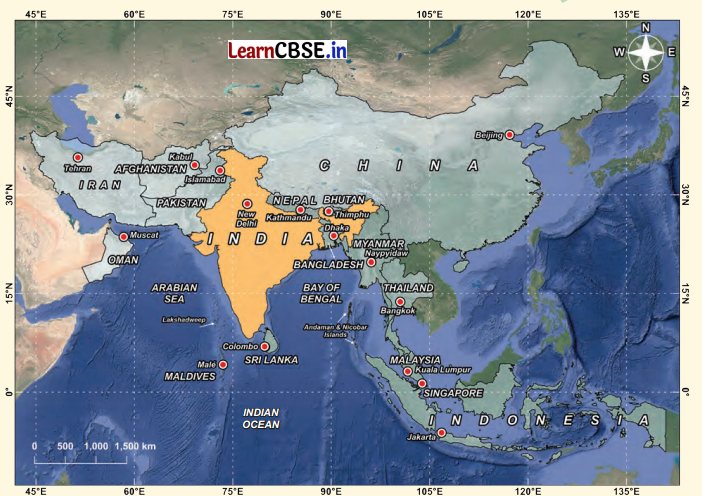
The three large bodies that surround India are:
- Indian Ocean (to the South)
- Arabian Sea (to the West)
- Bay of Bengal (to the East)
Question 2.
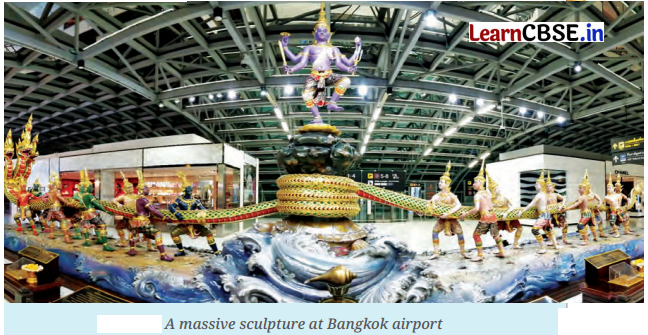
The scene in Fig. 2.21 depicts the well-known Hindu myth of samudra manthana or the churning of the ocean. The devas (gods, on the right here) and the asuras (demons, on the left) decided to join forces to churn the cosmic ocean in search of amrita or the nectar of immortality, with the serpent Vasuki as the churning rope and Vişhnu (above) presiding over the operation – he will eventually deceive the asuras to make sure that the amrita goes to the devas alone. Note also the airport’s official name of ‘Suvarnabhumi Airport’ – does it remind you of something? (Page 51)
Answer:
Yes, the official name of ‘Suvarnabhumi Airport’ reminds us the islands of Java, Sumatra, and Malaya, Indian traders visited these islands in search of gold and other valuable resources that these places to came to be known as “Suvarnabhumi” (the golden land) or “Suvarnadvipa” (the golden island).
Question 3.
Seeing that Tamil is one of Singapore’s official languages, what does this suggest to you about the relationship between south India and Singapore? (Page 53)
Answer:
Tamil is one of Singapore’s official languages. It shows the strong relationship between South India and Singapore.
Singapore shares close cultural and commercial ties with India.
Buddhist monks and traders visited Singapore a few centuries BCE.
Don’t Miss Out
Question 1.
Can the Kartarpur Corridor be a model for the possible progress of peace and dialogue? (Pages 36)
Answer:
Yes, the Kartarpur Corridor can be seen as a small but meaningful step toward peace between India and Pakistan. By allowing Indian Sikh pilgrims to visit a holy site in Pakistan without visas, it shows how shared faith and culture can overcome political barriers. Though larger issues still divide the two nations, the corridor highlights that cooperation in areas of mutual respect can build trust and open the door for dialogue.
India and Her Neighbours Class 7 Solutions (Exercise)
Question 1.
Explain who a maritime neighbour is with two examples with respect to India.
Answer:
Maritime Neighbour is a country that is connected to another country by a shared sea or ocean even without a direct land border.
Two examples with respect to India are Sri Lanka and Thailand.
- SriLanka is maritime neighbour of India. It is situated towards the southeast of India. SriLanka is divided by a narrow stretch of sea known as the Palk Strait.
It is only about 32 km away from India making them a close maritime neighbour. - Thailand is located to the east of India across the Bay of Bengal and the Andaman Sea. They share a maritime boundary.
Thailand is connected with India through Trilateral highway which stretches from Manipur through Myanmar to Thailand.
Question 2.
How has Buddhism created links with India’s neighbours? Give examples to explain your answer.
Answer:
Buddhism created strong cultural and spiritual links between India and her neighbours by spreading teachings, art, and traditions across Asia. From India, Buddhism travelled to Nepal, Bhutan, Sri Lanka, Myanmar, and further into Tibet, China, and Southeast Asia, shaping their societies and beliefs.
For example, Nepal shares close ties with India through Lumbini, the birthplace of the Buddha, while Sri Lanka adopted Buddhism from India in the 3rd century BCE during Emperor Ashoka’s reign, making it central to its culture. Similarly, Bhutan and Tibet developed deep connections with India through Buddhist monasteries and scholars, and Myanmar received Buddhist influence through trade and pilgrimages. These exchanges built bonds of faith, learning, and culture, showing how Buddhism acted as a bridge linking India with its neighbours across history.
Question 3.
What does ‘open border’ policy mean? How does the India-Nepal ‘open border’ policy affect the lives of people living along the border?
Answer:
Open border policy means that people from India and Nepal can visit across the border without a visa or passport.
The Treaty of Peace and Friendship 1950 between India and Nepal opened borders (free movement of people and goods between the nations).
This open border policy between India and Nepal has affected the lives of people significantly. It has enabled people from both the sides to access healthcare, education, employment and maintain family relations. People from Nepal visit India for economic activities, healthcare and education.
The people from both sides create such type of bonding that they make marriage relations too. However, this policy has increased vulnerability to illegal activities. India and Nepal’s government work together to ensure the open border remains safe and take actions on misusers or on illegal activities.
Question 4.
The chapter says, “Being neighbours is not just about geography.” Explain this statement with an example.
Answer:
“Being neighbour is not just about geography”. It is more about historical, cultural and economic connections. It is far beyond the geographical landscape and border. India has cultural and economical (trade) relations with her neighbours from ancient time.
For example:
- China shares a long and strategic relationship shaped by history, geography, culture and politics. Buddhism reached China from India many centuries ago. Many scholars from China visited Indian Schools of learning. Indian scholars carried Buddhist teachings to China.
- India had trade relations with China via ‘Silk route’ during ancient times. Relations between both the countries is still good. Though politically both India and China have many conflicts and issues regarding shared border etc. On the other hand efforts are being made to resolve conflicts through dialogue, border resolution mechanism and trade.
Question 5.
What are the different ways in which India has helped smaller countries in her neighbourhood? Explain with examples.
Answer:
Different ways in which India has helped smaller countries in her neighbourhood.
(i) In Myanmar, India helped to restore the Ananda temple (Bagan) which was damaged by an earthquake and also gifted a 16 feet replica of the Sarnath statue of the Buddha.
(ii) In Afghanistan, India supported the development of education healthcare and infrastructure.
India is also helping Afghanistan in the construction of the Afghan Parliament building and the Zaranj-Delaram Highway which is a great initiative in this direction by India.
(iii) In Maldives, India’s immediate help during, 2004 Tsunami, 2014 water crisis in Male, Maldives and COVID-19 pandemic has helped both the countries build a strong bond, socially, culturally, economically and politically.
Question 6.
How do shared challenges become opportunities for cooperation? Were there examples in this chapter to illustrate this?
Answer:
Shared challenges become opportunities for cooperation.
- Challenges such as: terrorism, security issues, economic disparities, regional instability, climate change and disaster management have turned into opportunities for cooperation between the neighbours.
Examples:
- Disputes and conflicts regarding shared borders and heightened tensions between India and China are being resolved through trade, dialogue, and border resolution mechanisms.
- Kartarpur Corridor in Pakistan is a great opportunity for thousands of Sikh pilgrims to visit the Gurudwara Darbar Sahib in Pakistan.
- Sundarbans National Park’s, it’s protection and management has coordinated India and Bangladesh relations.
- The land border agreement (2018) between India and Myanmar facilitate the cross border movement for people living in border areas.
- India and Indonesia: Strategic cooperation has grown stronger, particularly in maritime security, defence and disaster relief. Both countries share common concerns about piracy, climate change and the protection of sea lanes.
Question 7.
If borders were drawn only by culture and connections, how would the map look different?
Answer:
If borders were drawn only by culture and connections, the map would look completely different. It would look like a complex mosaic rather than the neat lines as in a political map.
- This type of map would represent shared identities, languages, religions, culture and historical connections rather than administrative and legal divisions.
- In reality constructing this type of map would be really a complex and complicated process. In my opinion, it would create conflicts and confusions too.
Question 8.
On blank maps:
(a) Label India’s neighbours.
(b) Draw arrows showing cultural flows (e.g, food, festivals, languages) between India and her neighbours.
(c) Imagine and redraw new “borders of friendship” that connect neighbours through rivers, trade routes, or cultural zones.
(d) Collect pictures of the flags of the countries listed in this chapter and write your observations.
Answer:
(a)

(b) The cultural flow of food, festivals, and languages between India and its neighbours. This exchange is centuries old, shaped by trade, migration, and shared traditions.
Food Exchanges
- India-Nepal: Shared love for dal-bhat (lentils and rice), momos (dumplings), and use of spices like turmeric and cumin.
- India-Bangladesh: Common Bengali cuisine-fish curries, sweets like rasgulla and sandesh, and rice-based dishes.
- India-Pakistan: Mughlai and Punjabi food traditions overlap-biryani, kebabs, parathas, and rich gravies.
- India-Sri Lanka: Exchange of ricebased meals, curries with coconut milk, and snacks like hoppers (appa) and dosas.
- India-Myanmar: Similarities in curries, use of lentils, and Indian-inspired street foods.
- India-Afghanistan: Influence of naan, kebabs, dried fruits, and pulao, which entered North India via trade routes.
Festivals Celebrations
- Diwali: Celebrated in India, Nepal, and among Hindu communities in Sri Lanka and Myanmar.
- Eid: Shared across India, Pakistan, Bangladesh, Afghanistan, and beyond.
- Buddha Purnima: Observed in India, Nepal, Bhutan, Sri Lanka, and Myanmar, reflecting Buddhist heritage.
- Durga Puja: Strongly celebrated in India and Bangladesh, with cultural troupes often crossing borders.
- Holi: Popular in India and Nepal, spreading to communities in Pakistan and Bangladesh.
- Harvest Festivals: Pongal (India-Sri Lanka), Baisakhi (India-Pakistan), and similar agrarian festivals show shared rhythms of rural life.
Language Literature Flow
- Sanskrit Pali: Ancient texts spread to Nepal, Sri Lanka, Myanmar, and Tibet, influencing Buddhist and Hindu traditions.
- Hindi Urdu: Shared across India and Pakistan; Bollywood films and ghazals strengthen linguistic ties.
- Bengali: Common in India (West Bengal, Tripura) and Bangladesh, with shared literary heritage (Tagore, Nazrul).
- Tamil: Spoken in India and Sri Lanka, with deep cultural and literary exchanges.
- Punjabi: Shared between India and Pakistan, especially in poetry and folk songs.
(c) Do it yourself
(d) Do it yourself