Class 8 Science Chapter 11 Keeping Time with the Skies Question Answer
Science Class 8 Chapter 11 Question Answer Keeping Time with the Skies
Keeping Time with the Skies Class 8 Question Answer (InText)
Question 1.
Have you ever seen the Moon during the day? Why do you think it is sometimes possible when the Sun is up? (Page 170)
Answer:
Yes, the Moon can often be seen during the day, especially in its waxing and waning phases. This happens because the Moon reflects sunlight, and during certain phases, it is high enough in the sky while the Sun is also up, making it visible.
Question 2.
Imagine you lived on the Moon instead of Earth. What would you mean by a day, a month, or a year? (Page 170)
Answer:
- A day on the Moon (from one sunrise to the next) would be about 29.5 Earth days.
- A month might be defined by one complete orbit around Earth (which is also about 27.3 Earth days).
- A year is the time the Earth to complete one orbit around the Sun, which you could still observe from the Moon in about 365 Earth days.

Question 3.
What would happen if Earth had two moons instead of one? How would that change the night sky? (Page 170)
Answer:
If Earth had two moons:
- The night sky would be brighter and more dynamic.
- There could be more frequent eclipses.
- The gravitational pull on Earth would be different, possibly affecting tides and even weather patterns.
- The two moons might cross paths, creating fascinating views or even risks of collision over long periods.
Question 4.
If we didn’t have clocks or calendars, how else could we measure time? (Page 170)
Answer:
We could measure time by:
- Observing the position of the Sun (sunrise, noon, sunset).
- Using the phases of the Moon to count months.
- Tracking stars and constellations that change with the seasons.
- Using natural events, like plant flowering or animal behaviour, to mark the passage of time.
NCERT Class 8 Science Chapter 11 Question Answer Keeping Time with the Skies (Exercise)
Keep the Curiosity Alive (Pages 187-189)
Question 1.
State whether the following statements are True or False.
(i) We can only see that part of the Moon which reflects sunlight towards us.
(ii) The shadow of Earth blocks sunlight from reaching the Moon, causing phases.
(iii) Calendars are based on various astronomical cycles which repeat predictably.
(iv) The Moon can only be seen at night.
Answer:
(i) True: We can only see the part of the Moon that reflects sunlight towards Earth.
(ii) False: The Earth’s shadow causes lunar eclipses, not the regular phases of the Moon.
(iii) True: Calendars are based on repeating astronomical events like day-night, Moon phases, and seasons.
(iv) False: The Moon can also be seen during the daytime, depending on its phase and position in the sky.
Question 2.
Amol was born on the 6th of May on a full Moon day. Does his birthday fall on the full Moon day every year? Explain your answer.
Answer:
No, Amol’s birthday does not fall on a full Moon Day every year. This is because the Moon’s phases follow a lunar cycle of about 29.5 days, while the calendar year follows the solar cycle of about 365 days. So, the date of the full Moon changes each year in the Gregorian calendar.
Question 3.
Name two things that are incorrect in the Figure.

Answer:
Two incorrect things are:
- Stars are shown near the Moon during the daytime, which is incorrect because stars are not visible in the daytime sky.
- The Moon’s dark part is shaded incorrectly to show a phase. The shadow in the figure suggests it’s caused by Earth’s shadow, which is not true for regular Moon phases; they are caused by the Moon’s position relative to the Earth and Sun, not a shadow.
Question 4.
Look at the pictures of the Moon in the figure, and answer the following questions.
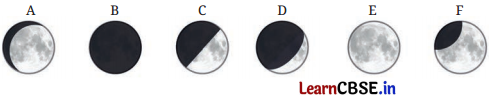
(i) Write the correct panel number corresponding to the phases of the Moon shown in the pictures above.
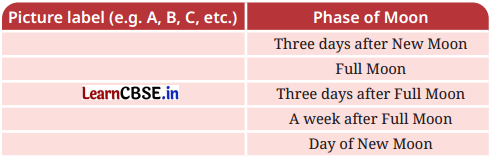
(ii) List the picture labels of the phases of the Moon that are never seen from Earth.
[Hint: You can use your observations from Activity Fig. as a reference.]
Answer:
(i)
| Picture Label | Phase of Moon |
| C | Three days after New Moon |
| E | Full Moon |
| F | Three days after the Full Moon |
| A | A week after the Full Moon |
| B | Day of New Moon |
(ii) Picture B (New Moon phase) is never seen from Earth because the illuminated side of the Moon is facing away from us.
Question 5.
Malini saw the Moon overhead in the sky at sunset.
(i) Draw the phase of the Moon that Malini saw.
(ii) Is the Moon in the waxing or the waning phase?
Answer:
(i) At sunset, the Moon is overhead only during the first quarter (a week after New Moon), when the right half is illuminated. So, we need to draw a half Moon (right half bright, left half dark).

(ii) Waxing phase (because it occurs after New Moon and the bright part is increasing).
Question 6.
Ravi said, “I saw a crescent Moon, and it was rising in the East when the Sun was setting.” Kaushalya said, “Once I saw the gibbous Moon during the afternoon in the East.” Who out of the two is telling the truth?
Answer:
Kaushalya is telling the truth because gibbous Moons can be seen in the East during the afternoon. Ravi’s statement is incorrect because Crescent Moons do not rise in the East at sunset. A crescent Moon appears just after the New Moon (waxing crescent) or just before the New Moon (waning crescent). Waxing crescent is visible after sunset in the western sky, not rising in the east, and waning crescent rises just before sunrise, not at sunset.
Question 7.
Scientific studies show that the Moon is getting farther away from the Earth and slower in its revolution. Will luni-solar calendars need an intercalary month more often or less often?
Answer:
Luni-solar calendars will need an intercalary month more often as the Moon moves farther and slower, and it takes longer to complete a cycle. So, a lunar year becomes even shorter compared to the solar year.
Question 8.
A total of 37 full Moons happen during 3 years in a solar calendar. Show that at least two of the 37 full moons must happen during the same month of the solar calendar.
Answer:
Yes, at least two full Moons must happen in the same solar month.
- A solar calendar has 12 months × 3 years = 36 months.
- 37 full Moons in 36 months, at least one month must have 2 full Moons.
Question 9.
On a particular night, Vaishali saw the Moon in the sky from sunset to sunrise. What phase of the Moon would she have noticed?
Answer:
As the Moon is visible all night long only on a Full Moon, it is a Full Moon.
Question 10.
If we stopped having leap years, in approximately how many years would the Indian Independence Day happen in winter?
Answer:
One leap year adds ~1 day every 4 years.
Without leap years, the calendar shifts by 1 day every 4 years.
There are roughly 183 days between 15 August (monsoon) and winter (mid-February).
183 days × 4 = 732 years
In approximately 730-732 years, 15 August would occur in winter.
Question 11.
What is the purpose of launching artificial satellites?
Answer:
Artificial satellites are launched for:
- Communication
- Navigation
- Weather monitoring
- Scientific research
- Disaster management
- Earth observation
Question 12.
On which periodic phenomenon are the following measures of time based:
(i) day
(ii) month
(iii) year?
Answer:
(i) Day → Earth’s rotation
(ii) Month → Moon’s revolution (phases of the Moon)
(iii) Year → Earth’s revolution around the Sun.
Class 8 Keeping Time with the Skies Question Answer (Activities)
Activity 11.1: Let us Explore (Pages 171-172)
Documenting Changes in the Moon’s Appearance
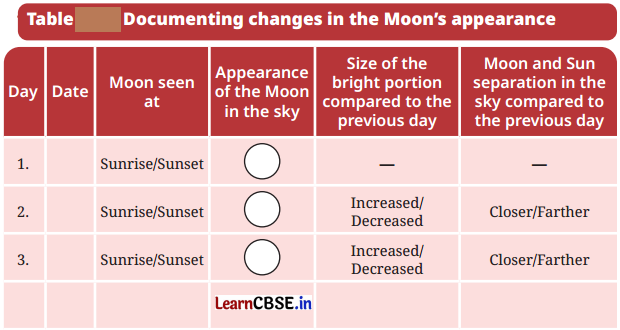
Analysis Questions:
Question 1.
Did the Moon appear different each day?
Answer:
Yes, its visible shape (phase) changed daily.
Question 2.
Was the Moon visible on all days?
Answer:
Yes, during these three days, it was visible at sunrise.
Question 3.
Did the Moon appear at the same position in the sky as on the previous day?
Answer:
No, it appeared closer to the Sun and lower in the sky each day.
Activity 11.2: Let us Measure a Day! (Pages 178-179)
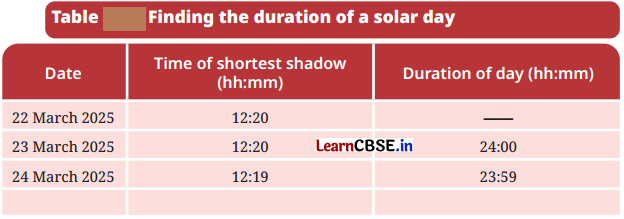
Find the average duration of the day. Is it nearly equal to 24 hours?
Answer:
We calculate the average of 24:00 and 23:59
1. Convert both to minutes:
24:00 = 1440 minutes
23:59 = 1439 minutes
2. Add them: 1440 + 1439 = 2879 minutes
3. Average = 2879 ÷ 2 = 1439.5 minutes
4. Convert back to hours and minutes:
1439.5 minutes = 23 hours 59 minutes and 30 seconds
The average duration of the day = 23 hours 59 minutes 30 seconds, which is nearly equal to 24 hours.