Class 8 Science Chapter 10 Light: Mirrors and Lenses Question Answer
Science Class 8 Chapter 10 Question Answer Light: Mirrors and Lenses
Light: Mirrors and Lenses Class 8 Question Answer (InText)
Question 1.
Can we make mirrors that can give enlarged or diminished images? (Page 152)
Answer:
Yes, we can make mirrors that produce enlarged or diminished images. Specifically, concave mirrors can form both enlarged and diminished images depending on the object’s distance from the mirror, while convex mirrors always produce diminished images.
Question 2.
On the side-view mirrors of vehicles, there is a warning that says “Objects in mirror are closer than they appear”. Why is this warning written there? (Page 152)
Answer:
The warning “Objects in mirror are closer than they appear” is written on the side-view mirrors of vehicles because these mirrors are typically convex. Convex mirrors make objects appear smaller and farther away than they are, which can lead to misjudging distances. The warning is there to alert drivers to this effect and prevent accidents caused by inaccurate distance perception.
Question 3.
Why is there a curved line on some reading glasses? (Page 152)
Answer:
The curved line on reading glasses is due to the convex shape of the lens. These lenses are thicker in the middle and thinner at the edges, causing light rays to converge (bend inward) and improve near vision for individuals with presbyopia. This curvature is essential for correcting the vision by focusing light properly on the retina.
Question 4.
How can we distinguish between concave and convex mirrors? (Page 155)
Answer:
To distinguish between concave and convex mirrors, observe how they reflect light and the images they form. Concave mirrors curve inward, causing parallel light rays to converge at a focal point, and can form both real and virtual images. Convex mirrors curve outward, causing parallel light rays to diverge, and always form virtual, diminished images.

Question 5.
We have observed images formed by three types of mirrors – plane, concave, and convex. But are there any laws that govern the image formation? (Page 157)
Answer:
Yes, some laws govern image formation by mirrors, including plane, concave, and convex mirrors. These laws are based on the laws of reflection, which state that the angle of incidence (the angle at which light hits the mirror) is equal to the angle of reflection (the angle at which light bounces off the mirror). Additionally, the incident ray, the reflected ray, and the normal (an imaginary line perpendicular to the mirror’s surface at the point of incidence) all lie in the same plane.
Question 6.
Are the laws of reflection applicable to spherical mirrors also?
Answer:
Yes, the laws of reflection apply to spherical mirrors. These laws state that the angle of incidence is equal to the angle of reflection, and the incident ray, reflected ray, and normal all lie in the same plane. These laws hold for all types of reflecting surfaces, including spherical mirrors like concave and convex mirrors.
Question 7.
What changes can be seen in the objects when viewed through lenses? (Page 163)
Answer:
When an object is viewed through a lens, several changes can be observed in its image compared to the object itself. The most common changes include alterations in size, orientation, and whether the image is real or virtual. Specifically, concave lenses typically produce diminished, virtual, and upright (erect) images.
Question 8.
Do lenses also converge or diverge the light beam? (Page 163)
Answer:
Yes, lenses can both converge and diverge light beams. Convex lenses converge (focus) light, while concave lenses diverge (spread out) light.
Question 9.
Since a convex lens converges a light beam, can it also burn a paper? (Page 164)
Answer:
Yes. In simple terms, the convex lens acts like a magnifying glass, focusing the sun’s rays and intensifying the heat at a specific spot, which can be enough to ignite a flammable material like paper.
Question 10.
Where are all the lenses used? (Page 165)
Answer:
Lenses are used in a variety of applications, both in everyday life and in scientific instruments. These include eyeglasses, cameras, microscopes, telescopes, and projectors, as well as simple magnifying glasses and spyholes indoors.
NCERT Class 8 Science Chapter 10 Question Answer Light: Mirrors and Lenses (Exercise)
Keep the Curiosity Alive (Pages 166-169)
Question 1.
A light ray is incident on a mirror and gets reflected by it (Figure). The angle made by the incident ray with the normal to the mirror is 40°. What is the angle made by the reflected ray with the mirror?
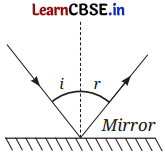
(i) 40°
(ii) 50°
(iii) 45°
(iv) 60°
Answer:
(ii) If the incident ray makes a 40° angle with the normal, then:
Angle of incidence (i) = 40°
According to the law of reflection,
Angle of reflection (r) = Angle of incidence (i) = 40°
Now, Angle between reflected ray and mirror = 90° – angle of reflection
= 90° – 40°
= 50°
Question 2.
The figure shows three different situations where a light ray falls on a mirror:
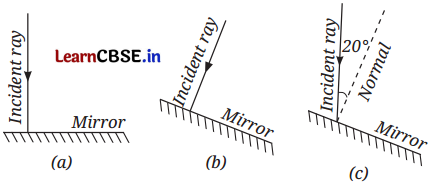
(i) The light ray falls along the normal.
(ii) The mirror is tilted, but the light ray still falls along the normal to the tilted surface.
(iii) The mirror is tilted, and the light ray falls at an angle of 20° from the normal.
Draw the reflected ray in each case (Use a ruler and protractor for accurate drawing). What is the angle of reflection in each case?
Answer:
(i) Light ray falls along the normal
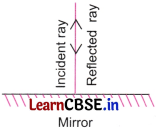
Angle of incidence = 0°
Angle of reflection = 0°
The ray retraces its path. It reflects straight back along the same line.
(ii) The mirror is tilted, but the light ray still falls along the normal to the tilted surface
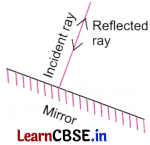
Even though the mirror is tilted, the ray is still perpendicular to the surface.
Angle of incidence = 0°
Angle of reflection = 0°
The ray again retraces its path — the tilt doesn’t affect the reflection if the ray is normal to the surface.
(iii) The mirror is tilted, and the light ray falls at 20° from the normal
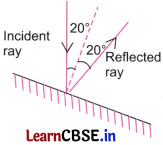
Angle of incidence = 20°
By the law of reflection:
Angle of reflection = 20°
The reflected ray will make a 20° angle with the normal, on the opposite side.
Question 3.
In the Figure, the cap of a sketch pen is placed in front of three types of mirrors.
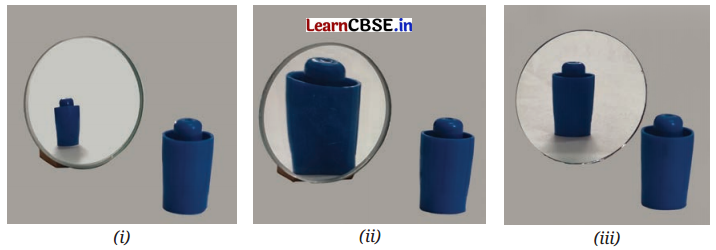
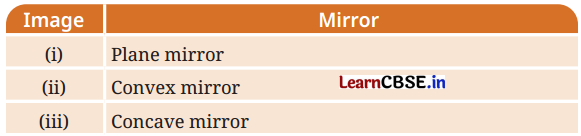
Match each image with the correct mirror.
Answer:
| Image | Mirror |
| Image (i) | Convex mirror |
| Image (ii) | Concave mirror |
| Image (iii) | Plane mirror |
Question 4.
In the Figure, the cap of a sketch pen is placed behind a convex lens, a concave lens, and a flat transparent glass piece —all at the same distance.
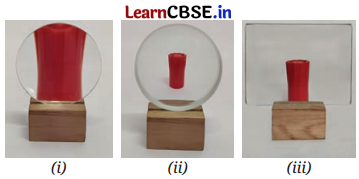
Match each image with the correct type of lens or glass.
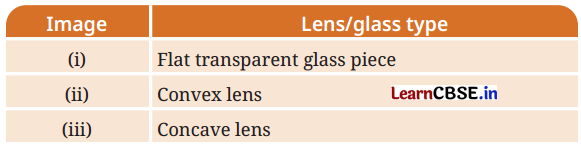
Answer:
| Image | Lens/Glass Type |
| Image (i) | Convex lens |
| Image (ii) | Concave lens |
| Image (iii) | Flat transparent glass piece |
Question 5.
When the light is incident along the normal on the mirror, which of the following statements is true:
(i) Angle of incidence is 90°
(ii) Angle of incidence is 0°
(iii) Angle of reflection is 90°
(iv) No reflection of light takes place in this case
Answer:
(ii) When light hits a surface at a 90° angle (perpendicular), it is considered to be incident normally.
Angle of incidence = Angle of reflection: In reflection, the angle of the reflected light is always equal to the angle of the incident light. Since the light is hitting the mirror normally (at a 0° angle), the reflected light will also be at a 0° angle.
Question 6.
Three mirrors-plane, concave, and convex, are placed in the Figure. Based on the images of the graph sheet formed in the mirrors, identify the mirrors and write their names above the mirrors.
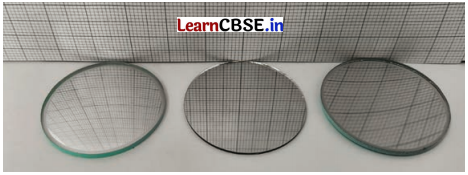
Answer:
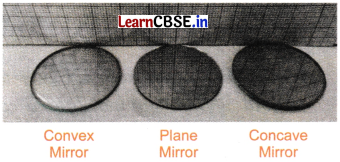
Question 7.
In a museum, a woman walks towards a large convex mirror (Figure). She will see that:
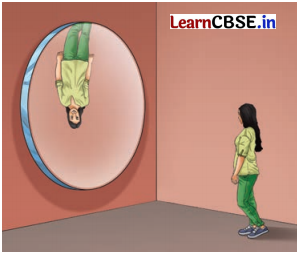
(i) Her erect image keeps decreasing in size.
(ii) her inverted image keeps decreasing in size.
(iii) her inverted image keeps increasing in size, and eventually it becomes erect and magnified.
(iv) Her erect image keeps increasing in size.
Answer:
The correct answer is (i) her erect image keeps decreasing in size. Because a convex mirror always forms a virtual, erect, and diminished image.
Question 8.
Hold a magnifying glass over the text and identify the distance at which you can see the text bigger than they are written. Now move it away from the text. What do you notice? Which type of lens is a magnifying glass?
Answer:
A magnifying glass uses a convex lens to make text appear larger. When we hold the magnifying glass close to the text and then slowly move it away, the image of the text will first appear larger and sharper, then progressively get larger and more blurred, and finally invert and appear smaller again.
Question 9.
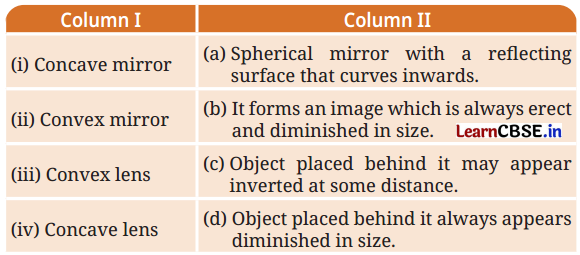
Match the entries in Column I with those in Column II.
Answer:
| Column I | Column II |
| (i) Concave mirror | (a) Spherical mirror with a reflecting surface that curves inwards. |
| (ii) Convex mirror | (b) It forms an image which is always erect and diminished in size. |
| (iii) Convex lens | (c) An object placed behind it may appear inverted at some distance. |
| (iv) Concave lens | (d) The object placed behind it always appears diminished in size. |
Question 10.
The following question is based on Assertion/Reason.
Assertion: Convex mirrors are preferred for observing the traffic behind us.
Reason: Convex mirrors provide a significantly larger view area than plane mirrors.
Choose the correct option:
(i) Both Assertion and Reason are correct, and Reason is the correct explanation for Assertion.
(ii) Both Assertion and Reason are correct, but Reason is not the correct explanation for Assertion.
(iii) Assertion is correct, but Reason is incorrect.
(iv) Both Assertion and Reason are incorrect.
Answer:
(i) Both Assertion and Reason are correct, and Reason is the correct explanation for Assertion.
Question 11.
In the Figure, note that O stands for object, M for mirror, and I for image.
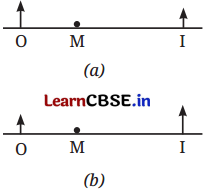
Which of the following statements is true?
(i) Figure (a) indicates a plane mirror, and Figure (b) indicates a concave mirror.
(ii) Figure (a) indicates a convex mirror and Figure (b) indicates a concave mirror.
(iii) Figure (a) indicates a concave mirror and Figure (b) indicates a convex mirror.
(iv) Figure (a) indicates a plane mirror, and Figure (b) indicates a convex mirror.
Answer:
(ii) Figure (a) indicates a convex mirror and Figure (b) indicates a concave mirror.
Question 12.
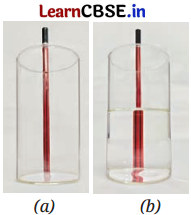
Place a pencil behind a transparent glass tumbler (Figure a). Now fill the tumbler halfway with water (Figure b). How does the pencil appear when mewed through the water? Explain why its shape appears changed.
Answer:
When we place a pencil behind a transparent glass tumbler and fill the tumbler halfway with water, the pencil will appear to be bent or broken at the point where it enters the water. The submerged portion of the pencil might also appear slightly thicker or shifted from its actual position. This phenomenon is called refraction of light.
Why it Happens
Change in medium: Light travels at different speeds in different materials (media). Air is an optically rarer medium, meaning light travels faster in it, compared to water, which is an optically denser medium where light travels more slowly.
Bending of Light (Refraction): When light rays from the pencil travel from the water (denser medium) into the air (rarer medium) and then into our eyes, their speed changes. This change in speed causes the light rays to bend or deviate from their original path. Specifically, when light goes from a denser medium to a rarer medium, it bends away from the normal (an imaginary line perpendicular to the surface at the point where light enters the new medium).
Apparent Position: Because our brains interpret light rays as traveling in straight lines, the bending of light at the water-air interface makes the submerged part of the pencil appear to be at a different location than its actual position, creating the illusion of a bent or broken pencil. The extent of this bending depends on the angle at which we view the pencil and the difference in optical density between the two media (water and air). If we view the pencil straight from above, we won’t observe the bending as the light rays would be traveling perpendicular to the surface, and refraction would be minimal.