Class 8 Science Chapter 8 Nature of Matter: Elements, Compounds, and Mixtures Question Answer
Science Class 8 Chapter 8 Question Answer Nature of Matter: Elements, Compounds, and Mixtures
Nature of Matter: Elements, Compounds, and Mixtures Class 8 Question Answer (InText)
NCERT Probe and Ponder Questions (Page 116)
Question 1.
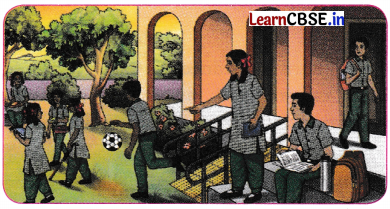
Which of the entities in the picture below consists of matter, and which of them do not?
Answer:
Entities that consist of matter are school buildings, students, trees, metal railings, footballs, school bags, books, water bottles, lunch boxes, and the clothes of students, etc.
Entities that do not consist of matter are light, sound, heat etc.
Question 2.
How can elements be combined to form a compound?
Answer:
A compound is a unique substance that forms when two or more elements combine chemically. Compounds form as a result of chemical reactions. The elements in compounds are held together by chemical bonds.

Question 3.
How could the discovery of a compound that absorbs carbon dioxide from the air contribute to solving environmental challenges?
Answer:
A compound that effectively absorbs carbon dioxide (CO2) from the air could significantly help mitigate climate change and other environmental challenges. Removing CO2, a major greenhouse gas, from the atmosphere could reduce global warming, ocean acidification, and other harmful effects associated with excess atmospheric CO2.
NCERT Class 8 Science Chapter 8 Question Answer Nature of Matter: Elements, Compounds, and Mixtures (Exercise)
Keep the Curiosity Alive (Pages 131-132)
Question 1.
Consider the following reaction where two substances, A and B, combine to form a product C:
A + B → C
Assume that A and B cannot be broken down into simpler substances by chemical reactions. Based on this information, which of the following statements is correct?
(i) A, B, and C are all compounds, and only C has a fixed composition.
(ii) C is a compound, and A and B have a fixed composition.
(iii) A and B are compounds, and C has a fixed composition.
(iv) A and B are elements, C is a compound, and has a fixed composition.
Answer:
(iv) A and B are elements, C is a compound, and has a fixed composition.
The question states that A and B cannot be broken down into simpler substances by chemical reactions. This means A and B are elements, because elements are pure substances made of only one kind of atom and cannot be broken down chemically. When A and B combine chemically to form C, the result is a compound. A compound is formed when two or more elements combine in a fixed ratio through a chemical reaction. Therefore, A and B are elements, and C is a compound with a fixed composition.
Question 2.
Assertion: Air is a mixture.
Reason: A mixture is formed when two or more substances are mixed, without undergoing any chemical change.
(i) Both Assertion and Reason are true and Reason is the correct explanation for Assertion.
(ii) Both Assertion and Reason are true, but Reason is not the correct explanation for Assertion.
(iii) Assertion is true, but Reason is false.
(iv) Assertion is false, but Reason is true.
Answer:
(i) Both Assertion and Reason are true and Reason is the correct explanation for assertion.
Air is indeed a mixture because it is composed of various gases like nitrogen, oxygen, and carbon dioxide, which are mixed without any chemical reaction between them. The properties of these individual gases are retained within the air.
Question 3.
Water, a compound, has different properties compared to those of the elements oxygen and hydrogen from which it is formed. Justify this statement.
Answer:
Water has properties which is completely different from hydrogen and oxygen. Like water is liquid in form, whereas hydrogen (H) and oxygen (O) are gases. This is because a compound’s properties depends on its molecular structure.
Question 4.
In which of the following cases are all the examples correctly matched? Give reasons in support of your answers.
(i) Elements – water, nitrogen, iron, air.
(ii) Uniform mixtures – minerals, seawater, bronze, air.
(iii) Pure substances – carbon dioxide, iron, oxygen, sugar.
(iv) Non-uniform mixtures – air, sand, brass, muddy water.
Answer:
(iii) Pure substances – Carbon dioxide, iron, oxygen, and sugar are all pure substances. (Correctly matched).
A pure substance is composed of only one type of particle. Carbon dioxide, iron, and oxygen are all elements, meaning they are made up of only one type of atom. Sugar is a compound, but it is still considered a pure substance because it consists of only one type of molecule.
Question 5.
Iron reacts with moist air to form iron oxide, and magnesium burns in oxygen to form magnesium oxide. Classify all the substances involved in the above reactions as elements, compounds, or mixtures, with justification.
Answer:
Iron reacts with moist air to form iron oxide
Iron (Fe) + Oxygen (O2) + Water (H2O) → Iron Oxide (Fe2O3)
Magnesium burns in oxygen to form magnesium oxide
Magnesium (Mg) + Oxygen (O2) → Magnesium Oxide (MgO)
Classification of Substances
| Substance | Type | Justification |
| Iron (Fe) | Element | A pure substance made of one kind of atom; it cannot be broken down chemically. |
| Magnesium (Mg) | Element | Pure metal element; basic building block of matter. |
| Oxygen (O2) | Element | Diatomic gas: a pure substance made of oxygen atoms. |
| Water (H2O) | Compound | Chemically combined hydrogen and oxygen in a fixed ratio. |
| Iron Oxide (Fe2O3) | Compound | Formed by a chemical reaction between iron and oxygen, has new properties. |
| Magnesium Oxide (MgO) | Compound | Formed by a chemical reaction between magnesium and oxygen. |
| Moist Air | Mixture | Contains gases like oxygen, nitrogen, water vapor; not chemically combined. |
Question 6.
Classify the following as elements, compounds, or mixtures in the Table.
Carbon dioxide, sand, seawater, magnesium oxide, muddy water, aluminum, gold, oxygen, rust, iron sulfide, glucose, air, water, fruit juice, nitrogen, sodium chloride, sulfur, hydrogen, and baking soda.

Identify pure substances amongst these and list them below.

Answer:
| Elements | Compounds | Mixtures |
| Aluminium | Carbon Dioxide (CO2) | Sand |
| Gold | Magnesium Oxide (MgO) | Seawater |
| Oxygen | Rust (Fe2O3) | Muddy Water |
| Nitrogen | Iron Sulfide (FeS) | Air |
| Sulfur | Glucose (C6H12O6) | Fruit Juice |
| Hydrogen | Water (H2O) | |
| Sodium Chloride (NaCl) | ||
| Baking Soda (NaHCO3) |
Pure Substances: Aluminium, gold, oxygen, nitrogen, sulfur, hydrogen, carbon dioxide, magnesium oxide, iron sulfide, glucose, water, sodium chloride, baking soda.
Question 7.
What new substance is formed when a mixture of iron filings and sulfur powder is heated, and how is it different from the original mixture? Also, write the word equation for the reaction.
Answer:
When iron filings and sulfur powder are heated, they react to form a new substance called ferrous sulfide (FeS), also known as iron sulfide. This is a chemical change, and the resulting compound has different properties from the original iron and sulfur. The word equation for the reaction is: Iron + Sulfur → Ferrous Sulfide.
Original Mixture
Iron filings and sulfur powder are physically mixed. They retain their individual properties, and the mixture can be separated by physical means like using a magnet to attract the iron.
Ferrous Sulfide (FeS)
Heating the mixture causes a chemical reaction. Iron and sulfur combine to form a new substance, ferrous sulfide. This is a compound, meaning the atoms are chemically bonded.
Difference in Properties
Ferrous sulfide has its unique properties that are distinct from those of iron and sulfur. For example, it is a black solid, whereas iron is typically gray, and sulfur is yellow. It is also not attracted to magnets like iron.
Word equation
The word equation for the reaction is Iron + Sulfur → Ferrous Sulfide
Question 8.
Is it possible for a substance to be classified as both an element and a compound? Explain why or why not.
Answer:
No, a substance cannot be classified as both an element and a compound. Elements are pure substances that cannot be broken down into simpler substances by chemical means, while compounds are formed when two or more different elements are chemically bonded together. The defining characteristic of a compound is that it is composed of multiple elements, whereas an element is a single type of atom. Therefore, a substance cannot be both a single type of atom and a combination of different types of atoms simultaneously.
Question 9.
How would our daily lives be changed if water were not a compound but a mixture of hydrogen and oxygen?
Answer:
Water’s role in life and nature depends on it being a compound with stable properties. If it were a mixture, it would be dangerous and unusable, making life as we know it impossible.
Impact on Daily Life
- No safe drinking water → Life would not be possible.
- No water for agriculture → Crops would not grow.
- No water for cleaning or cooking → Daily tasks would be unsafe.
- No aquatic life → Fish and underwater plants would die.
- Increased fire hazards → Hydrogen and oxygen together are explosive.
Question 10.
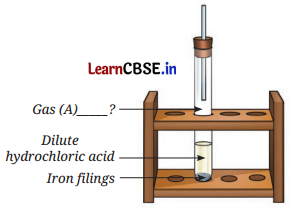
Analyse the figure. Identify Gas A. Also, write the word equation of the chemical reaction.
Answer:
By analysing the figure, it is found that there will be a chemical reaction inside the test tube between dilute HCl and Fe.
2HCl + Fe → FeCl2 + H2 ↑
So the reaction forms Iron Chloride (FeCl2) and the gas above will be Hydrogen (H2).
Hydrochloric Acid + Iron filing → Iron Chloride + Hydrogen (g)
Thus, Gas A = Hydorgen
Question 11.
Write the names of any two compounds made only from non-metals, and also mention two uses of each of them.
Answer:
1. Carbon Dioxide (CO2)
Made of: Carbon and Oxygen (both non-metals)
Uses:
- Used in fire extinguishers to put out flames.
- Used by plants during photosynthesis to make food.
2. Sulfur Dioxide (SO2)
Made of: Sulfur and Oxygen (both non-metals)
Uses:
- Used as a preservative in dried fruits and wines.
- Used in the manufacture of sulfuric acid, an important industrial chemical.
Question 12.
How can gold be classified as both a mineral and a metal?
Answer:
A mineral is a naturally occurring substance with a definite chemical composition.
Gold is found in nature in its native form, often embedded in rocks or alluvial deposits. It is extracted through mining, making it a metallic mineral. Minerals like gold are formed by natural geological processes.
Gold as a Metal
After extraction, gold is refined and used as a metal. It is a pure element (symbol: Au) with typical metallic properties:
- Lustrous (shiny)
- Malleable (can be shaped)
- Ductile (can be drawn into wires)
- Good conductor of electricity
- Used in jewelry, electronics, and currency.