Class 5 English Chapter 2 Around The World Questions From Textbook Solved
Reading is Fun
Question 1.
Which tribe of Red Indians attacked the travellers?
रेड इंडिअन्स के किस कबीले ने यात्रियों पर आक्रमण किया?
Answer:
The Sioux tribe of Red Indians attacked the travellers.
Question 2.
Which was the highest point of their journey?
उनकी यात्रा का उच्चतम बिन्दु कौन-सा था?
Answer:
The highest point of their journey was 7524 feet above the sea level.
Question 3.
Why did the train stop the first time?
ट्रेन पहली बार क्यों रुकी?
Answer:
The train stopped the first time when a herd of buffaloes began to cross the railway track.
Question 4.
How many days would it take for the train to reach New York?
न्यूयार्क पहुँचने में ट्रेन को कितने दिन लगेंगे?
Answer:
The train would take seven days to reach New York.
Question 5.
Tick the correct answer.
सही उत्तर पर निशान लगाएं।
(i) The first time the train stopped was because
(a) some robbers stopped the train.
(b) a herd of buffaloes was passing.
(c) the tracks were broken.
(ii) The bridge fell with a crash into the river.
(a) after the train had passed through.
(b) the train was still on the bridge.
(c) before the train passed over the bridge.
Answer:
(i) (b)
(ii) (a)
Question 6.
Match the following words with their meanings.
You can take the help of a dictionary.
निम्नलिखित शब्दों का उसके अर्थ के साथ मिलान करें। आप शब्दकोश की सहायता ले सकते हैं।
halted people travelling in buses, trains etc.
passengers stopped
defended completely
shuddered many times
several occasions trembled or shook violently
interruption break the continuity of
entirely protected from attack
Answer:
halted stopped
passengers people travelling in buses, trains, etc.
defended protected from attack
shuddered trembled or shook violently
several occasions many times
interruption break the continuity of
entirely completely
Word Building
Question 1.
Read the following sentences.
निम्नलिखित वाक्यों को पढ़ें।
- The train steamed forward at full speed.
- The train headed for the steep mountains.
Find five more such words from the lesson.
पाठ से ऐसे पाँच और शब्द खोजें।
Answer:
crossed, charged, passed, reversed, shrieked
Question 2.
From the text find three more describing words like the ones given below in the example.
उदाहरण में दिए गए वर्णनात्मक शब्दों की भांति तीन और शब्द खोजें।
Answer:
Steep mountain slopes shrill whistle
Deep canyons maximum speed
Hair raising curves. raging waters
Question 3.
Find the opposites of the following words from the text.
पाठ से निम्न शब्दों के विपरीत शब्द खोजें।
Answer:
(i) Minimum speed maximum speed
(ii) Moved forward reversed
(iii) Disappeared appeared
(iv) Closed opened
(v) Lowest highest
Question 4.
In the lesson you will find many words that describe sounds like whistling, roaring, braking, crashing, raging.
Can you list the things these sounds are related to?
पाठ में आपको बहुत-से शब्द मिलेंगे जो whistling, roaring, braking, crashing, raging, जैसी आवाज वाले शब्दों का वर्णन करते हैं। क्या आप उनकी सूची बना सकते हैं जिनसे ये आवाज संबंधित हैं?
Sounds Things associated
whistling wind, policeman
roaring lion, gun
braking car, truck
crashing aeroplane
raging waters, storm
Let’s Talk
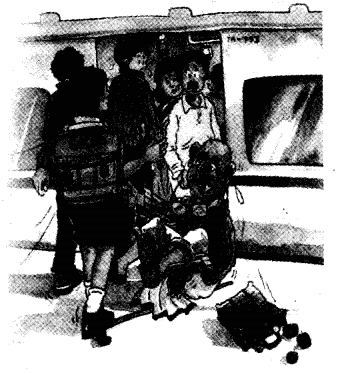
1. See the picture of the people climbing on the train. We notice that most of the time we do not wait for the other people to get off the train before boarding it, causing inconvenience to others.
2. Discuss with your partner the manner in which you conduct your-self while interacting with others.
Answer:
Do it yourself.
Reading a Map
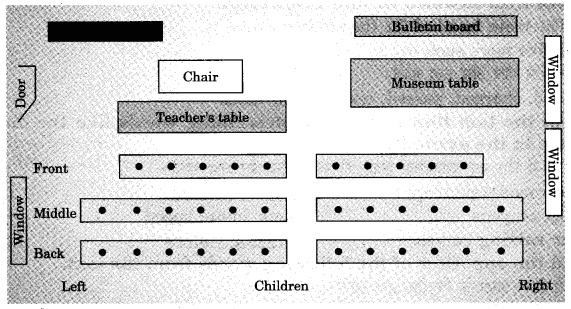
Look at the view of the classroom from above. Now answer the following. You can use words like front, back, left and right.
ऊपर से कक्षा के दृश्य का अवलोकन करें। अब निम्नलिखित का उत्तर दें। आप front, back, left और right जैसे शब्दों का प्रयोग कर सकते हैं।
1. How many doors and windows are there in the classroom?
2. Where are the blackboard and the cupboard?
3. How many rows of desks are there in the middle and back rows?
Answer:
1. There are two windows on the right side and one window and one door on the left side.
2. The blackboard is in front of the classroom on the left side.
3. There are two rows of desks in the middle and two in the back rows.
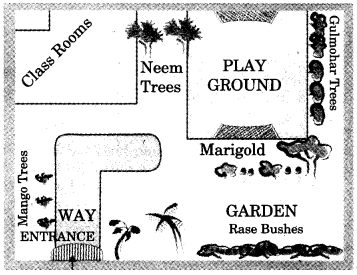
1. There are ________ trees between the classroom and the playground.
2. The ________ trees line the passage from the entrance.
3. Many ________ trees are along the side of the playground.
Answer:
1. neem
2. mango
3. Gulmohar
Use the side map to answer the questions.
परोक्त मानचित्र का प्रयोग कर प्रश्ननें का उतर दें |
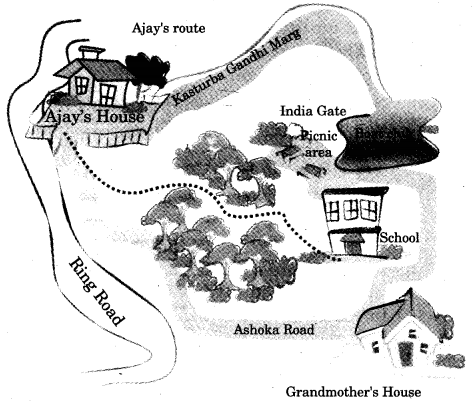
1. What does the dotted line on the map show?
2. What road would Ajay take to get to the boat club?
3. What building is next to the picnic area?
4. What road passes by Ajay’s house?
5. What other way could Ajay use to get from his house to his grandmother’s house?
Use verbs like: go, turn, cross
Use prepositions like: across, between, in front of, beside, near, behind
Answer:
1. Route from Ajay’s house to his school.
2. Kasturba Gandhi Marg.
3. India Gate.
4. Ring Road.
5. Ajay could take Ashoka Road to get his grandmother’s house from his house. He could go through Kasturba Gandhi Marg. From that road he could reach Boat club. Then he could go across the picnic area. From there he could turn right after walking a few steps and reach his grandmother’s house.
Let’s Listen
Do you like to float paper boats?
क्या आपको कागज की नावें तैराना अच्छा लगता है?
Listen to the poem given below.
Day by Day I Float My Paper Boats
Day by day I float my paper boats
one by one down the running stream,
In big black letters I write my name on them
and the name of the village where I live,
I hope that someone in some strange
land will find them and know who I am,
I load my little boats with shiuli flowers from our graden,
And hope that these blooms of the dawn will be carried safely
to land in the night.
Rabindra Nath Tagore
(i) Discuss with your partner how you would send a similar message to someone.
अपने साथी से चर्चा करें कि कैसे आप किसी को इसी तरह का संदेश भेजेंगे?
(ii) Also find out how people sent messages in olden days and how they send them nowadays.
यह भी पता करें कि कैसे लोग पुराने जमाने में संदेश भेजा करते थे और आजकल कैसे भेजते हैं?
Answer:
(i) I would write a similar message on a piece of thin paper. Then I would wrap it in small polybag and send it.
(ii) In olden days they sent messages through messengers and pigeons.
Nowadays messages are sent by post, telephones, mobile phones and e-mails.
Let’s Write
Question 1.
See the picture Travel Time below. Answer the questions that follow.
(i) Where did you go for an excursion/holiday?
(ii) With whom did you go?
(iii) What did you take with you?
(iv) What was the first thing you saw when you reached your destination?
(v) What did you like best about the place?
(vi) How long did you stay there?
(vii) What did you miss about home?
Answer:
(i) Shimla.
(ii) Parents and siblings.
(iii) Warm clothes, some eatables, camera, medicines, etc.
(iv) Tall mountains.
(v) Climate, natural scenery etc.
(vi) Three days.
(vii) Home-made foods.
Question 2.
Make sentences using any two new words which you have learnt in the lesson.
Answer:
(i) Suspension bridge—I got thrilled while crossing through the suspension bridge.
(ii) Defended—Policemen arrived in time and defended the poor boy from the criminals.
Question 3.
Which do you think would be more fun-travelling by aeroplane or sailing on a ship? Write why you think so.
आपके विचार में कौन-सा ज्यादा मजेदार होगा हवाई जहाज से यात्रा करना या समुद्री जहाज से?
Answer:
Sailing on a ship would be more fun because I love to be in the touch of water.
Question 4.
Look at the following words. There are group names:
troop of soldiers swarm of bees
team of players litter of puppies
fleet of ships library of books
Question 5.
Fill in the blanks choosing group words from box.
| clump cluster choir bunch flock band |
बॉक्स से शब्द समूह चुनकर रिक्त स्थानों को भरें।
(i) The travellers rested under the _______ of trees
(ii) The _______ sang beautifully.
(iii) The _______ of flowers was lying on the table.
(iv) The girl looked up at the _______ of stars.
(v) The _______ of robbers escaped.
(vi) The hunter shot at the _______ of birds.
Answer:
(i) clump
(ii) choir
(iii) bunch
(iv) cluster
(v) band
(vi) flock
Question 6.
Some words describe actions. Many of them end in -ly.
कुछ शब्द कार्यों का वर्णन करते हैं। उनमें से बहुतों का अंत -ly से होता है।
The girl danced beautifully.
Fill in the blanks by changing the word in the brackets suitably.
(i) The girl slept _______ (sound)
(ii) The children finished their work _______ [quick]
(iii) The old man shouted _______ [loud]
(iv) The boys played _______ [quiet]
(v) Do your work _______ [neat]
(vi) I can do the sum _______ (easy)
Answer:
(i) soundly
(ii) quickly
(iii) loudly
(iv) quietly.
(v) neatly
(vi) easily.
Fun Time
Question 1.
Which country would you like to visit when you grow up?
Make a project by drawing or pasting.
(i) a map of that country, its national flag
(ii) stamps of the country, its currency
(iii) some famous monuments or landmarks
Answer:
Do it yourself.
Question 2.
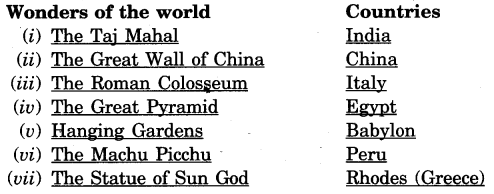
Do you know that there are seven wonders in the world?
Can you tell the name of the one which is in India?
Find out and write the names of all the seven wonders and the countries they are located in.
Fun With Sounds
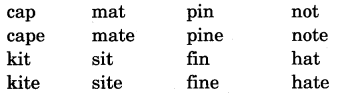
When an e is added to some words, the words change along with their sounds and meanings.
Answer:
Do it yourself.
Around The World Summary In English
‘Around the World’ is a story about Mr. Phileas Fogg and his journey of the world with his companion Passepartout.
They started their journey from San Fransisco to New York, which was three thousand seven hundred and eighty six miles away. The train crossed many steep mountain slopes, deep canyons, curves, tunnels and bridges. Suddenly the train stopped when a herd of buffaloes came on the trade. The herd took a full three hours to cross the tracks. The train began to move again and headed for steep mountains. This was the most different part of the journey with its winding roads. They passed the highest point of their journey, 7524 feet above sea level. In a few hours they came out of the Rocky Mountains. The train stopped once again when the suspension bridge on Medicine River had some of its cables broken. However, the driver crossed it at maximum speed.
Next day when the train was moving forward, it was suddenly attacked by hundreds of Scour Indians. But they fled away when they saw soldiers rushing towards them.
Around The World Summary In Hindi
Around the world’ मि. फिलिआस फॉग और उसकी अपने साथी पासपरत के साथ दुनिया की सैर की कहानी है। उन्होंने सैन फ्रान्सिसको से न्यूयार्क तक यात्रा की जो तीन हजार सात सौ और छियासी मील दूर था। ट्रेन खड़ी पर्वतीय ढलानों और गहरी घाटियों, मोड़ों, सुरंगों और पुलों से गुजरा। अचानक ट्रेन रुक गई जब भैंसों की एक झुण्ड पटरी पर आ गई। झुण्ड को पटरी पार करने में पूरे तीन घंटे लग गए। ट्रेन फिर से चल पड़ी और खड़ी चढ़ाई वाले पर्वतों की ओर बढ़ी। घुमावदार सड़कों वाली यात्रा का यह सबसे मुश्किल भाग था। वे अपनी यात्रा के सबसे ऊँचे स्थान, जो समुद्रतल से 1524 फुट ऊपर था, से गुजरे। कुछ ही घंटों में वे पथरीले पहाड़ों से शहर आ गए। ट्रेन एक बार फिर रुकी जब मेडिसिन नदी पर बने झूला पुल के मोटे रस्से टूट गए। लेकिन ड्राइवर अधिकतम गति के सहारे उसे पार कर लिया।
दूसरे दिन जब ट्रेन आगे बढ़ रही थी, सैकड़ों सिओक्स इंडियंस ने उस पर आक्रमण कर दिया। लेकिन जैसे ही उन्होंने | सिपाहियों को अपनी ओर तेजी से बढ़ते देखा, वे भाग खड़े हुए।
Class 5 English Chapter 2 Around The World Hindi Translation Of The Lesson
1. Mr. Phileas Fogg lays a bet with some of his friends to go around the world in 80 days. This is the story of how he travelled with his companion, Passepartout. That evening they were on the train from San Fransisco to New York, which was three thousand seven hundred and eighty six miles away. In seven days the train would take them from the Pacific to the Atlantic Ocean. The train steamed through California at full speed. It crossed steep mountain slopes, deep canyons and hair-raising curves moving through a few tunnels and bridges.
Word-Meanings-Bet (बेट)–शर्त, बाजी। Companion (कम्पेनियन)-friend, साथी। Steamed (स्टीम्ड)-passed, गुजरी। Canyons (केयन्ज)-passes, घाटियाँ। Tunnels (टनेल्स)underground passage, सुरंग।
अनुवाद : मि. फिलिआस ने अपने कुछ मित्रों से 80 दिनों में पूरी दुनिया की यात्रा करने की शर्त रखी। यह कहानी है कैसे उसने अपने मित्र पासपरतू के साथ यात्रा की।
उस शाम वे सैन फ्रांसिस्को से न्यूयार्क जाने वाली ट्रेन में थे जो तीन हजार सात सौ और छियासी मील दूर था। सात दिनों में ट्रेन उनको प्रशांत महासागर से अटलांटिक महासागर को ले जाएगी।
ट्रेन कैलिफोर्निया से पूरी गति से गुजरी। उसने खड़ी पर्वतीय ढलानों, गहरी घाटियों और रोंगटे खड़े करने वाले मोड़ों, कुछ सुरंगों और पुलों से गुजरते हुए पार किया।
2. Suddenly the train slowed down as a herd of buffaloes charged across the railway track. The train was forced to stop till the procession passed like a great brown river. The herd took a full three hours to cross the tracks. Night had fallen by the time the train could move again.
The train headed for the steep mountains. This was the most difficult part of the journey with its winding roads. They passed the highest point of their journey, 7524 feet above sea level. In a few hours they would be out of the Rocky Mountains.
After the passengers had taken their breakfast the train gave a shrill whistle and braked with a jerk and came to a halt. Passepartout, a French passenger went to see what the matter was. There was nothing to be seen. The train had halted in the middle of nowhere. There was no station in sight.
Word-Meanings-Procession (प्रोशेसन) जुलूस। Steep (स्टीप)-sloping sharply, तेज ढाल। Shrill (शिल)-piercing, कर्कश। Jerk (जर्क)–झटका। Halted (हॉल्टेड)-stopped, रुका।
अनुवाद : अचानक ट्रेन की गति धीमी हो गई क्योंकि भैंसों के एक झुण्ड ने रेल की पटरी पर धावा बोल दिया। ट्रेन को रुकने के लिए विवश होना पड़ा तब तक जब तक कि उनका झुण्ड (जुलूस) एक विशाल भूरी नदी की तरह गुजर नहीं गया। भैंसों के झुण्ड को पूरे तीन घंटे पटरी पर पार करने में लगे। जब तक ट्रेन फिर से चले, रात हो गई। ट्रेन खड़ी चढ़ाई वाले पहाड़ों की ओर बढ़ी। घुमावदार सड़कों वाली यात्रा का यह सबसे मुश्किल भाग था। वे अपनी यात्रा के सबसे ऊँची बिन्दु, जो समुद्र तल से 7524 फीट ऊपर थी, से गुजरे। कुछ ही घंटों में वे पथरीले पहाड़ों के बाहर आ गए।
यात्रियों के नाश्ता करने के बाद ट्रेन ने कर्कश सीटी बजाई और झटके के साथ रुक गई। पासपरतू, एक फ्रांसीसी यात्री, देखने चला गया कि बात क्या है। वहां कुछ भी दिखाई नहीं दे रहा था। ट्रेन एक सुनसान स्थान में रुकी थी। वहाँ कोई स्टेशन नहीं था।
3. He heard the signalman say. “The train can’t go on. The bridge near Medicine Bow won’t support the weight.” It was a suspension bridge and some of its cables were broken.
The driver of the train said, “Perhaps there is a chance of getting across the bridge by letting the train proceed at maximum speed.”
“All aboard,” said the conductor. The passengers got on the train and the driver reversed the train for nearly a mile. Then he gave another whistle. The train began to move forward so fast that it was frightening. The passengers had the feeling that the train was not resting on the tracks but was floating through air. As the engine shrieked and the train shuddered they were over the bridge in a flash!
As soon as they passed over the Medicine River, the bridge crashed down into the raging waters below. The train continued its course that evening without interruption.
Word-Meanings-Suspension bridge (सस्पेंसन ब्रिज)—झूला पुल। Perhaps (परहैप्स)शायद। Reversed (रिवर्ड)-पीछे ले गया।
अनुवाद : उसने सिग्नल वाले आदमी को कहते सुना, “ट्रेन आगे नहीं जा सकती है। मेडिसिन बाउ के पास वाला पुल भार को सहन नहीं कर सकेगा।” यह झूला पुल था और इसके कुछ मोटे रस्से टूटे हुए थे।
ट्रेन का ड्राइवर बोला, “शायद ट्रेन को अधिकतम गति से बढ़ाने पर पुल को पार करना आसान हो जाए।” कन्डक्टर ने कहा, “सभी ट्रेन में स्थान ग्रहण करें और ड्राइवर ट्रेन को करीब एक मील पीछे ले गया। उसके बाद उसने दूसरी सीटी दी। ट्रेन इतनी तेज गति से चलने लगी कि भय लगता था। यात्रियों को ऐसा एहसास होने लगा कि ट्रेन पटरी पर टिकी हुई नहीं है वरन् हवा में तैर कर आगे बढ़ रही है। जैसे ही इंजन ने चीख मारी और ट्रेन हिली, वे क्षणभर में पुल पार कर लिए। ज्यों ही उन्होंने मेडिसिन नदी को पार किया, पुल टूटकर नीचे तीव्र गति से बहते पानी में जा गिरा। ट्रेन उसे शाम बिना किसी व्यवधान के आगे बढ़ती गई।
4. As the train moved forward the next day, it was suddenly attacked by hundreds of Sioux Indians (a tribe of native Red Indians). Many of them appeared from all sides, jumped on to the moving train and pulled themselves up the steps. They were armed with rifles. Some of the travellers had revolvers. They defended themselves bravely by answering with pistol shots.
The conductor cried out, “The train must be stopped or we are lost!” “I will go,” said Passepartout. He opened a door and unseen by the Red Indians he slipped under the racing train, and holding on to the chains he slowly reached the engine. Then he separated the engine from the coaches. They started to slow down. They had neared a station where soldiers, attracted by the sound of shots, hurried towards the train. The Red Indians on board saw them and quickly jumped off before the train stopped entirely.
Word-Meanings-Defended (डिफेन्डेड)-saved, बचाए। Racing (रसिंग)-running, दौड़ते हुए। Hurried (हरिड)—rushed, दौड़े। Entirely (इनटायलिं)–completely, पूरी तरह से।
अनुवाद : अगले दिन जब ट्रेन आगे बढ़ रही थी, उस पर हठात् सैकड़ों सिओक्स इंडिअन्स (रड इंडिअन्स की एक स्थानीय कबीला) ने धावा बोल दिया। उनमें से कई सभी तरह से आ गए, चलती ट्रेन पर कूद गए और पायदानों तक अपने को खींच लिए। वे सभी राइफल से लैश थे। कुछ यात्रियों के पास रिवाल्वर थे। उन्होंने बड़ी बहादुरी से पिस्तौल की गोलियां चलाकर अपनी रक्षा की।
कन्डक्टर चिल्ला उठा, “ट्रेन को रोक दो अन्यथा हम लोग मारे जायेंगे।” “मैं जाऊँगा”, पासपरतू ने कहा। उसने एक दरवाजा खोला और रेड इंडिअन्स की नजरों से बचकर चलती ट्रेन के नीचे फिसल गया और जंजीर को पकड़े हुए। धीरे-धीरे इंजन तक पहुँच गया। फिर उसने इंजन को डिब्बों से अलग कर दिया। धीरे-धीरे उनकी गति कम पड़ने लगी।
वे एक स्टेशन के समीप पहुँच गए थे जहाँ सिपाही गोलियों की आवाज सुनकर ट्रेन की ओर दौड़ पड़े थे। ट्रेन में सवार रेड इंडिअन्स ने उन्हें देखा और उसके पूरी तरह रुकने से पहले ही छलांग लगाकर ट्रेन से उतर गए।
NCERT Solutions for Class 5 English