.
Class 5 EVS Chapter 5 Our Vibrant Country Question Answer
Our Vibrant Country Class 5 EVS Question Answer
Our Wondrous World Class 5 EVS Chapter 5 Question Answer – Class 5 EVS Our Vibrant Country Question Answer
Write (Pages 76-78)
Question 1.
What special events or activities take place at your school on the occasion of Republic Day?
…………………………………………………………
…………………………………………………………
Answer:
On Republic Day, we come to school early and gather around the flagpole in proper queues. The area is decorated with flowers. Our principal hoists the national flag, and we all sing the National Anthem with pride. There are also speeches, patriotic songs, dance performances, and sometimes a small parade or a cultural programme to celebrate the day.

Question 2.
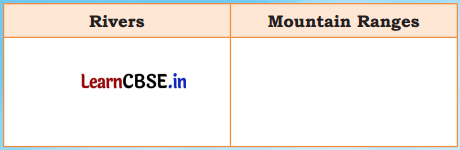
We sing the National Anthem together on this day! Can you name some rivers and mountain ranges mentioned in the National Anthem? Fill in the table given below.
Answer:
The rivers and mountain ranges mentioned in the National Anthem show the natural beauty and diversity of India. The complete table is as follows:
| Rivers | Mountain Ranges |
| (i) Ganga (ii) Yamuna |
(i) Vindhya Hills (ii) Himalaya Mountains |
Question 3.
On Republic Day, which activities would you like to participate in?
Answer:
On Republic Day, I would like to take part in the flag hoisting and sing the National Anthem with my classmates. I would also enjoy performing a patriotic dance, giving a short speech, or joining the school parade. I would love to help decorate the school and create a tableau to show the culture of our state.
Question 4.
Have you ever watched the Republic Day parade in Delhi on television? What did you like the most about it?
Answer:
Yes, I have watched the Republic Day parade in Delhi on television. I liked the marching of the soldiers, the colourful tableaux of states, and the fighter jets flying in the sky the most. I also enjoyed watching the cultural dances from different parts of India. The best part was when the jets flew high and left trails of saffron, white, and green smoke in the sky just like our national flag. It made me feel proud of my country.
Activity 1 (Page 78)
Question 1.
Discuss and list down the various items of your state tableau. Make a poster or a model of it.
Answer:
Do it yourself.
Write (Page 79)
Question 1.
What events take place at your school on the Independence Day?
Answer:
On Independence Day, we come to school early and gather for the flag hoisting ceremony. We sing the National Anthem and shout slogans like “Jai Hind?” and “Vande Mataram?” There are patriotic songs, dances, speeches about freedom fighters, and sometimes even a fancy dress competition. The school is decorated with tricolour balloons and flags, and we all feel very proud and happy.
Activity 2 (page 79)
Question 1.
Write down five rules that are followed at your school. If you were to make one new rule, what would it be?
Answer:
The five rules that are followed at our school are given below:
- We must come to school on time.
- We should wear proper school uniform every day.
- We should speak politely and respectfully to everyone.
- We should keep our classrooms and school clean.
- We should raise our hands before speaking in class.
If I were to make one new rule: Every Friday should be “Reading Day”, where we all read our favourite books for fun and share stories with our friends.
Activity 3 (page 80)
Question 1.
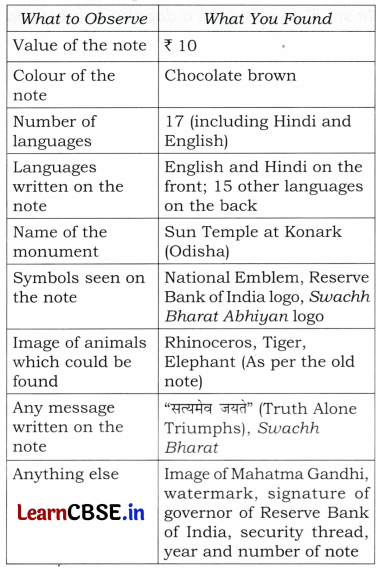
Take any Indian currency note and observe it carefully. Then, fill in the table below.
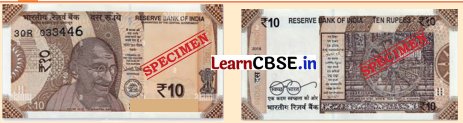
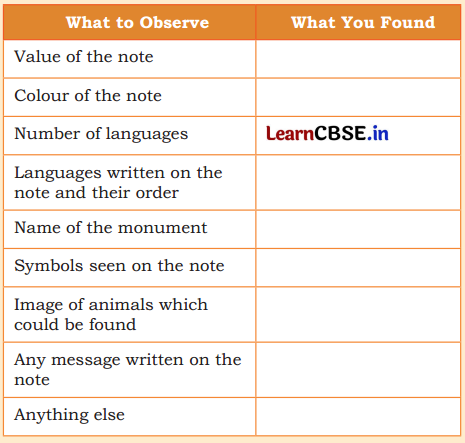
Answer:
The complete table is as follows:
Activity 4 (Page 82)
Design an emblem for your school. Think of the message you want to convey by using symbols, words, shapes and colours to make it special. Do it yourself.
Write (Page 83)
Question 1.
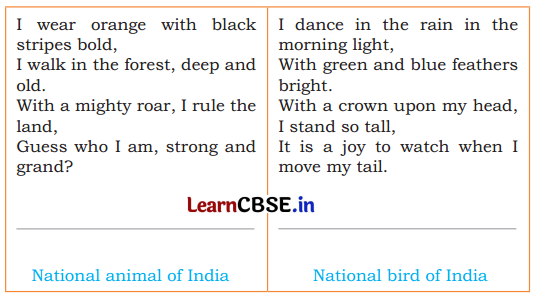
Read the riddles given below and guess the national symbols of India:
Answer:
- National animal of India- Tiger
- National bird of India- Peacock
Discuss (Page 83)
Question 1.
If we had to choose a national fruit for our country, which one would you suggest? Tell us why.
Answer:
I would suggest the mango as the national fruit of our country. Mango is called the “King of Fruits” and is loved by people of all ages. It grows in many parts of India and has been enjoyed here for hundreds of years. Mango is also used in sweets, pickles, and juices. It shows the richness and sweetness of our culture.
Find Out (Page 83)
Question 1.
States also have some symbols. With the help of your teacher, find out the following symbols of your state.
State animal : ………..
State bird : ………..
State tree : ………..
State flower : ………..
Answer:
(Answers may vary)
State: Punjab
State Animal: Blackbuck (Kala Hiran)
State Bird: Northern Goshawk (Baaz)
State Tree: Indian Rosewood (Sheesham)
State Flower: Sword Lily (Gladiolus)
Draw (Page 84)
Spot a tree, bird, animal, flower or object near your school. Choose one as your school symbol. Draw it and write one line on why it can be your school’s symbol.
Answer:
Do it yourself.
Activity 5 (Pages 84-85)
Question 1.
Find out about the languages spoken by students in your class and name them.
Answer:
(Answers may vary)
The languages spoken by students in my class are Hindi and English.
Question 2.
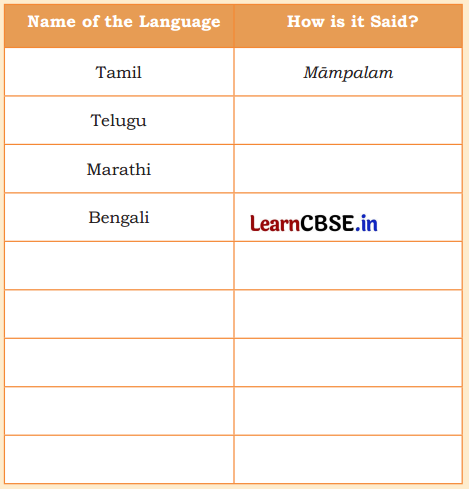
Pick a specific word (for example, mango) and have fun learning what it is called in different languages.
Answer:
| Name of the Language | How is it Said? |
|
Tamil Telugu Marathi Bengali Hindi Malayalam Punjabi Kannada Gujarati |
Mampalam Mamidi Amba Ama Aam Manga Aamb Mavu Keri |
Intext (Page 87)
Question
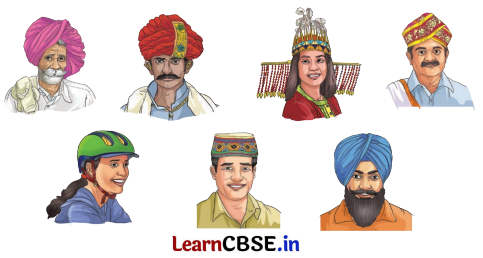
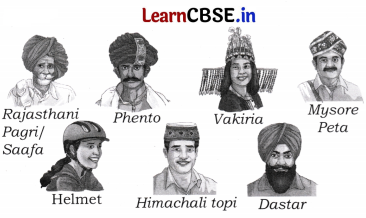
How many headgears can you name?
Answer:
Activity 6 (Page 87)
In small groups, take a dupatta or scarf and help each other make a traditional headgear. Create a headgear or cap using waste materials.
Answer:
Do it yourself.
Activity 7 (Page 89)
Under your teacher’s guidance, identify and mark the states on the map of India where these dance forms originated.
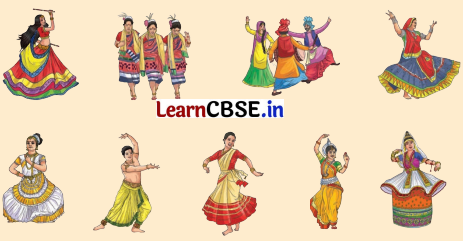
Answer:
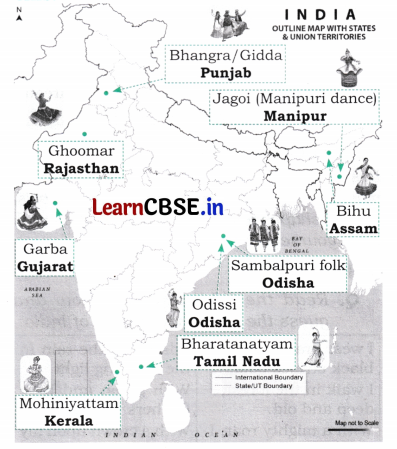
Write (Page 89)
Question 1.
What are some traditional Indian musical instruments that you know of?
Answer:
(Answers may vary) Tabla, Mridangam, Sitar, Veena, Shehnai, Dhol, Thavil, Kanjira, Pakhawaj, Harmonium, etc.
Question 2.
Try to make a musical instrument from locally available materials.
Answer:
Do it yourself.
Let Us Reflect (Pages 91-93)
Question 1.
If you could learn one more Indian language, which one would you select and why?
Answer:
(Answers may vary) If I could learn one more Indian language, I would choose Manipuri. It offers a unique linguistic perspective, being distinct from most other Indian languages. Manipuri is deeply rooted in the rich traditions of classical dance and martial arts, making it not just a language but a gateway to cultural expression. Learning this language is a way to support cultural preservation. Moreover, it opens the door to understanding the broader cultural and languages of India’s North-eastern region.
Question 2.
Which monuments do you see in different currency notes? Make a table.
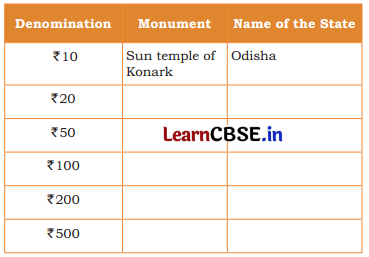
Answer:
The table is given as:
| Denomination | Monument | Name of the State |
| ₹ 10 | Sun temple of Konark | Odisha |
| ₹ 20 | Ellora Caves | Maharashtra |
| ₹ 50 | Hamvi | Karnataka |
| ₹ 100 | Rani ki Vav | Guiarat |
| ₹ 200 | Sanchi Stupa | Madhva Pradesh |
| ₹ 500 | Red Fort | Delhi |
Question 3.
Identify the currency symbol of India among the images shown below (the clue is in our currency note). Which other country’s currency symbol can you identify?

Answer:
The currency symbol of India is ₹. The name of the currency is Indian Rupee. The other symbols identified are given as:
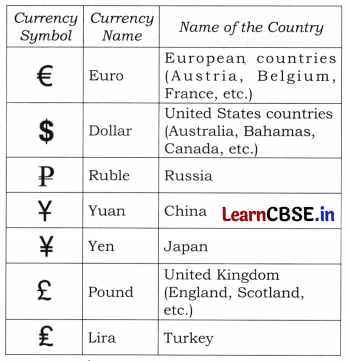
Question 4.
Which animals do you see in a ₹ 10 note?
Answer:
The ₹ 10 currency note displays images of animals (As per old note):
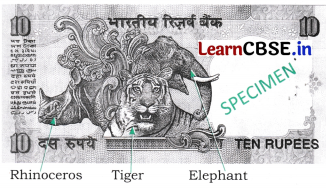
Question 5.
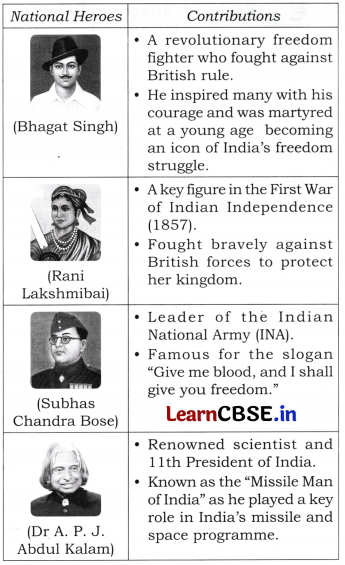
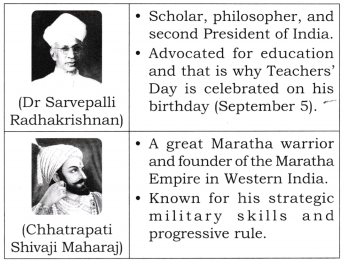
You must have seen pictures of a few great people of India in your school or any other place. Identify the names of these great men and women shown below, and write a few lines about their contributions.
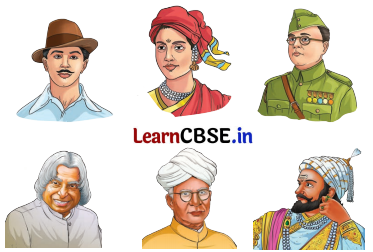
Answer:
The given pictures depict our national heroes who played significant roles in shaping India’s history and freedom struggle. Their contributions are given in the table below:
Question 6.
Group activity: Find out from your elders about people, who have contributed to the nation from your locality or state, and share what you learnt in the classroom.
Answer:
Do it yourself.
Hint: You can find out the contributions of people who are working for NGOs, volunteers in health camps, women’s self-help groups, etc.
Question 7.
Project: Cultural fair
Celebrate the vibrant diversity of India, where every state tells its own colourful story.
- Divide the class into different groups.
- Assign each group a different state of India.
- Each group will explore their assigned state and prepare a presentation covering – traditional dress, popular food, festivals, languages, dance or music.
You may also prepare posters, cutouts, etc., on the assigned state.
- Set up a cultural fair in the class. Each group can set up their own state booth. Students will take turns and visit other booths, and learn about each state.
- After the fair, gather all the students in a circle and discuss:
- What are the unique features you found in each state?
- What are the similarities or common values you found?Answer:
Do it yourself.
Hint: Divide the class into different groups:
Each group got one Indian state, like Punjab, Kerala, Gujarat, Assam, etc.
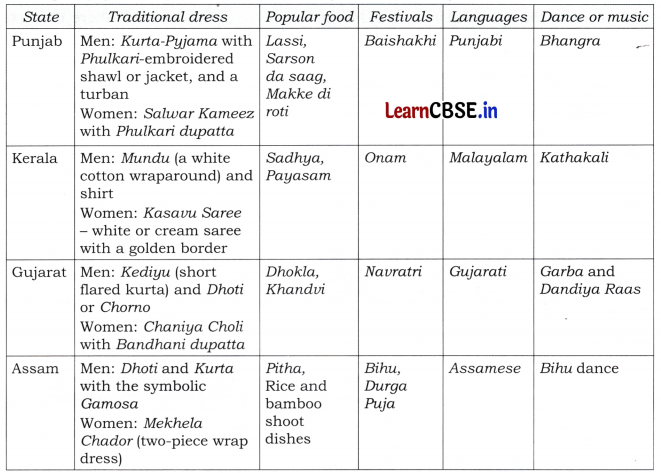
You can also prepare posters, cut-outs, etc., on the assigned state. You can discuss with your classmates about the unique features you found in each state and the similarities or common values you found.