.
Class 4 Maths Chapter 3 Pattern Around Us Question Answer Solutions
Pattern Around Us Class 4 Maths Solutions
Class 4 Maths Chapter 3 Solutions
NCERT Textbook Page 34 – Let Us Count
Gundappa has some land with tall coconut trees.
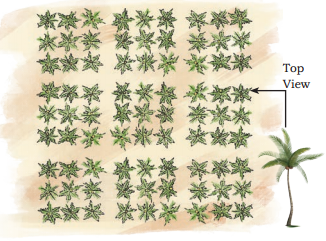
How many coconut trees does Gundappa have? How do you knpw?
Solution:
Gundappa has 81 trees of coconut.
By observing the image of the land, there are 9 trees in each of 9 sections.
To find the total number of trees, we multiply 9 trees by 9 sections.
Hence, the total number of trees = 9 × 9 = 81
Gundappa has plucked 5 coconuts from each tree. How many coconuts has he plucked?
Solution:
There are 81 coconut tre.es and Gundappa has plucked 5 coconuts from each tree.
The total number of coconuts- plucked = 5 × 81 = 405 coconuts
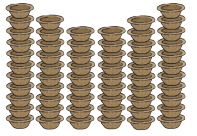
Muniamma makes plates and cups. Number of cups = __________
Solution:
In the first stack, from top to bottom, there are 11 cups. Similarly, in the second, third, fourth, fifth and sixth stacks, there are 10, 9, 9, 10 and 11 cups, respectively.
So, the total cups are:
11 + 10 + 9 + 9 + 10 + 11 = 60 cups
How many coconut laddoos are there in the trays?

Solution:
There are a total of 3 trays. Each tray has 13 coconut laddoos.
Total number of coconut laddoos = 3 × 13 = 39 coconut laddoos

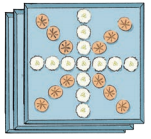
How many milk pedas are there in the trays?
Solution:
Since each tray has 12 milk pedas.
So, total number of milk pedas = 3 × 12 = 36 milk pedas
NCERT Textbook Pages 35-36 – Patterns with Money
Shirley and Shiv arranged their play money in some nice patterns as shown below.
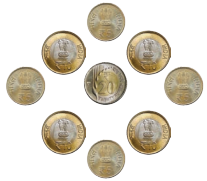
How much money? ________
Solution:
₹ 80
How did you count them? Discuss in class.
Solution:
Do it yourself
Arrange play money of amounts 1, 2, 5, and 10 to show ₹ 36, ₹ 125, and ₹ 183. Ask your peers to tell how much it is.
Solution:
Do it yourself
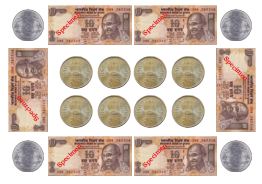
How much money? ________
Solution:
₹ 108
Do you think all numbers in times-2 table are even?
Solution:
Yes, all nun’bers in the times-2 table (multiples of 2) are even numbers and they can be arranged in pairs.
Two Ways
Shirley and Shiv arranged their coins in the following ways. Write the number of coins in the triangles.
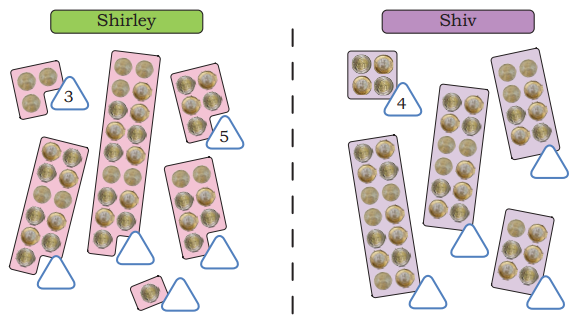
Describe Shiv’s arrangement and write his numbers.
Solution:
Shiv has arranged his coins in even numbers. The numbers are 4, 6, 8, 12 and 14.
Describe Shirley’s arrangement and write her numbers.
Solution:
Shirley has arranged her coins in odd numbers. The numbers are 1, 3, 5, 7, 11 and 17.
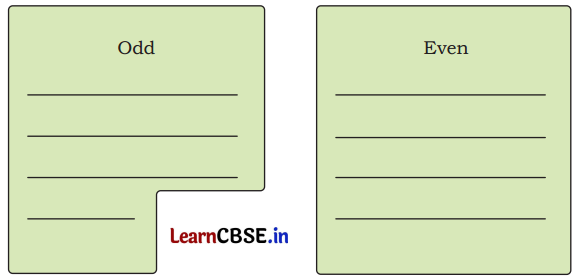
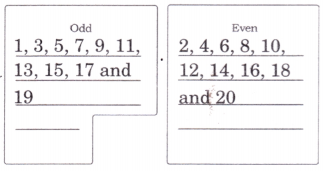
Identify numbers between 1 and 20 as even or odd. You may draw the pairing arrangement of the numbers.
Do you think all numbers in times-2 table are even?
Solution:
Yes, all numbers in the times-2 table (multiples of 2) are even numbers and they can be arranged in pairs.
NCERT Textbook Pages 37-38 – Crayons Arrangement
Circle the odd numbers and put a square around each even number. Use the crayons arrangement, if needed.
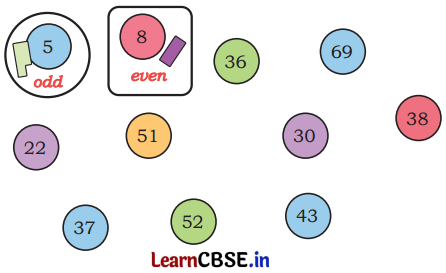
Which numbers are even and which are odd? Discuss.
Solution:
Even numbers: 8, 36, 22, 30, 38 and 52.
Odd numbers: 5, 69, 51, 37 and 43.
Explore your textbook and find out what Shirley has seen. Draw a square on the even numbers. Put a circle on the odd numbers.
Solution:
Do it yourself.
Identify which of the following numbers are even and which are odd. Explain your reasoning.

Solution:
Odd numbers: 67, 99, and 415
Even numbers: 30, 46, 78, 154, and 300
Even numbers always end with 0,2,4, 6, or 8.
Odd numbers always end with 1, 3, 5, 7, or 9.
Make two 2-digit numbers using the digits 1 and 6 without repetition.
Solution:
The possible numbers with digits 1 and 6 without repetition are: 16 and 61.
Identify the numbers as even or odd. Now choose any two digits and make 2-digit numbers in such a way that the numbers are even.
Solution:
16 is an even number and 61 is an odd number.
Let’s choose 2 and 8 to form two even numbers: 28 and 82 are even numbers.
(Answer may vary)
Are there more even or odd numbers between 1 and 100?
Solution:
Yes, even numbers between 1 and 100 are 2, 4, 6, 8, …, 96, 98.
Odd numbers between 1 and 100 are 3, 5, 7, 9, …, 97, 99.
There are equal number of even and odd numbers between 1 and 100.
Shirley notices that both the numbers, before and after an odd number, are even.
Shiv wonders if both the numbers, before and after an even number, will be odd. What do you think? Check and discuss.
Solution:
Do it yourself.
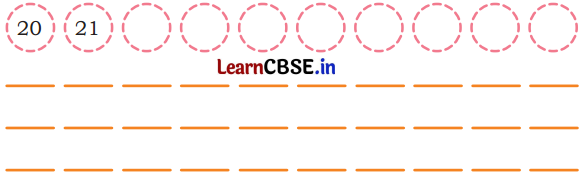
Choose any 10 numbers in an order, without skipping any consecutive numbers. Write whether they are even or odd below each number. What do you notice? Discuss.
Solution:

Every even number is followed by an odd number and every odd number is followed by an even number. This happens because numbers increase by 1 each time.