NCERT Class 8 Maths Chapter 2 Power Play Solutions Question Answer
Ganita Prakash Class 8 Chapter 2 Solutions Power Play
NCERT Class 8 Maths Ganita Prakash Chapter 2 Power Play Solutions Question Answer
2.1 Experiencing the Power Play…
Intext Questions
Question 1.
What would the thickness of a sheet of paper be after 30 folds? Assume that the thickness of the sheet is 0.001 cm. (Page 19)
Solution:
Here, 230 = 1,073,741,824
Final thickness = 0.001 × 1,073,741,824
= 1,073,741.824 cm
= 10,737.41824 meters (1 m = 100 cm)
= 10.74 kilometers (1 km = 1000 m)
Hence, after 30 folds, the thickness of the paper would be approximately 10.74 kilometers.

Question 2.
Fill in the table below. (Use the thickness of the sheet 0.001 cm) (Page 20)
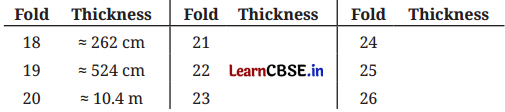
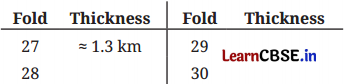
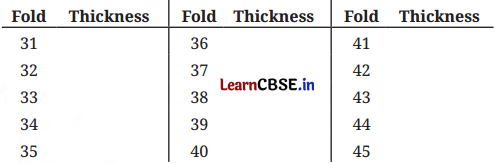
Solution:
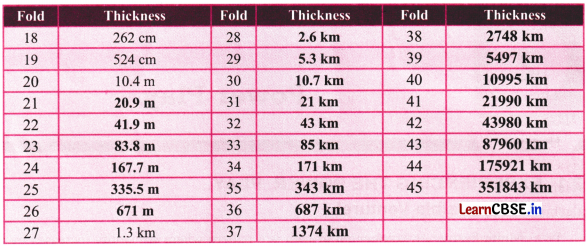
The height of folded paper will blow our minds. Here are some equivalent heights based on the number of folds.
- After 10 folds, the thickness is just above 1 cm (1.024 cm).
- After 17 folds, the thickness is about 131 cm (a little more than 4 feet).
- At 24 folds, the paper is nearly as tall as the Statue of Unity.
- At 25 times its height, it becomes taller than the Statue of Unity and the Eiffel Tower.
- At 26 folds, the paper becomes taller than the Statue of Unity and the Eiffel Tower, but it is still slightly shorter than Burj Khalifa.
- At 27 folds, the paper becomes 1.34 km thick, which is taller than the Burj Khalifa, the world’s tallest building.
- At 33 folds, the thickness reaches 85.9 km, bringing it close to the Karman Line, the official edge of outer space!
- By 36 folds, the paper’s thickness is around 687 km, making it taller than the orbit of the International Space Station (ISS)!
- After 45 folds, the paper becomes about 351,844 km thick, which is almost the distance from Earth to the Moon!
- It may seem unbelievable, but after just 46 folds, the thickness of a paper exceeds 700,000 kilometers.
- That’s the incredible power of exponential (multiplicative) growth, small beginnings that grow unimaginably big, very fast!
Question 3.
What do you think the thickness would be after 30 folds? 36 folds? Try to match it to a real-world height.
Solution:
After 30 folds, the paper’s thickness exceeds 10.74 km, which is higher than Mount Everest and even higher than most airplanes fly.
After 36 folds, the paper becomes about 687 km thick, which is almost the distance from Earth to the exosphere (Earth’s outermost atmospheric layer).
2.2 Exponential Notation and Operations
Intext Questions
Question 1.
Which expression describes the thickness of a sheet of paper after it is folded 10 times? The initial thickness is represented by the letter-number v. (Page 22)
(i) 10v
(ii) 10 + v
(iii) 2 × 10 × v
(iv) 210
(v) 210 v
(vi) 102 v
Solution:
Each time a sheet of paper is folded, its thickness doubles. So after:
1 fold → thickness = 2 × v
2 folds → thickness = 22 × v
Similarly, 10 folds → thickness = 210 × v
Hence, the correct option is (v) 210 × v.
When we have a negative number like -2 and we raise it to different powers, the sign of the result depends on whether the power is even or odd.
A negative number raised to an even power gives a positive result.
(-2)2 = (-2) × (-2) = 4
A negative number raised to an odd power gives a negative result.
(-2)3 = (-2) × (-2) × (-2) = -8.
Question 2.
What is (-1)5? Is it positive or negative? What about (-1)56? (Page 22)
Solution:
(-1)5 = -1, which is negative. [∵ (-1)0dd number = -1 → Negative]
(-1)56 = +1, which is positive. [∵ (-1)even number = +1 → positive]
Question 3.
Is (-2)4 = 16? Verify. (Page 22)
Solution:
(-2)4 = (-2) × (-2) × (-2) × (-2)
= 4 × 4
= 16
Yes, (-2)4 = 16.
Question 4.
What is 02, 05?
Answer:
02 = 0 × 0 = 0
05 = 0 × 0 × 0 × 0 × 0 = 0
Question 5.
What is 0n?
Answer:
0n = 0 × 0 × 0 × …… n times = 0
Figure It Out (Pages 22-23)
Question 1.
Express the following in exponential form:
(i) 6 × 6 × 6 × 6
(ii) y × y
(iii) b × b × b × b
(iv) 5 × 5 × 7 × 7 × 7
(v) 2 × 2 × a × a
(vi) a × a × a × c × c × c × c × d
Solution:
(i) 6 × 6 × 6 × 6 = 64
(ii) y × y = y2
(iii) b × b × b × b = b4
(iv) 5 × 5 × 7 × 7 × 7 = 52 × 73
(v) 2 × 2 × a × a = 22 × a2
(vi) a × a × a × c × c × c × c × d = a3 × c4 × d1
Question 2.
Express each of the following as a product of powers of their prime factors in exponential form.
(i) 648
(ii) 405
(iii) 540
(iv) 3600
Solution:
(i) Prime factors of 648 = 2 × 2 × 2 × 3 × 3 × 3 × 3
Exponential form of 648 = 23 × 34
(ii) Prime factors of 405 = 3 × 3 × 3 × 3 × 5
Exponential form of 405 = 34 × 5
(iii) Prime factors of 540 = 2 × 2 × 3 × 3 × 3 × 5
Exponential form of 540 = 22 × 33 × 5
(iv) Prime factors of 3600 = 2 × 2 × 2 × 2 × 3 × 3 × 5 × 5
Exponential form of 3600 = 24 × 32 × 52
Question 3.
Write the numerical value of each of the following:
(i) 2 × 10³
(ii) 72 × 23
(iii) 3 × 44
(iv) (-3)2 × (-5)2
(v) 32 × 104
(vi) (-2)5 × (-10)6
Solution:
(i) 2 × 103 = 2 × 10 × 10 × 10
= 2 × 1000
= 2000
(ii) 72 × 23 = 7 × 7 × 2 × 2 × 2
= 49 × 8
= 392
(iii) 3 × 44 = 3 × 4 × 4 × 4 × 4
= 3 × 256
= 768
(iv) (-3)2 × (-5)2 = -3 × -3 × -5 × -5
= 9 × 25
= 225
Negative numbers raised to even powers become positive.
(v) 32 × 104 = 3 × 3 × 10 × 10 × 10 × 10
= 9 × 10,000
= 90,000
(vi) (-2)5 × (-10)6 = -2 × -2 × -2 × -2 × -2 × 10 × 10 × 10 × 10 × 10 × 10
= (-32) × (10,00,000)
= -3,20,00,000
Odd power of a negative number remains negative, even power becomes positive.
The Stones that Shine…
Question 1.
Use this observation to compute the following. (Page 24)
(i) 29
(ii) 57
(iii) 46
Solution:
(i) 29 = 23 × 23 × 23
= 8 × 8 × 8
= 512
(ii) 57 = 52 × 52 × 52 × 5
= 25 × 25 × 25 × 5
= 625 × 125
= 78125
(iii) 46 = 42 × 42 × 42
= 16 × 16 × 16
= 256 × 16
= 4096
Question 2.
Write the following expressions as a power of a power in at least two different ways: (Page 24)
(i) 86
(ii) 715
(iii) 914
(iv) 58
Solution:
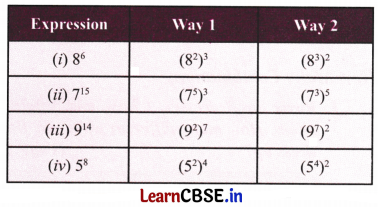
Magical Pond
Question 1.
Write the number of lotuses (in exponential form) when the pond was
(i) fully covered
(ii) half covered (Page 25)
Solution:
The number of lotuses doubles every day.
On the 30th day, the pond is fully covered.
So, on the 29th day, the pond must be half full.
Number of lotuses:
Day 1 → 1 = 20
Day 2 → 21
Day 3 → 22
Day 4 → 23
.
.
.
Day 29 → 228
Day 30 → 229
(i) The number of lotuses when the pond was fully covered (Day 30) = 229
(ii) The number of lotuses when the pond was half covered (Day 29) = 228
Question 2.
Simplify \(\frac{10^4}{5^4}\) and write it in exponential form. (Page 25)
Solution:
\(\frac{10^4}{5^4}=\left(\frac{10}{5}\right)^4=(2)^4=2^4\) [∵ \(\frac{a^m}{b^m}=\left(\frac{a}{b}\right)^m\)]
How Many Combinations
Question 1.
Roxie has 7 dresses, 2 hats, and 3 pairs of shoes. How many different ways can Roxie dress up? (Page 26)
Solution:
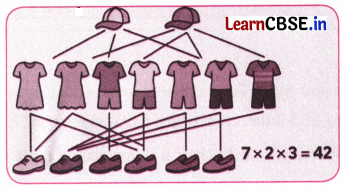
Roxie, pick one dress from the 7 options.
Pair it with one hat from the 2 choices.
Then choose one pair of shoes from the 3 styles.
Each piece is independent, so we multiply the choices = 7 × 2 × 3 = 42
That means Roxie has 42 unique combinations to show off!
Question 2.
Estu and Roxie came across a safe containing old stamps and coins that their great-grandfather had collected. It was secured with a 5-digit password. Since nobody knew the password, they had no option except to try every password until it opened. They were unlucky, and the lock only opened with the last password, after they had tried all possible combinations. How many passwords did they end up checking? (Page 26)

Solution:
Password Possibilities
Each digit can be any number from 0 to 9 → 10 choices per digit
Total combinations for a 5-digit password = 105 = 100,000
So Estu and Roxie ended up checking:
100,000 passwords…with the safe finally unlocking on that very last one.
Question 3.
Estu says, “Next time I will buy a lock that has 6 slots with the letters A to Z. I feel it is safer.”
How many passwords are possible with such a lock? (Page 27)
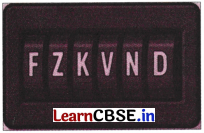
Solution:
Password Possibilities
Each slot has 26 choices (letters A-Z)
Total combinations: 266 = 308,915,776
So with Estu’s upgraded lock, there are 308,915,776 possible passwords.
Question 4.
Think about how many combinations are possible in different contexts. (Page 27)
(i) Pin codes of places in India
The Pincode of Vidisha in Madhya Pradesh is 464001.
The Pincode of Zemabawk in Mizoram is 796017.
(ii) Mobile numbers.
(iii) Vehicle registration numbers.
Try to find out how these numbers or codes are allotted/generated.
Solution:
(i) PIN Codes in India
India uses a 6-digit Postal Index Number (PIN) system introduced in 1972.
Structure:
- 1st digit: Region (9 zones total)
- 2nd digit: Sub-region
- 3rd digit: Sorting district
- Last 3 digits: Specific post office
Combinations:
- Theoretically: 106 = 1,000,000 combinations
- Practically: Only valid combinations are used based on geography and postal infrastructure.
e.g, 464001 → Vidisha, Madhya Pradesh
796017 → Zemabawk, Mizoram
(ii) Mobile numbers in India
Indian mobile numbers are 10 digits, starting with digits 6-9.
Structure:
- 1st digit: Must be 6, 7, 8, or 9
- Remaining 9 digits: Any number from 0-9
Combinations:
4 × 109 = 4,000,000,000 possible mobile numbers
Allocation:
- Managed by the Department of Telecommunications
- Prefixes (like 91x, 98x) are assigned to different telecom operators.
(iii) Vehicle Registration Numbers
Vehicle numbers follow a format like DL 01 AB 1234.
Structure:
- 2 letters: State/UT code (e.g., DL for Delhi)
- 2 digits: RTO code
- 1-2 letters: Series
- 4 digits: Unique vehicle number
Combinations:
Varies by state and RTO, but for one RTO:
262 letter combinations × 104 numbers = 676 × 10,000 = 6,760,000 combinations per RTO
Allocation:
- Managed by the Ministry of Road Transport & Highways via the Parivahan portal.
- Fancy numbers can be bid for, and older vehicles may require re-registration.
2.3 The Other Side of Powers
Intext Questions
Question 1.
What is 2100 ÷ 225 in powers of 2? (Page 27)
Solution:
2100 ÷ 225 = 2100-25 = 275
So, dividing powers is just like reducing the number of times we multiply the base.
This rule helps us solve problems faster and understand how powers behave when we break them down.
Question 2.
In a generalised form, na ÷ nb = na-b, where n ≠ 0 and a and b are counting numbers and a > b. Why can’t n be 0? (Page 28)
Solution:
na ÷ nb = \(\frac{n^a}{n^b}\)
This can also be written as \(\frac{n \times n \times n \times n \times \ldots \ldots \times n(\text { a times })}{n \times n \times n \times n \times \ldots \ldots \times n(\text { b times })}\)
So if n = 0, both the numerator and denominator involve multiplying by zero, and especially the denominator becomes zero, like: \(\frac{0^a}{0^b}\)
If b > 0, then 0b = 0, and we’re dividing by zero, which is undefined in mathematics.
For example, \(\frac{0^3}{0^2}=\frac{0}{0}\) which has no defined value.
When Zero is in Power!
Question 1.
Can we write 103 = \(\frac{1}{10^{-3}}\)? (Page 29)
Solution:
Yes, \(\frac{1}{10^{-3}}=\frac{1}{1 / 10^3}=1 \div \frac{1}{10^3}\)
= 1 × 103
= 103
In a generalized form,
\(n^{-a}=\frac{1}{n^a}\) and na = \(\frac{1}{n^{-a}}\) where n ≠ 0.
Question 2.
We had required a and b to be counting numbers? Can a and b be any integers? Will the generalised forms still hold? (Page 29)
Solution:
For powers with the same base:
na ÷ nb = na-b
This rule originally uses a and b as counting numbers (i.e., 1, 2, 3,…).
But what happens if a and b are any integers, including zero or negative numbers?
Yes, the rule still holds as long as n ≠ 0.
Case 1: a and b are positive.
\(\frac{2^{11}}{2^7}=2^{11-7}=2^4=16\)
Case 2: a or b is zero
\(\frac{2^0}{2^5}=2^{0-5}=2^{-5}=\frac{1}{32}\)
We can write \(x^{-a}=\frac{1}{x^a}\)
Case 3: a and/or b are negative.
\(\frac{2^{-2}}{2^{-5}}=2^{-2+5}=2^3=8\)
Question 3.
Write equivalent forms of the following: (Page 29)
(i) 2-4
(ii) 10-5
(iii) (-7)-2
(iv) (-5)-3
(v) 10-100
Solution:
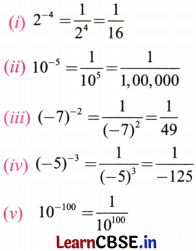
Question 4.
Simplify and write the answers in exponential form.
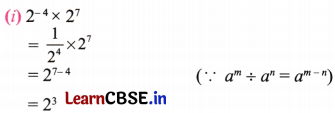
(i) 2-4 × 27
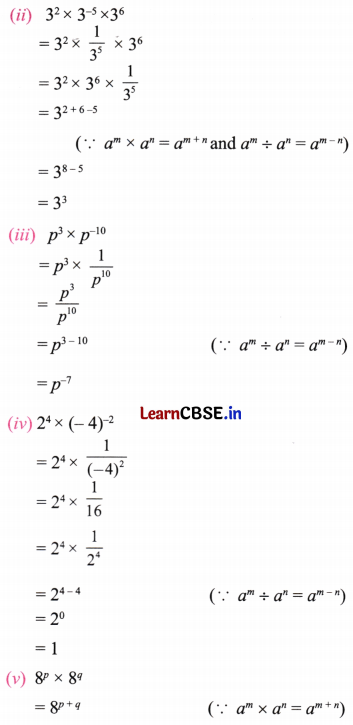
(ii) 32 × 3-5 × 36
(iii) p3 × p-10
(iv) 24 × (-4)-2
(v) 8p × 8q
Solution:
Power Lines
Intext Questions
Question 1.
How many times larger than 4-2 is 42? (Page 30)
Solution:
42 = 16
4-2 = \(\frac{1}{4^2}\) = \(\frac {1}{16}\)
\(\frac{4^2}{4^{-2}}=4^2 \times 4^2\)
= 42+2
= 44
= 256
42 is 256 (44) times larger than 4-2.
Question 2.
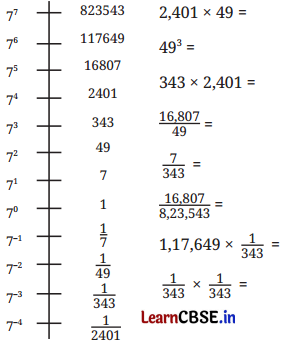
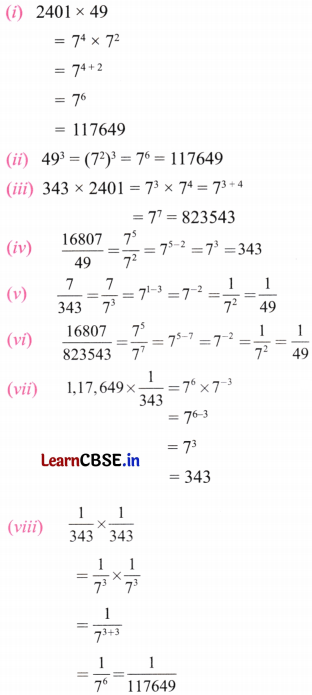
Use the power line for 7 to answer the following questions. (Page 30)
Solution:
2.4 Powers of 10
Intext Questions
Question 1.
Write these numbers in the same way: (Page 30)
(i) 172
(ii) 5642
(iii) 6374
Solution:
(i) 172
= 1 × 100 + 7 × 10 + 2 × 1
= (1 × 10²) + (7 × 101) +(2 × 100)
(ii) 5642
= 5 × 1000 + 6 × 100 + 4 × 10 + 2 × 1
= (5 × 10³) + (6 × 10²) + (4 × 101) + (2 × 100)
(iii) 6374
= 6 × 1000 + 3 × 100 + 7 × 10 + 4 × 1
= (6 × 10³) + (3 × 10²) + (7 × 101) + (4 × 100)
Scientific Notation
Intext Questions
Question 1.
Can you say which of the following distances is the smallest? (Page 32)

(i) The distance between Sun and Saturn is 1.4335 × 10¹² m.
(ii) The distance between Saturn and Uranus is 1.439 × 10¹² m.
(iii) The distance between the Sun and Earth is 1.496 × 10¹¹ m.
Solution:
(i) 1.4335 × 10¹² m = 14.335 × 10¹¹ m
(ii) 1.439 × 10¹² m = 14.39 × 10¹¹ m
(iii) 1.49 × 10¹¹ m
Comparing all three
14.39 × 10¹¹ > 14.335 × 10¹¹ > 1.49 × 10¹¹
∴ (iii) 1.49 × 10¹¹ m is the smallest.
Question 2.
Express the following numbers in standard form. (Page 32)
(i) 59,853
(ii) 65,950
(iii) 34,30,000
(iv) 70,04,00,00,000
Solution:
(i) 59853 = \(\frac {59853}{10000}\) × 10000 = 5.9853 × 10⁴
(ii) 65950 = \(\frac {65950}{10000}\) × 10000 = 6.595 × 10⁴
(iii) 3430000 = \(\frac {3430000}{1000000}\) × 1000000 = 3.43 × 10⁶
(iv) 70040000000 = \(\frac {70040000000}{10000000000}\) × 10000000000 = 7.004 × 10¹⁰
2.5 Did You Ever Wonder?
Intext Questions
Question 1.
Nanjundappa wants to donate jaggery equal to Roxie’s weight and wheat equal to Estu’s weight. He is wondering how much it would cost.
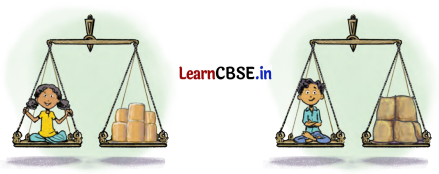
What would be the worth (in rupees) of the donated jaggery? What would be the worth (in rupees) of the donated wheat?
Make necessary and reasonable assumptions for the unknowns and find the answers. Remember, Roxie is 13 years old and Estu is 11 years old. (Page 33)
Solution:
Average weight of a 13-year-old = 45 kg
Average weight of 11-year-olds = 38 kg
Cost of 1 kg jaggery = ₹ 60
Cost of 1 kg wheat = ₹ 30
Worth for jaggery and wheat donation = 45 × 60 + 38 × 30
= 2700 + 1140
= ₹ 3840
Question 2.
Roxie wonders, “Instead of Jaggery, if we use 1 1-rupee coin, how many coins are needed to equal my weight?” How can we find out? For questions like these, you can consider following the steps suggested below:
Guessing: Make an instinctive (quick) guess of what the answer could be, without any calculations. (Page 33)
Solution:
Guessing
Roxie is 13 years old, so we might guess her weight is around 40 to 45 kg.
If we assume the price of jaggery is ₹ 60 per kg, then
No. of 1 rupee coins = 45 × 60 = 2700
Question 3.
Calculating using estimation and approximation:
(i) Describe the relationships among the quantities that are needed to find the answer.
(ii) Make reasonable assumptions and approximations if the required information is not available.
(iii) Compute and find the answer (and check how close your guess was). (Page 33)
Solution:
(i) Describing relationships between quantities.
To find out how many ₹ 1 coins match Roxie’s weight in rupee value, we need to identify:
Roxie’s weight in kg
Price of 1 kg of Jaggery
Value of donation = weight × price per kg
Number of ₹ 1 coins needed = value in rupees ÷ 1
(ii) Assumptions and approximations since exact data isn’t provided.
Let’s use reasonable estimates:
Roxie’s weight ~ 45 kg (typical for a 13-year-old)
Cost of 1 kg jaggery ~ ₹ 60 (average market rate)
Value of jaggery = 45 × 60 = ₹ 2700
(iii) Number of ₹ 1 coin needed = ₹ 2700 ÷ ₹ 1 = 2700 coins
So, Roxie would need approximately 2,700 ₹ 1 coins to match the value of jaggery equal to her weight.
Question 4.
Would the number of coins be in hundreds, thousands, lakhs, crores, or even more? Make an instinctive guess. (Page 34)
Solution:
A quick, instinctive guess using some smart thinking
Roxie’s weight is about 45 kg, and jaggery costs ₹ 60 per kg.
∴ Total cost = 45 × ₹ 60 = ₹ 2700
If we are using ₹ 1 coins, then 2700 coins are needed, which falls in the thousand range.
Hence, thousands of coins would be needed, not lakhs or crores, but more than hundreds.
Question 5.
Estu asks, “What if we use 5-rupee coins or 10-rupee notes instead? How much money could it be?” (Page 34)
Solution:
We already calculated the total donation value of ₹ 1140.
No. of ₹ 5 coins = 1140 ÷ 5 = 228
Number of ₹ 10 notes = 1140 ÷ 10 = 114
Question 6.
Estu says, “When I become an adult, I would like to donate notebooks worth my weight every year.”
Roxie says, “When I grow up, I would like to do annadana (offering grains or meals) worth my weight every year.”
How many people might benefit from each of these offerings in a year? Again, guess first before finding out. (Page 34)
Solution:
Quick Guess
Estu’s notebook donation may benefit 100 to 200 students could benefit each year.
Roxie’s meal offering is perhaps enough grains or meals to feed 150 to 300 people annually.
Estimate and calculate
Assumptions:
Estu’s weight ~ 38 kg
Cost of 1 notebook ~ ₹ 20
Roxie’s weight is ~ 45 kg
Cost of 1 kg of grain or meal donations ~ ₹ 30
Meal cost per person per day ~ ₹ 15
Estu’s donation: Notebooks worth her weight
Value of donation = 38 × ₹ 20 = ₹ 760
If each student needs 2 notebooks:
No. of students helped = ₹ 760 ÷ ₹ 40 = 19
19 students could receive notebooks each year.
Roxie’s donation: Grains or Meals worth her weight
Value of donation = 45 × ₹ 30 = ₹ 1350
Each meal costs = ₹ 15
∴ No. of people to whom meal can be provided = ₹ 1350 ÷ 15 = 90
90 people could receive a single meal, or fewer people could eat multiple meals per year.
Question 7.
Roxie and Estu overheard someone saying, “We did a padayatra for about 400 km to reach this place! We arrived early this morning.” How long ago would they have started their journey? Find answers by making necessary assumptions and approximations. Do guess first before calculating to check how close your guess was! (Page 34)
Solution:
Guessing
If someone walked 400 km on foot, how long might it take?
Let us guess they walked about 25-30 km per day.
∴ Rough guess for number of days = 400 ÷ 25 = 16 days
Or maybe 13-20 days, depending on speed and rest.
Estimating and Calculating
Let daily distance walked = 30 km
Distance covered = 400 km
Number of days = 400 ÷ 30
= 13.3 days
~ 13 to 14 days
Question 8.
How many times can a person circumnavigate (go around the world) the Earth in their lifetime, if they walk non-stop? Consider the distance around the Earth as 40,000 km. (Page 35)
Solution:
Assumptions
Circumference of Earth = 40,000 km
Average walking speed = 5 km/hr
Maximum walking hours per day = 8 hours (approx.) years spent walking.
Let’s assume an active span of 60 years (ages 15 to 75)
Distance covered in 1 day = 8 × 5 = 40 km
Total days walked over = 60 × 365 = 21,900 days
Total lifetime distance walked = 21900 × 40 = 876000 km
Earth circumnavigations = 876000 + 40,000 = 21.9 times
Linear Growth Vs Exponential Growth
Question 1.
Can you come up with some examples of linear growth and of exponential growth? (Page 36)
Solution:
Linear Growth Examples
- Pocket money increase: If our parents add ₹ 50 to our savings every week, it’s growing linearly: ₹ 50, ₹ 100, ₹ 150, and so on.
- Steps Climbed: Climbing 10 steps every minute means we’ve climbed 10, 20, 30,… that’s a linear increase.
- Plant height: If a bamboo plant grows 5 cm each day, it follows linear patterns 5 cm, 10 cm, 15 cm, …..
Exponential Growth Examples
- Virus speed: If 1 person infects 2 others, and each of them infects 2 more… the numbers explode quickly: 1, 2, 4, 8, 16,…
- Magic coins doubling: If we get 1 coin today, 2 coins tomorrow, then 4, 8, 16,… that’s exponential.
- Bacterial growth: If bacteria double every hour, a single one can become millions in just a day!
Getting a Sense for Large Numbers
Intext Questions
Question 1.
With a global human population of about 8 × 10⁹ and about 4 × 10⁵ African elephants, can we say that there are nearly 20,000people for every African elephant? (Page 38)
Solution:
Global human population = 8 × 109 = 8,00,00,00,000
Number of African elephants = 4 × 105 = 4,00,000
Number of people per elephants = \(\frac {8,00,00,00,000}{4,00,000}\) = 20,000
Question 2.
Calculate and write the answer using scientific notation. (Pages 38-39)
(i) How many ants are there for every human in the world?
(ii) If a flock of starlings contains 10,000 birds, how many flocks could there be in the world?
(iii) If each tree had about 104 leaves, find the total number of leaves on all the trees in the world.
(iv) If you stacked sheets of paper on top of each other, how many would you need to reach the Moon?
Solution:
(i) Estimated number of ants = 2 × 10¹⁶ (20 quadrillion)
Estimated human population = 8 × 10⁹
Number of ants per person = \(\frac{2 \times 10^{16}}{8 \times 10^9}\)
= 0.25 × 107
= 2.5 × 10⁶
(ii) Estimated number of starlings = 3.1 × 10⁸ (310 millions)
Number of birds in each flock = 1 × 10⁴
Number of flocks in the world = \(\frac{3.1 \times 10^8}{1 \times 10^4}\) = 3.1 × 10⁴
(iii) Estimated number of trees = 3 × 10¹²
Number of leaves on each tree = 1 × 10⁴
Total number of leaves on all the trees in the world = 3 × 1012 × 1 × 104 = 3 × 10¹⁶
(iv) Distance of Moon = 3.84 × 10⁸ m
Thickness of one sheet of paper = 1 × 10⁻⁴ m
Number of sheets required to reach moon = \(\frac{3.84 \times 10^8}{1 \times 10^{-4}}\) = 3.84 × 10¹²
Question 3.
If you have lived for a million seconds, how old would you be? (Page 39)
Solution:
1 minute = 60 seconds
1 hour = 60 minutes
= 60 × 60 seconds
= 3600 seconds
1 day = 24 hours
= 24 × 3600 seconds
= 86,400 seconds
You lived for = 1 million seconds = 10,00,000 seconds
Number of days = \(\frac {10,00,000}{86,400}\) ~ 11.57 days
Question 4.
105 seconds ~ 1.16 days and 106 seconds ~ 11.57 days. Think of some events or phenomena whose time is of the order of (i) 105 seconds and (ii) 106 seconds. Write them in scientific notation. (Page 40)
Solution:
(i) Events lasting ~ 105 seconds (~ 1.16 days)
(a) Multi-stage cycling race leg (like one stage of the Tour de France)
Duration: 1 × 10⁵ seconds
(b) Filming a short movie or documentary:
Shooting schedule ~ 1.2 × 10⁵ seconds
(c) College entrance exams conducted over 2 full days (including breaks)
Total time of exam ~ 1.1 × 10⁵ seconds
(ii) Events lasting ~ 106 seconds (~ 11.57 days)
(a) International space station crew adjustment period:
Time for acclimatization ~ 1 × 10⁶ seconds
(b) Large festival duration (e.g., Kumbh Mela or Olympics opening events):
Full festivity span ~ 1 × 10⁶ seconds
(c) Incubation period for chicken eggs:
Time until hatching ~ 1.2 × 10⁶ seconds
Question 5.
Calculate and write the answer using scientific notation:
(i) If one star is counted every second, how long would it take to count all the stars in the universe? Answer in terms of the number of seconds using scientific notation.
(ii) If one could drink a glass of water (200 ml) every 10 seconds, how long would it take to finish the entire volume of water on Earth? (Page 42)
Solution:
(i) Estimated number of stars in the observable universe: 1 × 1024 stars (1 septillion)
If you count 1 star per second, then:
Time required = 1 × 1024 seconds
(ii) Total volume of water on Earth: 1.386 × 10⁹ km3
Convert to milliliters: 1.386 × 10⁹ km3
= 1.386 × 109 × 1015 ml
= 1.386 × 1024 ml
Capacity of each glass = 200 ml
Time taken to drink per glass = 10 seconds
Total number of glasses = \(\frac{1.386 \times 10^{24}}{200}\) = 6.93 × 10²¹
Total time used = 6.93 × 1021 × 10 = 6.93 × 10²² seconds
2.5 A Pinch of History
Figure It Out (Pages 44-45)
Question 1.
Find out the units digit in the value of 2224 ÷ 432? [Hint: 4 = 22]
Solution:
2224 ÷ 432
For powers of 2, the units digits cycle as 2, 4, 8, 6.
(∵ 21 = 2, 22 = 4, 23 = 8, 24 = 16 ⇒ 6, 25 = 32 ⇒ 2)
This cycle has a length of 4.
The exponent is 224.
Divide 224 by 4: \(\frac {224}{4}\) = 56
The remainder is 0.
When the remainder is 0, the units digit is the last in the cycle.
The last digit in the cycle 2, 4, 8, 6 is 6.
Question 2.
There are 5 bottles in a container. Every day, a new container is brought in. How many bottles would be there after 40 days?
Solution:
Start with 1 container having 5 bottles,
1 new container is added every day, so after 40 days.
Number of bottles after 40 days = 40 containers × 5 bottles each = 200 bottles
Question 3.
Write the given number as the product of two or more powers in three different ways. The powers can be any integers.
(i) 643
(ii) 1928
(iii) 32-5
Solution:
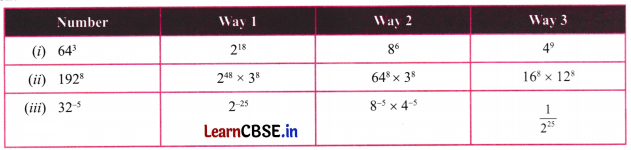
Question 4.
Examine each statement below and find out if it is ‘Always True’, ‘Only Sometimes True’, or ‘Never True’. Explain your reasoning.
(i) Cube numbers are also square numbers.
(ii) Fourth powers are also square numbers.
(iii) The fifth power of a number is divisible by the cube of that number.
(iv) The product of two cube numbers is a cube number.
(v) q46 is both a 4th power and a 6th power (q is a prime number).
Solution:
(i) Cube numbers are also square numbers — Only Sometimes True
Reason:
(a) 64 = 43 = 82 → both cube and square
(b) 8 = 23 → not a square.
A number must be both a square and a cube, i.e., a sixth power, to satisfy both.
Not all cubes are sixth powers.
(ii) Fourth powers are also square numbers. — Always True
Reason: Any fourth power is the form of a4 = (a2)2, which is clearly a square.
Fourth powers are squares because squaring a square gives a fourth power.
(iiii) The fifth power of a number is divisible by the cube of that number. — Always True
Reason: a5 ÷ a2 = a5-3 = a2, which is valid for any a ≠ 0.
The fifth power contains at least three powers of the base, so it’s divisible by its cube.
(iv) The product of two cube numbers is a cube number. — Always True
Reason: The product of two cubes is also a cube, just raise the product of their bases to the third power.
(v) q46 is both a 4th power and a 6th power (q is a prime number) — Never True
Reason: 46 is not divisible by 4 or 6 → can’t be a 4th or 6th power.
Question 5.
Simplify and write these in the exponential form.
(i) 10-2 × 10⁻⁵
(ii) 57 ÷ 54
(iii) 9-7 ÷ 94
(iv) (13-2)-3
(v) m5 n12 (mn)9
Solution:
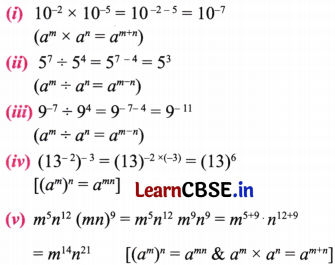
Question 6.
If 122 = 144, what is
(i) (1.2)2
(ii) (0.12)2
(iii) (0.012)2
(iv) 1202
Solution:
(i) (1.2)2 = \(\left(\frac{12}{10}\right)^2=\frac{144}{100}\) = 1.44
(11) (0.12)2 = \(\left(\frac{12}{100}\right)^2=\frac{144}{10000}\) = 0.0144
(111) (0.012)2 = \(\left(\frac{12}{1000}\right)^2=\frac{144}{10,00,000}\) = 0.000144
(iv) 1202 = (12 × 10)2 = 144 × 100 = 14400
Question 7.
Circle the numbers that are the same
24 × 36
64 × 32
610
182 × 62
624
Solution:
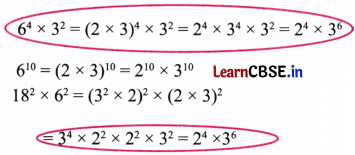
624 = (2 × 3)24 = 224 × 324
Question 8.
Identify the greater number in each of the following:
(i) 43 or 34
(ii) 28 or 82
(iii) 1002 or 2100
Solution:
(i) 43 = 64, 34 = 81
81 > 64
∴ 34 > 43
(ii) 28 = 256, 82 = 64
256 > 64
∴ 28 > 82
(iii) 1002 = 10,000
2100 ~ 1.27 × 1030
A number with 30 zeros is much larger than 10,000.
∴ 2100 > 1002
Question 9.
A dairy plans to produce 8.5 billion packets of milk in a year. They want a unique ID (identifier) code for each packet. If they choose to use the digits 0-9, how many digits should the code consist of?
Solution:
Total no. of packets produced in a year = 8.5 billion
∴ Number of codes required = 8.5 × 10⁹ codes
For ID digits to be taken from 0 to 9.
So each digit has 10 choices.
To make code with n digits, the total number of possible codes = 10n
∴ 10n ≥ 8.5 × 10⁹
109 = 1,00,00,00,000
The smallest value of n that satisfies
10n ≥ 8.5 × 10⁹ is 10.
Hence number of digits the code should consist of 1010.
Question 10.
64 is a square number (82) and a cube number (43). Are there other numbers that are both squares and cubes? Is there a way to describe such numbers in general?
Solution:
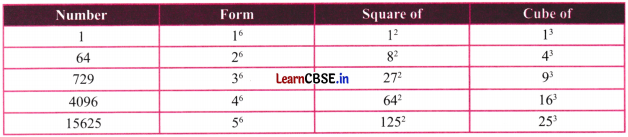
Yes, other numbers are both squares and cubes.
General Rule: A number is both a perfect square and a perfect cube if and only if it is a perfect sixth power, i.e., it can be written as x6 for some integer x.
Question 11.
A digital locker has an alphanumeric (it can have both digits and letters) pass code of length 5. Some example codes are G89P0, 38098, BRJKW, and 003AZ. How many such codes are possible?
Solution:
Number of letters (A-Z) = 26
Number of digits (0-9) = 10
So, each character in the passcode can be any of the 36 alphanumeric characters.
Also, each of the 5 positions has 36 options.
Total codes = 365 = 6,04,66,176
Hence number of possible 5-character alphanumeric passcodes is 6,04,66,176.
Question 12.
The worldwide population of sheep (2024) is about 109, and that of goats is also about the same. What is the total population of sheep and goats?
(i) 209
(ii) 1011
(iii) 1010
(iv) 1018
(v) 2 × 10⁹
(vi) 109 + 109
Solution:
Sheep population = 109
Goat population = 109
Total population of sheep and goats = 109 + 109 = 2 × 10⁹
Question 13.
Calculate and write the answer in scientific notation:
(i) If each person in the world had 30 pieces of clothing, find the total number of pieces of clothing.
(ii) There are about 100 million bee colonies in the world. Find the number of honeybees if each colony has about 50,000 bees.
(iii) The human body has about 38 trillion bacterial cells. Find the bacterial population residing in all humans in the world.
(iv) Total time spent eating in a lifetime in seconds.
Solution:
(i) World population = 8.2 billion = 8.2 × 10⁹
Pieces of clothing = 30 pieces per person
Total pieces of clothing = 8.2 × 109 × 30
= 246 × 109
= 2.46 × 10¹¹ pieces of clothing
(ii) No. of bee colonies = 100 million = 1 × 10⁸
No. of bee per colony = 50,000 = 5 × 10⁴
Total no. of bees = 1 × 108 × 5 × 104
= 5 × 10⁸+4
= 5 × 10¹² honeybees
(iii) No. of bacterial cells per human body = 38 trillion = 3.8 × 10¹³
World population (approx.) = 8.2 billion = 8.2 × 10⁹
Total bacterial population = 3.8 × 1013 × 8.2 × 109
= 31.16 × 10¹³+9
= 31.16 × 10²²
(iv) Let average eating time per day = 1.5 hours
In seconds = 1.5 × 60 × 60 = 5400 = 5.4 × 10³
and an average person’s lifetime (approx.) = 70 years
In seconds = 70 × 365 × 24 × 60 × 60
= 161,148,960,000
= 1.61 × 10¹¹
Total time spent in eating = 5.4 × 103 × 1.61 × 1011
= 8.694 × 10³+11
= 8.7 × 10¹⁴ seconds
Question 14.
What was the date 1 arab/1 billion seconds ago?
Solution:
1 arab / 1 billion = 109
minutes = \(\frac {1,000,000,000}{60}\)
hours = \(\frac{1,000,000,000}{60 \times 60}\)
days = \(\frac{1,000,000,000}{60 \times 60 \times 24}\)
years = \(\frac{1,000,000,000}{365 \times 60 \times 60 \times 24}\)
Now, we go back to the calendar.
So, it is approx. 31 years, 8 months, and 15 days.
Let today’s date = 1 Jan, 2026
After 31 years and 8 months and 15 days before the date was 24th April, 1994 (approx.)