.
Class 5 EVS Chapter 6 Some Unique Places Question Answer
Some Unique Places Class 5 EVS Question Answer
Our Wondrous World Class 5 EVS Chapter 6 Question Answer – Class 5 EVS Some Unique Places Question Answer
Find Out (Page 95)
Look at the map for the southernmost point of India.
Answer:
Do it yourself.

Find Out (Page 95)
Question 1.
In which sea are the Andaman and Nicobar Islands located?
Answer:
The Andaman and Nicobar Islands are located in the Bay of Bengal.
Question 2.
Name the other islands you know.
Answer:
Some other islands are Lakshadweep Islands and Sri Lanka.
Activity 1 (Page 96)
Take a rectangular piece of newspaper or used paper, and roll it into a thin tube. Glue the edges so it does not open. Then, make it stand it up on a flat surface. Does it stay up? Now, cut 3-4 small triangles from thick paper. Stick the triangles evenly around the bottom of the roll. Rest the paper on a flat surface again. Does it stay upright now? The base supports the roll like the roots support the tree to stand upright.
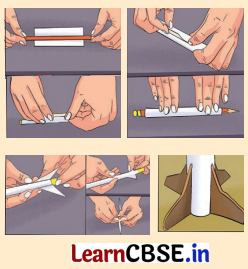
Do it yourself.
Intext (Page 97)
Question
Why do you think some birds and animals are found only on these islands?
Answer:
Some birds and animals are found only on islands like Andaman and Nicobar because the islands are far from other lands. These animals live there for many years, and slowly they change and adapt to that place. Since they do not mix with animals from other places, they become special and are found only on these islands.
Write (Pages 97-98)
Question 1.
Draw or write about your favourite fish or other sea animal.
Answer:
My favourite sea animal is the sea turtle. Sea turtles have hard shells to protect their bodies and flippers to swim in the water. They live in the sea but come to the beach to lay eggs. (You can draw your favourite animal by yourself.)
Question 2.
List at least three living things found in the sea.
Answer:
Jellyfish, Crab and Coral.
Discuss (Page 98)
Question 1.
Why do you think life under the sea is just as important as life in the forests?
Answer:
Life under the sea is also important because many animals and plants live there, just like in the forests. The sea helps keep the Earth healthy by providing us oxygen and food.
Question 2.
How do you think the coral reef helps the fish and other sea creatures?
Answer:
Coral reefs give shelter and food to many fish and sea animals. They protect small creatures from big fish and provide a safe place to live and grow.
Discuss (Page 98)
Question 1.
How do you think their knowledge might have helped the people of North Sentinel Island stay safe?
Answer:
The people of North Sentinel Island live close to nature and watch it very carefully. Before the tsunami, they may have noticed changes in the way the wind blows, the sea waves, and the behaviour of animals. This helped them understand that something dangerous was going to happen. Their knowledge of nature helped them stay safe by moving to a safer place in time.
Write (Page 99)
Question 1.
What do you see in the mangrove forest? List three things that live there.
Answer:
In the mangrove forest, the land is muddy and salty. Special mangrove trees grow in this wet and salty land. The roots of mangroves come out of the water and help them breathe in the muddy salt water. Three things that live there are mangrove trees, animals, and people who depend on the forest.
Question 2.
What do you think makes this place different from other forests?
Answer:
This place is different from other forests because it grows in muddy and salty water where the river Ganga meets the sea. The mangrove trees have special roots that come out of the ground to help them breathe in salty water.
Write (Page 100)
Question 1.
In what ways do people in Sundarbans depend on the mangrove forests?
Answer:
People in the Sundarbans depend on the mangrove forests for many things in their daily life. The forests provide them with wood for fuel and building, food like fish and honey, and other natural resources. The strong roots of the mangrove trees hold the soil together and protect their land from floods and sea waves.
Discuss (Page 101)
Question 1.
Why do you think it is important to take care of places like the Sundarbans?
Answer:
It is important to take care of places like the Sundarbans because they are home to many plants, animals, and people. In the Sundarbans, land, water, and wildlife live together in harmony. The mangrove trees protect the land from floods and strong waves. These forests also give people food, wood, and other things they need. Taking care of the Sundarbans helps protect nature and the lives of the people who depend on it.
Find Out (Page 101)
Question 1.
Look around yourself. Do you see any living thing that has something special to help it live there? What is it?
Answer:
Do it yourself.
Intext (Page 101)
Question 1.
Can you name the seven Northeastern states?
Answer:
Arunachal Pradesh, Assam, Manipur, Meghalaya, Mizoram, Nagaland and Tripura.
Write (Page 102)
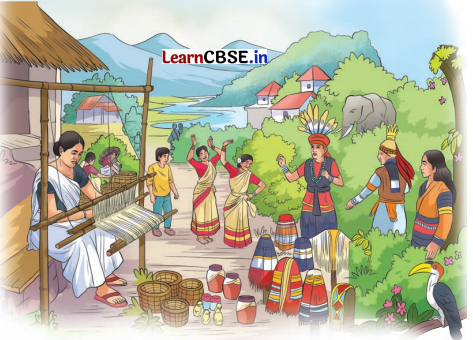
Question 1.
Look at the picture. Can you spot three things being sold in the market?
Answer:
Toys, handmade baskets and clothes.
Question 2.
Can you identify the festival from the above picture?
Answer:
Yes, the festival is Bihu, which is a famous festival celebrated in Assam.
Question 3.
Why do you think the houses are built on bamboo structures?
Answer:
The houses are built on bamboo structures to keep them safe from floods and rain, as it rains a lot in this region.
Question 4.
What animals can you see in the picture?
Answer:
Hornbill and elephant.
Question 5.
What does this picture tell you about the people who live with nature in the Northeast of India?
Answer:
The picture shows that the people in the Northeast of India live close to nature. They grow their own food. They make houses, baskets, and other things using natural materials like bamboo. They also weave beautiful clothes using natural fibres like cotton and silk. They celebrate festivals with joy and togetherness. Their way of life shows a deep connection with nature and creativity.
Discuss (Page 104)
Question 1.
In small groups, choose an animal or bird near you that needs protection. What can you do to help? Create a protection plan and share it with the class.
Answer:
(Answers may vary)
Chosen bird: Sparrow
Protection Plan:
- Create safe homes: We will make small birdhouses using cardboard or wood and hang them in gardens, balconies, or trees to give sparrows a place to live.
- Provide food and water: We will keep bowls of grains like rice or millet and clean water in open places where sparrows can eat and drink.
- Plant more trees: We will plant small trees and flowering plants in school and at home. Sparrows like to stay near green places.
- Spread awareness: We will make posters and tell others about the importance of sparrows and how we can help protect them.
Activity 2 (Page 104)
Question.
In small groups, collect twigs, leaves and soft materials like cotton or paper available around you. Create a small bird’s nest using the materials. What makes a good nest? What does the nest need to keep the eggs safe?
Answer:
A small bird’s nest – Do it yourself. A good nest should be soft, strong and must be made using things like twigs, leaves, grass, cotton, or paper. The nest needs the following to keep the eggs safe:
- It should be hidden from animals or people.
- It must be strong so the eggs do not fall.
- It should be warm and soft to protect the eggs until they hatch.
- It should protect the eggs from different weather.
Activity 3 (Page 105)
Question.
Try a ‘Root bridge challenge’ in class. Can you connect two chairs using string or sticks in a way that will hold a small toy?
Answer:
Do it yourself.
Write (Pages 105-106)
Question 1.
Look at the map, locate the Western Ghats and name the six states it passes through.
Answer:
Do it yourself.
The Western Ghats pass through six states: Gujarat, Maharashtra, Goa, Karnataka, Kerala, and Tamil Nadu.
Question 2.
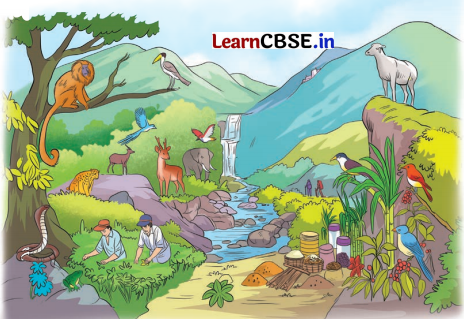
What animals can you spot in the forest?
Answer:
Birds, lion-tailed macaque, elephant, leopard, goat, deer, snake and frog.
Question 3.
What are the people doing in the picture given below?
Answer:
The people are plucking tea leaves from the tea plantations.
Question 4.
Why do you think forts were built on hilltops instead of flat land?
Answer:
Forts were built on hilltops to keep a watch on enemies and to stay safe from attacks.
Write (Page 106)
Question.
Give the names of three rivers that start from the Western Ghats.
Answer:
Three rivers that start from the Western Ghats are Godavari, Krishna, and Kaveri.
Activity 4 (Page 107)
Question.
Pick a fruit or vegetable that grows in your state. It may have varieties. With the help of your teacher or elders make a list of how many types and varieties of fruits and vegetables are locally known.
Answer:
Do it yourself.
Write (Page 109)
Question.
List three protected areas in the Western Ghats.
Answer:
Three protected areas in the Western Ghats are:
- Silent Valley National Park, Kerala
- Periyar Wildlife Sanctuary, Kerala
- Bandipur National Park, Karnataka
Let Us Reflect (Pages 109-111)
Question 1.
What surprised you the most about the places visited in this journey across India? Why?
Answer:
Hint: The most surprising was the living root bridges in the Northeast. They are made by using the roots of trees to create bridges that people can walk on. It is amazing how nature and people work together to make something so strong and useful without cutting down trees. This shows how people live in harmony with nature.
Question 2.
Which place would you like to visit the most and what would you do there?
Answer:
Hint: I would like to visit the Sundarbans the most. I want to see the special mangrove trees with their roots coming out of the water and learn how the animals like tigers and birds live there. I would also like to explore the forest and understand how people and nature live together in this unique place.
Question 3.
How is your region similar or different from one of the places in the story?
Answer:
Hint: My region is similar to the Western Ghats because we also have hills and forests with many plants and animals. Like the people there, many people here depend on the forest for food and medicine.
It is different because we do not have living root bridges like in the Northeast, and our forests may not have some of the special animals found in the Western Ghats.
Question 4.
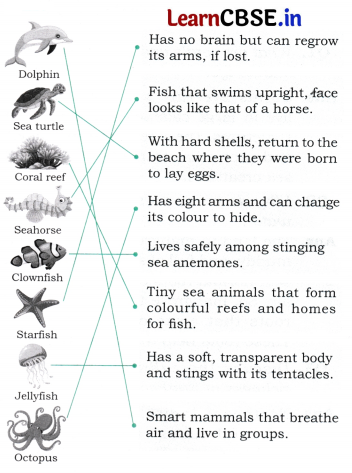
Match the following aquatic animals with their features.
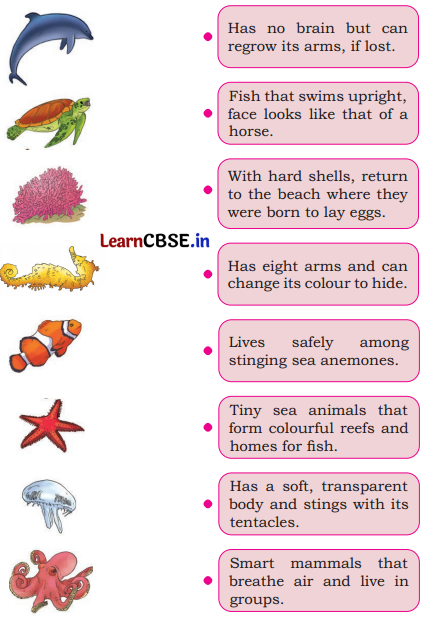
Answer:
Question 5.
What is special about mangroves?
Answer:
Mangroves are special because their roots help them breathe in muddy and salty water. These roots also hold the soil together and stop waves from washing the land away. Mangroves provide a home for many animals and give food, wood, and other things to the people who live nearby.
Question 6.
How do people in different regions live in harmony with the nature?
Answer:
People in different regions live in harmony with nature in many ways.
- In the Andaman Islands, they protect special animals and forests.
- In the Sundarbans, they depend on mangrove forests for their needs without harming them.
- In the Northeast, people use natural materials like bamboo for making various things and help protect birds like the Hargila.
- In the Western Ghats, tribal communities use plants for food and medicine carefully.
Question 7.
Make a collage by pasting pictures depicting vibrant India.
Answer:
Do it yourself