Class 8 Social Science Chapter 4 Question Answer The Colonial Era in India
NCERT Class 8 Social Science Chapter 4 The Colonial Era in India Questions and Answers Solutions
The Colonial Era in India Class 8 Question Answer (In-Text)
Question 1.
What is colonialism?
Answer:
Colonialism means one country ruling another to use its land, people, and resources for its own benefit. It often causes hardship for the people being ruled and changes their way of life.
Question 2.
What drew European powers to India?
Answer:
European powers were drawn to India by a mix of economic ambition, strategic interests, and cultural motivations.
Economic Temptations:
-
- Spices and Textiles: India was famous for its rich resources of spices, indigo, silk, and cotton, which were highly sought after in European markets.
- Direct Trade Routes: The Europeans sought to avoid Arab and Venetian middlemen who monopolized land-based trade routes and charged exorbitant rates.
Technological and Navigational Innovations
-
- Sea Route Discovery: Vasco da Gama arrived in Calicut in 1498, establishing a sea route to India directly and paving the way for numerous European expeditions.
Religious & Cultural Motives
-
- Christianisation: The missionary zeal pushed numerous explorers, particularly the Portuguese, to spread Christianity.
Geopolitical Strategy
-
- Control of Oceans: Controlling Indian Ocean trade routes equated to world dominance.
- European Power Rivalry: Portugal, Spain, the Netherlands, France, and Britain all attempted to establish bases in India in a bid to outcompete each other. India was not merely a land of spices it was a means of acquiring the world power.

Question 3.
What was India’s economic and geopolitical standing before and during the colonial period?
Answer:
Before the Colonial Era: India was not a single country but a group of kingdoms and empires and they had their own political agendas.
Power was divided .between local rulers such as the Mughals, Marathas, Rajputs, and southern kingdoms. India was a significant center along international trade routes, particularly for gems, textiles, and spices. This drew merchants from the Middle East, Europe, and Southeast Asia.
Indian kings exercised their autonomy in diplomacy and entered into alliances, waged war, and concluded treaties. India employed its soft power via religion, art, and philosophy to influence Southeast Asia with Hinduism and Buddhism. Wars were mostly local in nature, with rare pan-Indian campaigns such as those of the Mauryas or Mughals.
During the Colonial Period:
The British reshaped India’s economy into one that supplied raw materials to Britain and was forced to buy British goods, damaging local industries and crafts.
British rule transformed India’s geopolitical identity:
The defense and foreign policy of India were dominated by the British Crown, with no independent presence in the world. Indian princely states were free but were not allowed to deal with foreign affairs. India’s borders were modified to fit colonial needs and, in doing so, neglected cultural and historical facts. Indian soldiers were sent abroad to further British interests, from the World Wars to the enforcement of colonial laws.
Question 4.
How did the British colonial domination of India impact the country?
Answer:
Resource Drain: Britain literally rained trillions of dollars worth of resources from India over almost two centuries.
- Destruction of Irreplaceable Local Industries: Traditional economies of cotton textiles and local craft industry were destroyed by forced British imports.
- Land Revenue Practices: Land revenue practices such as the Permanent Settlement created immense debt and landlessness for farmers working-the land and its resources.
- Famines: British neglect of natural disasters meant that instead of offering any relief, state focus turned to tax collection during droughts, thus aggravating famines like the Bengal famine of 1943.
Political Change
Loss of Sovereignty: India’s leaders changed or were subject to foreign authority and foreign affairs, foreign policy and defence were taken over by Britain.
- Top-Down Authority Structure: British administrative structures replaced local governance apparatuses, and established the groundwork for modern civil services in India.
- Legal System Replacement: Traditional justice systems that preferred traditional customs and practices were replaced with English common law, which was frequently biased towards colonial interests.
Social and Cultural Changes
- Western Education: English-language schools cultivated a new elite while excluding Indigenous knowledge and languages.
- Western Education: English-language schools cultivated a new elite while excluding Indigenous knowledge and languages.
Infrastructure & Modernisation
- Railways & Roads: They were designed primarily for British Trade and military use, later the railways and roads served India’s unification and the independence struggle.
- Communications Networks: The telegraph and postal networks had increased connectivity across India, but these were still tools to develop connectivity for colonial administrations use.
Let’s Explore
Question 1.
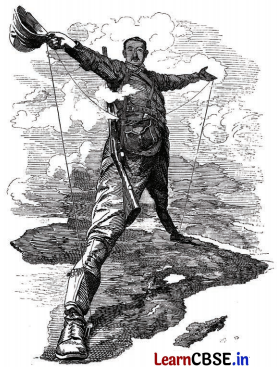
What do you think the cartoon (Fig. 4.3) is trying to express? (Keep in mind that the telegraph, which permitted instant communications for the first time, was then a recent invention.) Analyse different elements of the drawing. (Page 87)
Answer:
Speed of Communication: Before the telegraph, messages traveled between countries in weeks or months. The cartoon will likely show characters shocked or amazed that they can now send messages “faster than the wind.” Visuals could include a character in London pressing a key on a telegraph, while someone in India or America receives it instantly.
Transformative Power: This cartoon might illustrate the telegraph as powerful technology that continues to link previously remote sectors of the globe. It might depict a world being “shrunk” – the Earth seems smaller when people are able to communicate from continent to continent.
Colonialator: From a colonialism perspective, the telegraph allowed the British and other empires to assert their control over colonies much more easily. A cartoon can depict a British officer relating orders from London to officer in India instantly, with the commanding officer smiling – meaning he/she had total control.
Question 2.
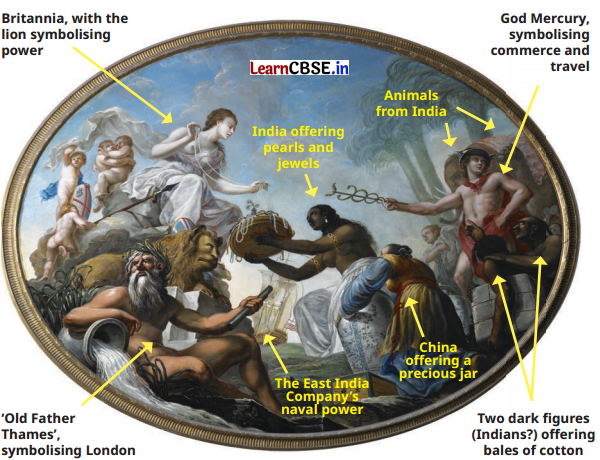
Before you read further, have a good look at the painting on the first page of this chapter. It was specially ordered for the London headquarters of the East India Company and is over three metres long. Observe every aspect of it the people in it, the objects, the symbols and the attitudes. Form groups of four or five students and let each group present its conclusions as regards the messages the painting conveys. (You will find our answers a few pages down, when we return to the painting, but avoid looking at them right now!) (Page 92)
Answer:
This painting shows the following aspects:
- Britain as Powerful and Supreme: At the top, a white woman, Britannia, is seated, dressed like a goddess, representing Britain. She looks calm and confident, showing that Britain is powerful and in control.
- India Offering Wealth: India is shown as a land full of riches. Dark-skinned figures (likely Indians) are bowing and offering pearls, jewels, and cotton to the British. This shows India as a supplier of valuable goods.
- China’s Role: A figure from China is also offering a precious jar, suggesting that China too is contributing wealth to Britain.
- Animals and Trade: Exotic animals from India are shown, and a man with a winged helmet (symbol of commerce and travel) holds a staff, symbolizing Britain’s global trade power.
- The East India Company’s Naval Power: In the foreground, a powerful man with a trident represents the sea and naval strength, showing how the British controlled the seas and trade routes.
- ‘Old Father Thames’: The man in the bottom left symbolizes the River Thames and London, indicating that all the wealth from India and China is being brought to Britain.
Conclusion: According to all the groups in my class, the painting conveys one common message that Britain, especially through the East India Company, was a powerful, god-like force that ruled over the wealth of India and other countries, using naval power, commerce, and controlled the colonies. It also showed that the colonies were places that exist to serve Britain by giving them their riches.
Question 3.
Why do you think Dadabhai Naoroji means by ‘un-British rule in India’? (Hint: he was an MP in the House of Commons in 1892.) (Page 98)
Answer:
Dadabhai Naoroji used the phrase “Un- British Rule in India” to highlight how British colonial governance violated the very principles of justice, fairness, and liberalism that Britain claim to up hold. He argued that while British rule appeared civil and progressive on the surface, it was fundamentally exploitative and unjust in practice. As a British MP, he believed the British were not treating Indians with the same respect or rights given to people in Britain.
Question 4.
Do you understand all the terms used above to list and describe Indian textiles? If not, form groups of four or five and try to find out more, then compare your findings with the help of your teacher.(Page 100)
Answer:
Here are some terms used to describe Indian textiles listed below with their simplest explanation
- Cotton: Cotton is a soft, fluffy fiber that grows around the seeds of cotton plant. It is used to make light and breathable clothes.
- Silk : Silk is a fine and luxurious fabric that is commonly used to make saree, suite-salwar, and kurtas etc.
- Wool : Wool is a soft, warm fiber taken from the fleece (hair) of animals like sheep, it is highly used during winters to make sweaters, shawls, mufflers etc.
- Jute : Jute is a rough yet very strong fiber; used to make sacks, ropes, carpets, and mats.
- Hemp : Hemp is a very strong natural fiber. It is used to make bags and ropes.
- Coir : Coir is a dried fiber taken from the outer husk of coconuts.
- Muslin : Muslin is a fine cotton; famous in Dhaka (Bangladesh) was used for royal garments and now is used to make regular wear cotton clothes.
Question 5.
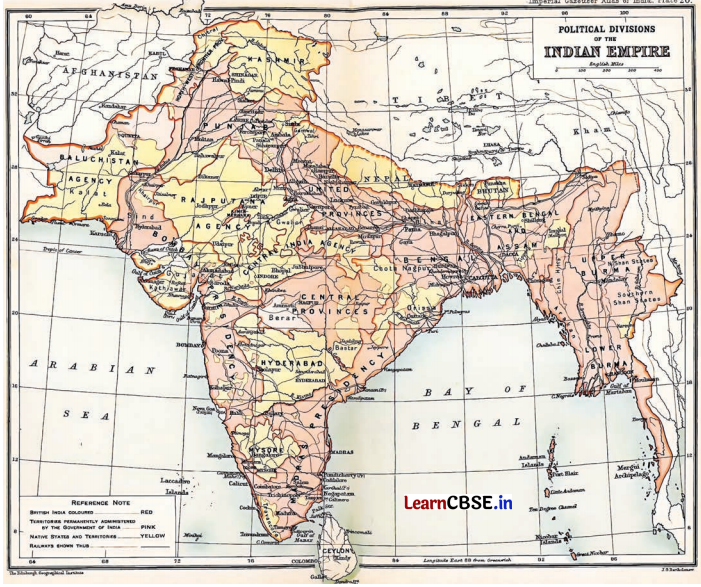
Examine the map. What are the main differences with the map of today’s India, in terms both of borders and of names? (Page 105)
Answer:
This historical map of the Indian Empire shows many differences from the map of today’s India. Here are the main changes:
1. Borders:
a. During British reign in 1909, India included Pakistan, Bangladesh, and Myanmar (Burma) as well.
b. These countries have become separate nations now.
c. The northwestern border included Baluchistan and the North West Frontier Province (now in Pakistan).
2. Some places are called with different names now. For example:
a. Calcutta is now Kolkata
b. Bombay is now Mumbai
c. Madras is now Chennai
d. Burma is now Myanmar
During British rule the regions were called Provinces, Agencies, or Native States, which no longer exist under those names.
3. Territories:
a. The map shows areas in pink as “British India” (directly ruled by the British).
b. Areas in yellow were “Native States” ruled by Indian kings under British control.
c. Today, all areas are part of the Republic of India, with states and union territories except neighbouring countries Pakistan, Bangladesh and Myanmar, which were formed later.
4. Railways: The map also shows railway lines which were important during British rule for transport and control.
Question 6.
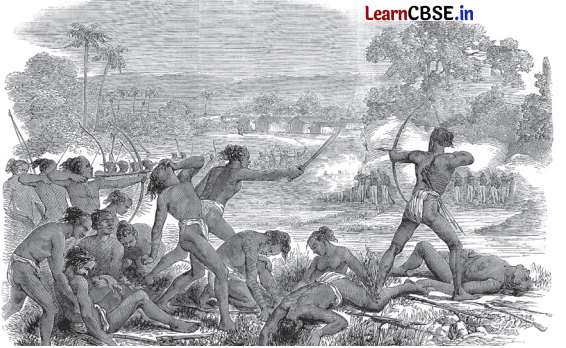
Note how the Santhals are depicted in the 1856 sketch (Fig. 4.17) drawn from an artist’s imagination: observe their
complexion, dress, weapons and draw your conclusions as regards the image this depiction would create in the popular mind in Britain (Page 107)
Answer:
In this 1856 sketch, the Santhals are shown with dark skinned, minimal clothing, with traditional bows and arrows. They appear wild, primitive, and violent, fighting British soldiers with their handmade traditional weapons. This image, drawn from imagination, likely created a negative and fearful picture in the British public’s mind depicting the Santhals as uncivilized savages rather than people resisting injustice. It helped justify British rule as a “civilizing mission”, hiding the real reasons for tribal uprisings like exploitation and land loss.
Question 7.
Indigo is a natural deep blue pigment used in dyeing. Can you think of other natural substances that have been traditionally used in India to dye cloth? (Page 108)
Answer:
India use several natural substances that have been traditionally used in India to dye cloth such as Turmeric, Henna (Mehndi), Madder root, Pomegranate rind, Indigo, Neem leaves, Bark of trees, Lac insect resin etc. and these substances give various colours like yellow, reddish-brown, red, pink, greenish, gray, purple etc. These dyes were eco-friendly and used in traditional textile arts like Block Printing, Kalamkari, and Bandhani.
Question 8.
Why do you think was the term ‘Sepoy Mutiny’ rejected after Indian Independence? Write one paragraph explaining your reasons. (Page 108)
Answer:
The term ‘Sepoy Mutiny’ was rejected by historians after Indian Independence because it gives the false idea that only a few Indian soldiers rebelled for personal or military reasons. In reality, the Revolt of 1857 was a large and widespread uprising involving not just Indian soldiers, but also farmers, landlords, regional kings, and citizens from different parts of India. It was a united fight against British rule and oppression. Calling it just a “mutiny” hides its true national character and the freedom struggle it represented.
Question 9.
In the sentence “It opened (or re¬opened) India to the world and the world to India”, why do you think we added ‘reopened’? (Page 112)
Answer:
The word re-opened was used as India was already connected with the world through trade, its cultural heritage and philosophy long before colonialism. Here’s a snapshot to its global exposure – India was a key player in trade through silk route and had a well-established sea ports and trade systems, exporting goods like spices, gems, cotton, indigo, and so much more. Buddhism and Hinduism were widely spread across the world even before the British. So British didn’t connect India with the world because it was already connected
Question 10.
Some argue that stolen cultural heritage has been better preserved abroad than it would have been in India. What is your view on its repatriation? Discuss in groups. (Page 112)
Answer:
Some say stolen Indian art is safe in foreign museums, many feel these stolen items belong to India and should be returned. They are a part of our history, identity, and pride. Keeping them in foreign museums ignores the injustice of how they were taken. India is now capable of preserving them properly and sharing them with its people.
They should be brought back home where they truly belong. If the Indian art and heritage were not looted by the Britishers, they would have been kept safely in temples, mathas, or under royal palaces and guarded by the regional kings. They would have continued to inspire local artists, scholars, and devotees. Today, they could have been on display in Indian museums, serving as symbols of our rich history and cultural identity, rather than being scattered across foreign countries.
Think About It
Question 1.
Let us return to this painting (Fig. 4.14), but now with some clues to its symbolism. Note how Britannia (a symbolic figure for Britain) sits higher than the colonies, pointing to her superior power; contrast with the lower position and bent posture of the colonies. Did they really ‘offer’ their wealth? Or did Britain seize it by force or ruse? Note also the Indians’ dark complexion (in contrast with that of Britannia), reflecting the belief in the superiority of white people over the dark¬skinned ‘natives’. (Pages 98-99)
Answer:
No, Indians did not offer their wealth willingly. In most cases, Britain seized it by force, unfair laws, or oppression. The British used high taxes, unfair trade rules, and military power to take control of land, resources, and money. Indian farmers, artisans, and rulers often had no choice but to give up their wealth. So, it was not a gift it was taken through exploitation and control.
Question 2.
What exactly did Macaulay mean when he wrote that “a single shelf of a good European library was worth the whole native literature of India and Arabia”? And why should he want to make Indians “English in taste, in opinions, in morals, and in intellect”? How does this relate to the ‘civilising mission’ mentioned at the start of the chapter? Ask your teacher to guide a class debate on these questions. (Pages 102-103)
Answer:
Macaulay meant that European books were better than all Indian and Arabic books, in his perception. He thought Indian knowledge and ideology had no value compared to British learning. This shows his colonial mindset, how he looked down on Indian culture and learning! He wanted Indians to become like the British in the way they think, live, and believe. This way, they could help the British rule India more easily, because they would accept British ideas and values. This relates to the “civilising mission”, mentioned in the start of the chapter, where the British claimed they came to educate and improve Indians. But in reality, it was a way to control them and weaken their own culture and identity.
Question 3.
What is meant by “the sun never sets on the British Empire”? Do you think this was a correct statement? (Page 104)
Answer:
“The sun never sets on the British Empire” means the empire was so vast, with colonies across the world, that the sun was always shining on at least one of its lands. Yes, I think this was a true statement for that time, because Britain ruled over many countries across Asia, Africa, Europe, and the Americas.
Class 8 SST Chapter 4 The Colonial Era in India Question Answer (Exercise)
NCERT Questions and Activities (Pages 114-115)
Question 1.
What is colonialism? Give three different definitions based on the chapter or on your knowledge.
Answer:
Colonialism is the practice by which a powerful country controls and exploits another country or region, politically, economically, socially, and culturally, often using military force and economic pressure.
Three Different Definitions of Colonialism:
- Definition from a historical perspective:” “Colonialism is a system in which a foreign power establishes control over another country or territory and uses its resources to serve its own interests.”
- Political Definition: “Colonialism is the formal or informal political rule of one country over another, often involving conquest, annexation, and the suppression of local governance.”
- Economic and Social Definition: “Colonialism is a process where a dominant country exploits the economy, labor, and natural resources of the colonised land, while also trying to impose its language, education, and culture.”
Question 2.
Colonial rulers often claimed that their mission was to ‘civilise’ the people they ruled. Based on the emdence in this chapter, do you think this was true in the case of India? Why or why not?
Answer:
No, this claim was not true in the case of India. The British claimed that they came ‘ to “civilise” Indians by introducing modern
education, law and order railways and so on but the real motive was economic exploitation and political control. The so-called civilising mission was a cover to justify colonisation.
Evidence from the Chapter:
1. Economic Exploitation:
- India’s raw materials like cotton, indigo, and spices were taken to feed British industries.
- Indian industries, especially textiles, were destroyed to promote British imports and policies.
2. Heavy Taxation and Famines:
- The British imposed high taxes on peasants and landowners.
- During the Famine of 1770-72, millions died, but the British continued collecting revenue instead of providing food at minimum cost.
3. Destruction of Traditional Governance:
- The British dismantled India’s indigenous ruling systems.
- Local rulers were defeated or forced into unfair treaties.
4. Biased Education Policies:
- Macaulay’s English education aimed to create Indians who thought like the British.
- From the above evidences, we can conclude that colonialism deeply affected India’s economy and culture, creating a social and religious division. The legacy of European colonialism in India is one of exploitation, brutal repression, violence and uprooting.
Question 3.
How was the British approach to colonising India different from earlier European powers like the Portuguese or the French?
Answer:
The British approach to colonising India was more systematic, organised, and long-lasting compared to the earlier European powers like the Portuguese and the French, who were mainly focused on trade and coastal control. Key Differences:
| Aspect | Portuguese French | British |
| Main Aim | Trade (spices, textiles) and sea dominance | Long-term political control and economic exploitation |
| Territory Control | Limited to ports like Goa (Portuguese) and Pondicherry (French) | Took over vast territories across India through wars, treaties, and annexations |
| Approach | Violent but shortterm; mostly stayed coastal | Systematic, using diplomacy, military, and administration to expand rule |
| Military-Strategy | Relied on alliances and small armies | Built a large army (with Indian sepoys), defeated major Indian powers (like Bengal, Mysore, Marathas) |
| Admini-stration | No strong administration; focus was commerce | Established strong British administrative structures like ICS, new laws, land systems |
| CulturalImpact | Minor influence, mainly in religion (Portuguese Christianity) | Deep cultural influence: English education, legal systems, railways, western customs |
The British went beyond trading they built an empire, interfered in Indian politics, introduced new systems, and completely reshaped India’s economy and society. In contrast, the Portuguese and French were mainly commercial powers with limited political ambitions and smaller territorial countries
Question 4.
“Indians” funded their own subjugation.” What does this mean in the context of British infrastructure projects in India like the railway and telegraph networks?
Answer:
During colonial rule, the British introduced major infrastructure projects such as the railway, telegraph, and postal networks. While these appeared modern and progressive, their main purpose was to serve British interests, not the welfare of Indians.
How Indians ‘Funded their own subjugation’:
| Aspect | Explanation |
| Indian Taxes | Indian peasants, farmers, and workers were heavily taxed. This money was used to finance infrastructure projects. |
| Railways | Built to transport raw materials (like cotton, coal, indigo) from the interiors to ports for British industriesnot to help Indian travel or trade. |
| Telegraph & Communication | Set up mainly to maintain fast communication between British officials and troopshelping suppress Indian revolts quickly. |
| No Indian Benefit | Indians bore the coststhrough taxes, land revenue, and labor while getting very little in return. Education, health, and rural development were ignored. |
Conclusion: The infrastructure may have modernized India physically, but it was funded by Indians to strengthen British economic and military control. So, Indians unknowingly paid in the form of heavy taxes and natural resources in India, for the very tools used to dominate and exploit them.
Question 5.
What does the phrase ‘divide and rule mean? Give examples of how this was used by the British in India?
Answer:
“Divide and Rule” refers to a strategy used by the British to maintain their control over India by creating or deepening divisions among Indians especially on the basis of religion, caste, region, and class so that Indians would not unite against British rule.
Examples of “Divide and Rule” Policy in India:
| Strategy | Description |
| Hindu-Muslim Divide | The British often portrayed Hindus and Muslims as different and opposing communities. This led to growing mistrust and later the partition of Bengal in 1905. |
| Princely States vs. British India | The British kept Indian princes loyal by giving them gifts, titles, or autonomy. This helped prevent a united Indian front. |
Conclusion: The British mastered the art of “Divide and Rule”, using religious, social, and political differences among Indians to keep them weak and disunited making it easier for a small foreign power to rule a vast country.
Question 6.
Choose one area of Indian life, such as agriculture, education, trade, or milage life. How was it affected by colonial rule? Can you find any signs of those changes still with us today? Express your ideas through a short essay, a poem, a drawing, or a painting.
Answer:
Colonialism and Indian Agriculture: A Lasting Impact Under British colonial rule, Indian agriculture underwent a massive transformation but not for the benefit of the farmers or the people. The British introduced cash crop farming like indigo, cotton, and opium, forcing farmers to grow crops that suited British industries instead of food for local consumption.
The Permanent Settlement of 1793 made zamindars (landlords) responsible for collecting taxes, which led to the exploitation of peasants. These farmers had to pay heavy taxes regardless of their harvest, pushing many into debt and poverty. Famines became more frequent like the devastating famine of 1770, where millions died, even while grains were exported to Britain.
The British also introduced the railways, not to help farmers sell their produce, but to transport raw materials quickly to ports. Indian agriculture became heavily dependent on global markets controlled by the British.
Many farmers are trapped in debt. There’s a continued focus on cash crops over food crops in some regions. The zamindari mindset still lingers in parts of India where landowners exploit laborers. Rural distress, poor irrigation, and lack of fair pricing can still be traced back to colonial-era policies.
Question 7.
Imagine you are a reporter in 1857. Write a brief news report on Rani LakshmibaVs resistance at Jhansi. Include a timeline or a storyboard showing how the rebellion began, spread, and ended, highliting key events and leaders.
Answer:
The Jhansi Flame: Rani Lakshmibai’s Heroic Resistance!
Date: June 1858
Reporter: Vansh Mishra The Hindustan Herald
Jhansi, Bundelkhand Region : The brave Rani Lakshmibai, the queen of Jhansi, stood tall against the might of the British East
India Company in one of the fiercest episodes of the 1857 Rebellion. When the British tried to annex Jhansi under the Doctrine of Lapse, denying her adopted son Damodar Rao’s right to the throne, the Lakshmibai famously declared, “I shall not surrender my Jhansi!”
Refusing to bow to colonial injustice, she led her armycomprising women warriors and loyal sepoysinto battle. Her courage, leadership, and swordsmanship have turned her into a legend across India. In June 1858, after intense fighting, British forces captured Jhansi. But Rani Lakshmibai escaped, regrouped, and joined forces with Tatya Tope and the Nawab of Banda. She died heroically in battle at Gwalior, sword in hand, dressed as a soldier. Her resistance continues to inspire a nation rising in unity.
Timeline / Storyboard: Rani Lakshmibai and the 1857 Revolt
- 1853 – British annex Jhansi under the Doctrine of Lapse.
- Rani protests the decision; appeals to the British, which are ignored.
- May 1857 – Revolt begins in Meerut and spreads rapidly across north India.
- Sepoys and local rulers rise against British rule.
- June 1857 – Jhansi rebels; British officers are killed.
- Rani Lakshmi Bai reluctantly assumes command to protect the city.
- March 1858 – British under Sir Hugh Rose lay siege to Jhansi.
- Rani leads a fierce defense. Women also take up arms.
- April 1858 – Jhansi falls, but Rani escapes with her loyal forces.
- June 1858 – Rani joins Tatya Tope in Gwalior.
- Fights the British in her final battle.
- June 17, 1858: Rani Lakshmi Bai is martyred.
- Statues and poems celebrate her bravery (“Khoob ladi mardani, woh toh Jhansi wali Rani thi!”).
- Remembered as a symbol of resistance and patriotism.
- Honored annually in schools, parades, and women’s leadership programs.
Question 8.
Imagine an alternate history where India was never colonised by European powers. Write a short story of about 300 words exploring how India might have developed on its own path.
Answer:
Title: The Lotus Never Wilted
In an alternate timeline, the sails of the Portuguese ships were blown off course in 1498, never reaching Calicut. The British, preoccupied with wars in Europe, turned their eyes elsewhere. India, untouched by colonial domination, flourished under a confederation of regional kingdoms bound by trade, diplomacy, and cultural unity.
By the mid-1700s, the Maratha Confederacy and the Mysore Sultanate formed a Grand Assembly with the Rajput kingdoms and the Sikh Empire. This political innovation, known as the Bharatiya Sabha, allowed for shared governance, trade regulation, and collective security. Sanskrit and Persian were retained as scholarly languages, while regional tongues thrived through education and literature.
Instead of railways built for resource extraction, India built its own transport systems to unify its vast geography. Indigenous industries in silk, cotton, metalwork, and shipbuilding modernised through global exchange with Japan, the Ottoman Empire, and China. Universities in Takshashila and Nalanda were revived, blending ancient philosophy with modern science.
By 1900, India was a global leader in astronomy, Ayurveda, and mathematics. The city of Varanasi was known as the “Light of the East,” rivaling Paris and Tokyo in art and academia. The caste system had weakened under pressure from reformist leaders like Savitri Bai Holkar and Maulana Azad Khan, who championed universal education and equal rights.
In 1947, while much of the world reeled from war, India hosted the World Congress of Civilizations in Madurai, emphasizing cooperation over conquest.
In this India, the tricolor still flewnot as a symbol of freedom from colonization, but of unity in diversity, of a civilization that charted its own path without ever being shackled. The lotus, undisturbed by foreign hands, bloomed freely in the sunlight of selfdetermination.
Question 9.
Role-play: Enact a historical discussion between a British official an Indian personality like Dadabhai Naoroji on the British Colonial rule in India.
Answer:
A Historical Role-Play Dialogue:
Setting: London, late 1890s. A private chamber in the British Parliament after a debate.
British Official (Sir Edward Harrington): Mr. Naoroji, while I respect your intellect, I must say your so-called “Drain Theory” is rather exaggerated. The British Empire has brought railways, law, and education to India. Surely, the benefits outweigh the costs?
Dadabhai Naoroji: Sir Harrington, with due respect, I acknowledge the infrastructure and institutions established but at whose expense? India’s wealth is being drained to Britain under the guise of administration, trade, and defense without fair return. My knowledge says millions of pounds were taken from India without equivalent service.
Sir Harrington: But India is a part of the Empire. It is only natural that subjects contribute to the crown’s responsibilities. Would India have had such modern systems without British guidance?
Naoroji: Guidance should not be exploited. We are not against progress, but it must be equitable. You build railway to transport raw materials not to empower Indians. Our industries are dying, our artisans are impoverished, and famine haunts us while British coffers grow. Is this progress?
Sir Harrington: It is the nature of the empire resources flow to the center. That is how civilisation advances.
Naoroji: Then allow Indians to govern themselves. If the Empire truly seeks civilisation, let it begin with justice. We seek representation, rights, and dignity. Not charity, but self-rule.
Sir Harrington (pauses): You are a rare Indian voice in Parliament, Mr. Naoroji. But do you truly believe India is ready for self governance?
Naoroji: We are more than ready. For centuries, India governed itself with wisdom. We ask not for domination, but for the return of what is rightfully ours our voice, our wealth, and our freedom.
Question 10.
Explore a local resistance movement (tribal, peasant or princely) from your state or region during the colonial period. Prepare a report or poster describing:
• What was the specific trigger, if any?
• Who let the movement?
• What were the demands?
• How did the British respond?
• How is this event remembered today (e.g. local festivals, songs, monuments)
Answer:
Report: The Santhal Rebellion (1855-56)
Region: Present-day Jharkhand (then part of Bengal Presidency)
Tribal Group: Santhals
Trigger: The .Santhals were forced to live under the oppressive rule of zamindars, moneylenders, and British revenue officials. Land alienation, high taxes, and exploitation led to poverty, loss of dignity, and starvation. The Santhals, once peaceful cultivators, were pushed to desperation.
The Spark: In June 1855, in a village called Bhognadih, leaders Sidhu and Kanhu Murmu raised the banner of revolt. Thousands of Santhals gathered, declaring they would no longer obey British laws or pay taxes.
Leaders of the Movement
- Sidhu Murmu
- Kanhu Murmu
- Supported by brothers Chand and Bhairav
These brave leaders mobilised around 60,000 Santhals to fight for justice.
Demands and Actions
- End to zamindari exploitation.
- Return of tribal land.
- A government by Santhals for Santhals.
- Punishment of corrupt moneylenders and British agents.
The Santhals attacked British outposts, government buildings, and moneylenders’ houses using traditional weapons and guerrilla warfare.
British Response
- The British responded with brutal force.
- Martial law was declared.
- Thousands of Santhals were killed.
- Sidhu and Kanhu were eventually captured and executed.
Legacy and Memory
- Remembered as the first major tribal uprising against the British.
- Bhognadih is now a memorial site.
- June 30 is celebrated as Hul Diwas (Day of Revolt).
- Songs, dances, and plays in tribal villages still narrate their bravery.
- Statues of Sidhu-Kanhu are found in Dumka and Ranchi.
- Santhal Hul Museum preserves their memory.