Class 8 Science Chapter 2 The Invisible Living World: Beyond Our Naked Eye Question Answer
Science Class 8 Chapter 2 Question Answer The Invisible Living World: Beyond Our Naked Eye
The Invisible Living World: Beyond Our Naked Eye Class 8 Question Answer (InText)
NCERT Probe and Ponder Questions (Page 8)
Question 1.
Have you ever wondered what you might see if the invisible world around you became visible?
Answer:
Yes, it would be fascinating to see the microorganisms like bacteria, fungi, protozoa, and viruses that are constantly interacting with our environment and even inside our bodies. It would change how we perceive cleanliness, health, and the complexity of ecosystems around us.
Question 2.
How do you think your observation of this hidden world might change the way you think about size, complexity, or even what counts as ‘living’?
Answer:
Observing this hidden world would reveal that even microscopic organisms exhibit complex behaviors such as movement, reproduction, response to stimuli, and forming colonies. This would deepen our understanding of what qualifies as a living being and show that size does not limit the complexity of life.

Question 3.
Have you thought about how these tiny living beings interact with each other?
Answer:
Yes, microorganisms constantly interact; some live symbiotically, while others compete for resources or prey on one another. For example, bacteria can help in digestion or cause diseases, and fungi can decompose organic matter, enriching the soil. These interactions form the foundation of many ecological processes.
NCERT Class 8 Science Chapter 2 Question Answer The Invisible Living World: Beyond Our Naked Eye (Exercise)
Keep the Curiosity Alive (Pages 25-26)
Question 1.
Various parts of a cell are given below. Write them in the appropriate places in the following diagram.
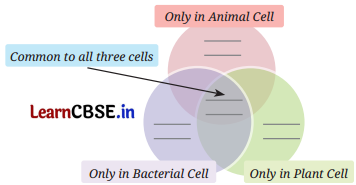
- Nucleus
- Cytoplasm
- Chloroplast
- Cell wall
- Cell membrane
- Nucleoid
Answer:
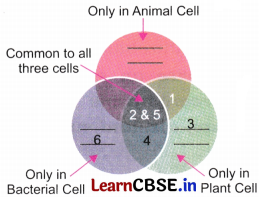
- Nucleus: Present in plant and animal cells (not in bacterial cells), controls the cell’s activities.
- Cytoplasm: Jelly-like substance that fills the cell and contains all organelles.
- Chloroplast: Found only in plant cells, responsible for photosynthesis.
- Cell wall: Found in plant and bacterial cells, forms the outermost layer.
- Cell membrane: Found in all cells, located inside the cell wall in plant/bacterial cells or as the outer layer in animal cells.
- Nucleoid: Found only in bacterial cells; the region where DNA is located since bacteria don’t have a true nucleus.
Question 2.
Aanandi took two test tubes and marked them A and B. She put two spoonfuls of sugar solution in each of the test tubes. In test tube B, she added a spoonful of yeast. Then she attached two incompletely inflated balloons to the mouth of each test tube. She kept the setup in a warm place, away from sunlight.
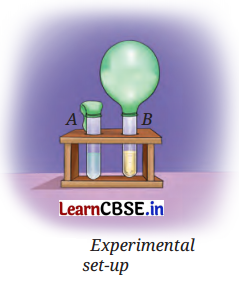
(i) What do you predict will happen after 3-4 days? She observed that the balloon attached to test tube B was inflated. What can be a possible explanation for this?
(a) Water evaporated in test tube B and filled the balloon with the water vapour.
(b) The warm atmosphere expanded the air inside test tube B, which inflated the balloon.
(c) Yeast produced a gas inside test tube B, which inflated the balloon.
(d) Sugar reacted with warm air, which produced gas, eventually inflating the balloon.
(ii) She took another test tube, 1/4 filled with lime water. She removed the balloon from test tube B in such a manner that the gas inside the balloon did not escape. She attached the balloon to the test tube with lime water and shook it well. What do you think she wants to find out?
Answer:
(i) (c) Yeast produced a gas inside the test tube B, which inflated the balloon.
Explanation: The yeast fermented the sugar, releasing carbon dioxide gas (CO2), which inflated the balloon.
(ii) She wants to test whether the gas produced is carbon dioxide (CO2). If the lime water turns milky, it confirms the presence of CO2, because CO2 reacts with lime water to form calcium carbonate.
Question 3.
A farmer was planting wheat crops in his field. He added nitrogen-rich fertiliser to the soil to get a good yield of crops. In the neighbouring field, another farmer was growing bean crops, but she preferred not to add nitrogen fertiliser to get healthy crops. Can you think of the reasons?
Answer:

Beans are leguminous crops that form a symbiotic relationship with Rhizobium bacteria present in their root nodules. These bacteria fix nitrogen from the atmosphere into the soil, providing a natural source of nitrogen. Therefore, the second farmer does not need to add nitrogen-rich fertiliser.
Question 4.
Snehal dug two pits, A and B, in her garden. In pit A, she put fruit and vegetable peels and mixed them with dried leaves. In pit B, she dumped the same kind of waste without mixing it with dried leaves. She covered both the pits with soil and observed after 3 weeks. What is she trying to test?
Answer:
She is trying to test the effectiveness of composting.
- In Pit A, the mixture of green waste (fruit/vegetable peels) and dry leaves provides the correct carbon-nitrogen balance needed for decomposition.
- Pit B lacks this balance and will decompose more slowly and may smell. This experiment shows that decomposing agents like microorganisms work better when both carbon-rich and nitrogen-rich materials are present.
Question 5.
Identify the following micro-organisms:
(i) I live in every kind of environment, and inside your gut.
(ii) I make bread and cakes soft and fluffy.
(iii) I live in the roots of pulse crops and provide nutrients for their growth.
Answer:
(i) Bacteria
(ii) Yeast
(iii) Rhizobium
Question 6.
Devise an experiment to test that microorganisms need optimal temperature, air, and moisture for their growth.
Answer:
Set up 3 bread slices:
- Slice A: Warm, moist environment (near sink)
- Slice B: Dry environment (sealed container)
- Slice C: Cold environment (refrigerator)
After 3 days, observe: Slice A will have maximum microbial (fungal) growth.
Conclusion: Microorganisms grow best when temperature, moisture, and air are optimal.
Question 7.
Take 2 slices of bread. Place one slice on a plate near the sink. Place the other slice in the refrigerator. Compare after three days. Note your observations. Give reasons for your observations.
Answer:
- A bread slice near the sink will show fungal growth (mold).
- Slices in the refrigerator will likely have no or slower growth.
Reason: Warm and moist conditions near the sink promote microbial growth, while cold temperatures in the refrigerator inhibit it.
Question 8.
A student observes that when curd is left out for a day, it becomes more sour. What are two possible explanations for this observation?
Answer:
- Microorganisms (lactic acid bacteria) continue to grow and multiply, producing more lactic acid, which makes the curd more sour.
- Warmer temperature speeds up bacterial activity, increasing acid production and sourness.
Question 9.
Observe the set-up given in Figure and answer the following questions.
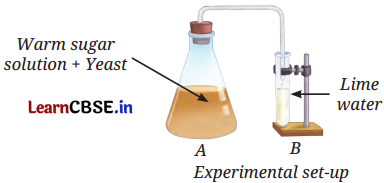
(i) What happens to the sugar solution in flask A?
(ii) What do you observe in test tube B after four hours? Why do you think this happened?
(in) What would happen if yeast were not added to flask A?
Answer:
(i) The yeast ferments the sugar in the warm solution, producing carbon dioxide gas and a small amount of alcohol.
(ii) Lime water in test tube B turns milky. This happens because CO2 produced in flask A travels through the delivery tube into flask B and reacts with lime water, confirming the presence of carbon dioxide.
(iii) Fermentation would not occur, so no carbon dioxide would be produced. As a result, lime water would remain clear in test tube B.