.
Class 5 EVS Chapter 3 The Mystery of Food Question Answer
The Mystery of Food Class 5 EVS Question Answer
Our Wondrous World Class 5 EVS Chapter 3 Question Answer – Class 5 EVS The Mystery of Food Question Answer
Think (Page 42)
Question 1.
Have you ever had an upset stomach? Do you know what could have caused it? What could happen if spoiled food is eaten by mistake? If yes, what did you do to get well? Share your experiences with the class.
Answer:
Yes, I once had an upset stomach after eating food from a street shop. I think the food was not fresh and may have been spoiled. Eating spoiled food can cause stomach pain, vomiting, diarrhoea, or even food poisoning. To get well, I took medicine from the doctor, drank lots of water, and ate light food like rice and curd. Now, I avoid eating food from street shops and always check if the food smells or looks fresh before eating it.

Intext (Page 42)
Question 1.
Why does some food spoil fast, and some last for a long time?
Answer:
Some foods spoil fast because they contain moisture and is not protected from microbes. Foods like pickles last longer because they are stored in oil, salt, or vinegar, which stop microbes from growing. Proper storage helps food stay fresh for a long time.
Write (Page 42)
Question 1.
Why do you think food gets spoiled?
Answer:
Food gets spoiled because of microbes like bacteria and fungi that grow on it. Microbes need moisture, air, and the right temperature to grow. If food is not stored properly, these microbes grow and spoil the food.
Write (Page 44)

Question 1.
What other things are dried so that they remain unspoilt throughout the year?
Answer:
Some other things that are dried so that they remain unspoilt throughout the year are:
- Fish
- Herbs like mint leaves
- Potato chips
- Amla (Indian gooseberry) slices
- Pumpkin seeds
- Pulses
- Turmeric
- Red chilli
- Raw mango slices
Activity 1 (Page 44)
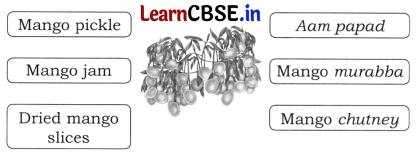
What items can be made from mangoes to enjoy them for longer durations? Write their names in the space given below.
Answer:
We can make things from mangoes to enjoy them for a longer duration, such as:
Activity 2 (Page 45)
1. Take a tomato and cut it into slices.
2. Put the slices of tomatoes on a tray and place it on the window where the sunlight comes through.
3. What changes did you observe in the fruit?
Can you think of a way to preserve items like tomato?
Answer:
After a few days, the tomato slices dried and shrank. They lost their moisture and became hard.
Yes, drying in the Sun is a method that helps preserve items like tomatoes so they last longer without getting spoiled.
Discuss (Page 45)
Question 1.
What would happen to this pickle if no oil had been added?
Answer:
If no oil had been added to the pickle, air would enter the pickle jar, and microbes could grow on the mango pieces. This would spoil the pickle quickly and make it unsafe to eat. Oil keeps out air and helps stop the growth of microbes, that is why oil is used in pickles.
Intext (Page 46)
Question 1.
Why does butter need refrigeration and ghee does not?
Answer:
Butter needs refrigeration because it has water in it. Water helps microbes grow and spoil the butter. Ghee is a pure fat and has no water, so microbes cannot grow in it. That is why ghee does not need refrigeration.
Activity 3 (Page 46)
Question 1.
Find out about food preservation practices at your family by asking the elders at home. Write at least one such practice.
Answer:
(Answer may vary)
- Drying
- Refrigeration
- Pickling and oiling
- Salting
Salting
Salting is a way to preserve food by adding lots of salt. Salt removes moisture from the food and prevents microbes from growing. It is commonly used to preserve fish, meat, and some vegetables. By salting, food does not spoil quickly and can be stored without a fridge for days or weeks.
Intext (Page 47)
Question 1.
Can you find how idlis are made? Is there something that makes the idli batter fluffy? Do you know what it is?
Answer:
Idiis are made from soaked rice and lentils. These are ground into a thick batter and kept aside for some time. Then, the batter is steamed to make idlis. Idli batter becomes fluffy due to a special process called fermentation. Good bacteria make air bubbles in the batter, which makes it light and soft.
Think (Page 48)
Question 1.
Did you ever have an upset stomach, vomiting or indigestion? Did you use any home remedies? Write about the home remedy given to you.
Answer:
Yes, I once had an upset stomach and indigestion. My mother gave me a small glass of buttermilk with a pinch of roasted cumin powder and salt as a home remedy. Buttermilk contains helpful microbes that help in digestion and soothe the stomach.
Activity 4 (Page 49)
Question 1.
Do you ever accompany your elders for buying vegetables and fruits? During such visits, observe how elders select fruits and vegetables in the market.
Write one thing that you learnt from your shopping trip and write it as a Finding #9, the way Disha would write.
Answer:
(Answer may vary)
Yes, I went to the vegetable market with my grandfather. He always looked carefully at the fruits and vegetables before buying them to check if they were fresh, clean, and free from spots or cuts. Damaged parts can spoil faster and may have microbes growing on them, which can make us sick if we eat them. I learned that we should always choose fresh, healthy fruits and vegetables to stay fit and avoid getting sick.
Finding #9
Damaged fruits and vegetables with cuts and spots may carry microbes. These microbes can spoil the food and make us sick.
Write (Page 50)
Question 1.
Name three seasonal fruits or vegetables of your region. For example, amla in winter and jamun in summer.
………..
………..
Answer:
Mango in summer
Orange in winter
Lady finger in summer
Intext (Page 50)
Question 1.
What happens to food after we eat it?
Answer:
After we eat food, it goes to our stomach where it is broken down. The useful parts give us energy and help us grow. The waste is removed from the body.
Activity 5 (Page 50)
Question 1.
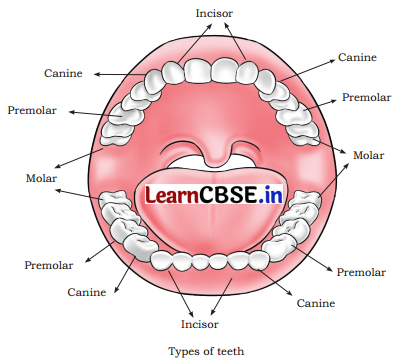
When you eat, try chewing each item properly till it breaks down into smaller pieces and then into mush. Which teeth did you use to cut and chew? Look at diagram given on page 51 and name them.
Answer:
I used my incisors to cut the food into small pieces. Then, I used my molars to chew and grind the food until it became soft and mushy.
Write (Page 53)
Question
How can you avoid choking?
………..
………..
………..
Answer:
To avoid choking, we should:
- Take small bites of food.
- Chew food properly before swallowing.
- Eat slowly and do not talk or laugh while chewing.
- Sit properly while eating. and avoid lying down with food in your mouth.
Let Us Reflect (Pages 53-54)
Question 1.
Why do some food items last for weeks and others spoil in just a few days?
Answer:
Some food items last for weeks because they are preserved by methods like drying, adding salt, or keeping them in oil or sugar. These methods stop microbes from growing and spoiling the food. Other foods spoil within a few days because they contain moisture and lack preservation, which helps microbes grow faster and spoil the food.
Question 2.
You are going on a field trip for two days. List five food items you will carry. How will you keep them from getting spoiled?
Answer:
Five food items I will carry on a two day field trip:
- Roasted snacks like namkeen or puffed rice
- Fruits like apple or banana
- Biscuits or cookies
- Whole wheat sandwiches with peanut butter
- Dry fruits like almonds and cashews
To keep these items from getting spoiled:
- I will pack the food items in airtight containers to keep them safe from air and moisture.
- I will avoid packing food items that have high water content.
Question 3.
What if food cannot be preserved? Imagine a world without food preservation and discuss the consequences.
Answer:
If food cannot be preserved, it will spoil very quickly, and we would have to eat everything immediately after it is prepared or grown. This would lead to a buy fresh food, which would be tiring and difficult. It would also be hard to store food for emergencies or for long trips. Without preservation, food shortages might happen, especially for fruits and vegetables that grow only in certain seasons and cannot be stored. Eating spoiled food can also make people sick. That is why food preservation is very important to keep our food safe, fresh, and available for a longer time.
Question 4.
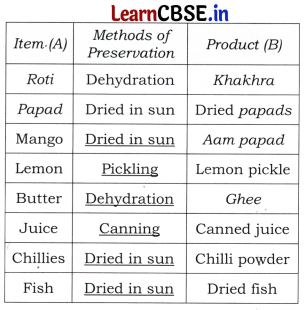
Match the following.
Which method is used to preserve the following food items (A) to make the final product (B).
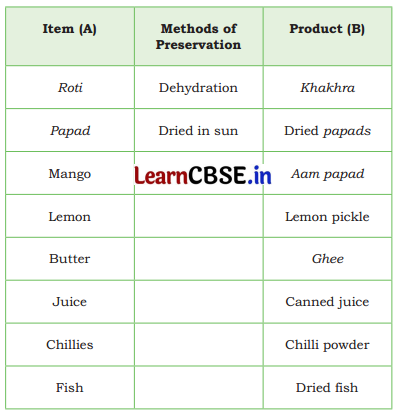
Answer: