Class 8 Social Science Chapter 6 Question Answer The Parliamentary System: Legislature and Executive
NCERT Class 8 Social Science Chapter 6 The Parliamentary System: Legislature and Executive Questions and Answers Solutions
The Parliamentary System: Legislature and Executive Class 8 Question Answer (In-Text)
The Big Questions (Page 139)
Question 1.
What is India’s parliamentary system, and how is it structured?
Answer:
India’s parliamentary system is a form of government where the executive (government) is drawn from the legislature and remains accountable to it. In this system, the people elect their representatives to the Lok Sabha, and the majority forms the government.
Structure of India’s Parliamentary System:
- At the Union level, the Parliament consists of the President, Lok Sabha (House of the People), and Rajya Sabha (Council of States). This is a bicameral system.
- The Prime Minister leads the government and is supported by the Council of Ministers, who are accountable to the Lok Sabha.
- At the State level, there is a State Assembly that performs legislative and executive functions. Some states have a bicameral legislature (Vidhan Sabha and Vidhan Parishad).
Question 2.
What are the key functions of the Parliament?
Answer:
The key functions of the Parliament are as follows:
Constitutional Functions: The Parliament is directly entrusted with upholding the values of the Indian Constitution, including:
- Enabling parliamentary democracy
- Ensuring federalism by representing both the Union and the States
- Upholding Fundamental Rights and Directive Principles of State Policy by framing appropriate laws and policies.
Legislative Function: The Parliament makes new laws, modifies existing ones and removes obsolete laws for the smooth running of the country.
Financial Function: Passes the Budget and controls public money.
Executive Control: Controls the work of the executive through questions, debates, and motions.
Financial Function: Passes the Budget and controls public money.
Executive Control: Controls the work of the executive through questions, debates, and motions.

Question 3.
What are the roles of the legislature and the executive in India’s Parliamentary democracy?
Answer:
In India’s Parliamentary democracy, both the legislature and the executive have important but different roles:
Role of the Legislature (Parliament and State legislature):
-
- The Legislature makes new laws.
- It also removes old or outdated laws to keep the legal system updated.
- Through debates and Question Hour, it holds the Executive accountable for its actions.
- It represents the will of the people, as the representatives elected by the citizens form the government.
- During the Budget Session, it controls and oversees the finances of the government.
Role of the Executive (Prime Minister or Chief Minister and Council of Ministers:
-
- It implements laws and policies made by the Parliament.
- Manages the day-to-day affairs of the country.
- It is responsible to the legislature, especially the Lok Sabha at the Union level.
Question 4.
How are the legislature and the executive organised at the union and state levels?
Answer:
India follows a federal system of government where both the union and state levels have their own legislature and executive structures. At the Union level, the legislature is bicameral, consisting of the Lok Sabha (Lower House) and the Rajya Sabha (Upper House).
The executive includes the President as the Head of State, the Prime Minister as the Head of Government, and the Council of Ministers who help the Prime Minister run the government. At the State level, the legislature can be unicameral, having only the Vidhan Sabha (Legislative Assembly), or bicameral in some states, with both Vidhan Sabha and Vidhan Parishad (Legislative Council). The executive includes the Governor as the Head of State, the Chief Minister as the Head of Government, and the Council of Ministers who help in administration.
Let’s Explore
Question 1.
Find out how many representatives from your state are in each House of the Parliament.
Answer:
(Suggestive Answer) Every state in India has representatives in both Houses of Parliament. In my state, Uttar Pradesh, there are 80 members in the Lok Sabha. These members are directly elected by the people. There are also 31 members from Uttar Pradesh in the Rajya Sabha. These members are elected by the state legislators. So, Uttar Pradesh has 80 representatives in the Lok Sabha and 31 in the Rajya Sabha. This shows how important my state is in making laws and decisions for the country.
For reference, the number of representatives from other states are also given below.
| Region | State | Lok Sabha Members | Rajya Sabha Members |
| North | Uttar Pradesh | 80 | 31 |
| Punjab | 13 | 7 | |
| South | Tamil Nadu | 39 | 18 |
| Karnataka | 28 | 12 | |
| East | Bihar | 40 | 16 |
| Odisha | 21 | 10 | |
| West | Maharashtra | 48 | 19 |
| Gujarat | 26 | 11 | |
| North-East | Assam | 14 | 7 |
| Manipur | 2 | 1 |
Question 2.
What makes the Indian Parliament the “voice of the people”? How does it ensure that different opinions are heard?
Answer:
The Indian Parliament is called the “voice of the people” because it is made up of representatives who speak on behalf of the citizens. Members of the Lok Sabha are directly elected by the people, while members of the Rajya Sabha are indirectly elected by the state legislatures, this system ensures that people from every region, including marginalised communities, are represented.
To ensure different opinions are heard, Parliament uses:
- Question Hour: Members of Parliament (MPs) ask the government questions to hold it accountable and raise important issues.
- Debates and Discussions: MPs from different parties and backgrounds discuss laws, national issues, and ideas. This allows different opinions to be heard before making any decisions.
- Parliamentary Committees: Standing Committees examine bills, budgets, and policies regularly.
Question 3.
Why do you think the Constitution made the Executive responsible to the Legislature?
Answer:
The Constitution made the Executive (such as the Prime Minister, ministers, and civil servants) responsible to the Legislature (Parliament) to ensure that the government remains accountable to the people. This system keeps the government in check and ensures it serves the people’s interests.
- It prevents the misuse of power and ensures that leaders act within their limits.
- Ministers must take responsibility for their decisions and actions in Parliament, making them answererable to people.
- This structure strengthens democracy by making the government transparent and responsible to citizens.
Question 4.
Why do you think we have chosen the system of bicameral legislature at the Union level?
Answer:
The Constitution makers decided on a bicameral legislature after careful discussion.
- They believed that a single House would not adequately represent the diversity and aspirations of our large and diverse country, India.
- Therefore, the Rajya Sabha was established to reflect the federal spirit, diversity, and interests of the states.
- The Rajya Sabha has a different structure and election process from the Lok Sabha.
- India follows a federal system, where power is shared between the centre, states and local governments.
- This system helps balance national unity and regional interests.
- Thus, the bicameral legislature ensures fair representation for everyone.
Question 5.
Try to track the journey of a recent bill passed by the Parliament. Identify in which House it was introduced. Were there any major debates or disagreements? How long did it take for the bill to become a law? Use newspaper archives, government websites, and Lok Sabha debates, or ask your teacher for help.
Answer:
(Suggestive Answer) The Women’s Reservation Bill, aimed at reserving 33% of seats for women in the Lok Sabha and State Assemblies, had a long journey. It was first introduced in 1996 but faced numerous delays. After several attempts, the bill was reintroduced in the Lok Sabha on 19th September 2023. It sparked debates on women’s political representation. Despite some disagreements, it
passed the Lok Sabha on 21 st September 2023, with 454 votes in favour and 2 against. The bill was then sent to the Rajya Sabha, where it was also passed on 21st September 2023, with all 215 members present voting in favour. After being passed by both Houses of Parliament, the Bill received the President’s assent on 28th September 2023, officially becoming The Constitution (106th Amendment) Act, 2023. It took 27 years for the bill to be passed. This highlights the challenges in increasing women’s participation in politics.
Question 6.
Choose a recent law passed by the Parliament. Ditnde into teams to role- play different parts of the process MPs debating in Lok Sabha and Rajya Sabha, ministers answering questions, and the President giving assent. Present a short skit showing how a bill becomes a law; enact a ‘model Parliament’.
Answer:
Model Parliament Skit: How the Women’s Reservation Bill Becomes a Law.
Characters:
- Speaker of the Lok Sabha
- Law Minister
- Supportive MP
- Opposition MP
- President
Scene: Lok Sabha (Lower House)
Speaker: Honourable Members, we will now discuss the Women’s Reservation Bill, which proposes reserving 33% of seats for women r the Lok Sabha and State Assemblies.
Law Minister: This bill will increase women 5 participation in politics. I request ever – support.
Supportive MP: I strongly support this bill! Women must have equal represent.
Opposition MP: I agree, but we ensure proper implementation in all regions.
Speaker: All in favour, say Aye!
All MPs (except a few): Aye
Speaker: The Bill passes in the Lok Sabha. Now, it goes to the Rajya Sabha.
Scene: Rajya Sabha (Upper House)
Rajya Sabha Speaker: The Women’s Reservation Bill is now being discussed.
Supportive MP: This bill is essential for a stronger democracy!
Opposition MP: Honourable Speaker, we support the bill, but we believe it should include more details on how women from all backgrounds will benefit, especially in rural areas.
Speaker: All in favour, say Aye!
Most MPs: Aye!
Rajya Sabha Speaker: The Bill passes. We now send it for Presidential assent.
Scene: The President’s Assent
President: I have received the Women’s Reservation Bill and after review, I give my assent.
President: The Women’s Reservation Bill is now a law.
Question 7.
The Women’s Reservation Bill, 2023, was passed with wide support. Why might it have taken over 25 years for this bill to be passed, despite being discussed for so long?
Answer:
The Women’s Reservation Bill, 2023 took 25 years to pass due to several reasons:
- Parties had different views on the reservation structure. Some demanded sub-reservation for women from OBCs (Other Backward Classes) within the 33% quota, while others opposed this.
- Reserving seats for women meant many male members would lose their positions, causing resistance within political parties.
- Although no major party openly opposed the bill, there was an absence of strong political support to prioritise and pass it. It was often treated more as a symbolic promise than a serious legislative agenda.
Question 8.
Sometimes the Parliament is disrupted and does not function for the number of days it is supposed to. What impact do you think this has on the quality of laws and the trust people place in their representatives?
Answer:
When Parliament is disrupted and does not function for its scheduled number of days, it affects both the quality of laws and the public’s trust in representatives.
- Important bills may be rushed through without proper debate, leading to incomplete or ineffective laws.
- Continuous disruptions make people lose faith in their elected representatives, reducing voter turnout and civic participation.
- Frequent disruptions lead to a huge waste of both human and financial resources, which could be used for development.
- Such behaviour in Parliament discourages young, talented people from entering politics. As a result, Parliament is being represented by mediocre leaders rather than the brightest minds of the country.
- In the long run, these disruptions weaken democratic institutions and derail the aspirations and dreams of the nation. It affects the future of the people and the progress of the country as a whole.
Question 9.
Can you create ‘interest’ groups among students and list questions related to any policy that you may want to ask your MP and/or your MLA? How would these questions be different if it is to the MP instead of the MLA, and vice versa?
Answer:
As students, we care about policies that affect our education, future careers, and the environment. To explore these issues, I divided the class into two groups: Group A and Group B.
Group A focused on national issues and prepared questions to ask our MP (Member of Parliament):
1. Education: What is the central government doing to make higher education more accessible and affordable for students across the country?
2. Jobs: What steps are being taken to create better job opportunities for young people in various sectors?
3. Environment: What national-level actions are being taken to reduce pollution and protect the environment?
Group B focused on local and state issues and prepared questions to ask our MLA (Member of Legislative Assembly):
- Education: What is being done to improve the quality of education in government schools and colleges in our area?
- Jobs: How is the state government helping to create more jobs for young people in our locality?
- Environment: What local steps are being taken to reduce pollution and make our surroundings more eco-friendly?
The questions we ask our MP and MLA are different because they handle different responsibilities. MPs work on national issues that affect the whole country, while MLAs focus on local and state-level problems in our area. By asking the right questions, we can make sure our leaders listen to the concerns of students like us.
Question 10.
What is the role that the Judiciary plays in Indian democracy? What could happen if we didn’t have an independent judiciary?
Answer:
Indian democracy thrives with equal and important roles played by the Legislature, Executive and Judiciary. The Judiciary has a special role in protecting democracy.
- The Judiciary ensures all laws and government actions follow the Constitution. Through judicial review, it can strike down any law or action that violates constitutional principles.
- Citizens can approach the High Courts or the Supreme Court if any law or government action infringes their fundamental rights. The Judiciary protects individual freedoms and ensure justice.
- The Judiciary acts as an impartial umpire in resolving disputes between citizens and the government, or between different levels of government.
If we didn’t have an independent judiciary, the government could pass unfair laws without being stopped. People’s rights might not be protected, and justice could become biased, leading to a loss of trust in the democratic system of India.
Don’t miss Out
Question 1.
Part V of the Indian Constitution begins with Chapter I – The Executive. It KSQIHI looks at the roles and responsibilities of the President, Vice President, and Council of Ministers, among others. It is in Chapter II that the role and functions of Parliament are listed. Why might this be so? (Page 151)
Answer:
The Constitution starts with the executive because it shows how important the executive is in running the country. While the parliament makes the laws, the executive like the president, prime minister, and council of ministers puts those laws into action. This order helps us understand that both law-making and law-implementation are important. The government works properly only when both the parliament and the executive do their jobs together.
Question 2.
Atal Bihari Vajpayee, a former Prime Minister of India, said during a amar rehna chhahiye.
(Governments will come and go , parties will rise and fall. But the nation must endure, and its democracy must live on.)
(a) What message do you think this gives about the role of Parliament and leaders in a democracy?
Answer:
This quote reflects the deep concern of our great former Prime Minister, Shri Atal Bihari Vajpayee. It shows his disappointment with the behaviour of some members of Parliament and offers valuable suggestions. He emphasises the importance of keeping the interest of the people and the country above personal or political gain.
(b) Why is it important to protect demo-cratic txilues even when political power changes?
Answer:
It is important to protect democratic values because they ensure the rights, freedoms, and voice of the people, regardless of who holds power. Governments may come and go, but democracy provides stability, accountability, and continuity for the nation. Without strong democratic values, political change could lead . to disorder or the misuse of power.
Lets’ Remember
Question 1.
(a) From your previous LET’S lessons on the theme of Democracy and Governance, name a few Constitutional functions of the Parliament.
Did you list the election of President and Vice President? (Page 145)
Answer:
The Parliament has important constitutional functions like electing the President and Vice President, making and changing laws, approving the budget, and holding the government accountable. Yes, I did list the election of the President and Vice President as key functions, as these elections play an important role in how the Parliament works in our democracy.
(b) What about amendments to the Constitution? (Page 145)
Answer:
The Parliament has the power to make amendments to the Constitution. This means it can change or update parts of the Constitution to meet the needs of the country. Amendments help keep the Constitution relevant and strong as India grows and changes.
Class 8 SST Chapter 6 The Parliamentary System: Legislature and Executive Question Answer (Exercise)
NCERT Questions and Activities (Pages 161-162)
Question 1.
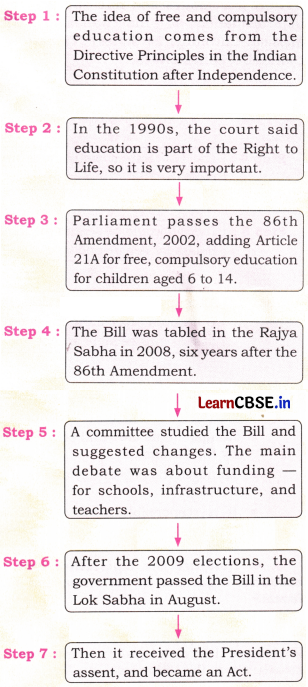
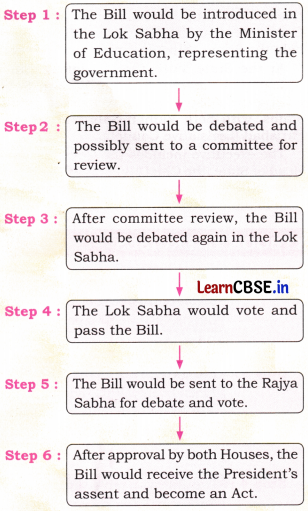
Draw a small chart to show the process of how RTE became an act. What do you think the process would be if RTE had been tabled in the Lok Sabha? (Page 148)
Answer:
The Right to Education (RTE) Act became law through a step-by-step process in Parliament. Below is a chart showing how it became an Act.
If it had been introduced in the Lok Sabha first:
Question 2.
Given here is an extract from the report of meetings between the Standing Committee on Health and Family Welfare and the officers from the Ministry of Health and Family Welfare. Observe the screenshots above and discuss the following in small groups – (Page 150)
(a) Who is reporting to whom?
Answer:
The Department-related Parliamentary Standing Committee on Health and Family Welfare (a committee of the Rajya Sabha) is reporting to the Ministry of Health and Family Welfare, particularly the Ministry of AYUSH.
(b) What is the subject that has been reviewed?
Answer:
The subject under review is the co-location of AYUSH facilities at Primary Health Centers (PHCs), Community Health Centers (CHCs), and District Hospitals (DHs). Specifically, the report addresses the need for separate Departments of AYUSH in some States and Union Territories (UTs) for better implementation and coordination of AYUSH healthcare services.
(c) Identify the Committee’s recommendation.
Answer:
The committee recommends that the Ministry of AYUSH should encourage and persuade states and Union Teritories (UTs) do not yet have a separate Department of AYUSH to establish one. This will help ensure:
- Better coordination in AYUSH healthcare.
- Faster development and implementation of AYUSH schemes.
(d) What is the government’s reply?
Answer:
The government says that creating AYUSH departments is up to the State/ UT Governments because health is a state matter. However, the Ministry of AYUSH has asked States/UTs to set up separate AYUSH directorates and hire staff for better implementation of the National AYUSH Mission. Currently, 24 States/UTs have their own AYUSH directorates.
Question 3.
Why do you think that Parliament keeps an eye on government expenditure? (Hint: Whose money does the government spend?) (Page 151)
Answer:
The Constitution has given Parliament the duty to keep an eye on government expenditure to ensure that public money is used properly, efficiently, and without corruption, and that it reaches the people instead of being wasted or misused.
- The government collects money through taxes, so Parliament makes sure this money is spent on public services like schools, hospitals, roads, and other public services.
- Through frequent debates and discussions, Parliament monitors how the government spends money.
- The Executive must explain to Parliament how, where, and why the money is spent. This makes the government accountable to the people.
- This system of checks and balances, prevents misuse of power and corruption.
Question 4.
If the Executive is part of the Legislature, how do we say that there is separation of power? (Hint: revisit the section on legislature above) (Page 152)
Answer:
In India’s parliamentary system, the Executive, made up of the Prime Minister and Council of Ministers, comes from the Legislature, or Lok Sabha. Although this may seem to weaken the separation of powers, the system keeps a balance. The Legislature makes laws, while the Executive enforces them, and the Judiciary makes sure neither branch goes beyond its limits. For example, during Question Hour, ministers must answer MPs’ questions, keeping the Executive accountable.
Debates in Parliament let MPs examine and discuss government policies, making sure the Executive’s actions are checked. The budget is another example, as the Executive has to present it to Parliament for approval, and the Legislature oversees government spending to ensure funds are used properly. So, even though the Executive is part of the Legislature, their roles remain separate, with checks and balances in place to prevent any branch from becoming too powerful.
Question 5.
(a) What might happen if one of the organs Legislature, Executive, Judiciary had all the power? (Pages 154-155)
Answer:
If one of the organs had all the power, it would go against the spirit of the Constitution and affect people’s rights and freedoms.
(b) How could it affect the rights of people?
Answer:
If the Legislature becomes supreme and has all the power laws could become unfair or biased and might not protect the rights of all people.
- If the Executive had all the power, decisions could benefit only the ruling political party, instead of serving the public.
- If the Judiciary had all the power, judges might interfere with the legislature and the executive, taking away decision making authority from elected representatives, which would go against democratic principles.
- In all these situations, India would no longer remain a true democracy, and people would lose their democratic rights.
(c) Discuss with your classmates how each organ checks the others. For example, how does the Legislature question the actions of the Executive?
Answer:
In a democracy, it’s essential that no single organ becomes too powerful. The Legislature, Executive and Judiciary all play key roles in checking and balancing each other.
There are several mechanisms to keep the Executive accountable:
- MPs ask questions to ministers about government work and policies during Question Hour.
- If MPs believe the government is not functioning properly or has lost majority support, they can remove it by passing a no-confidence motion.
- The government cannot spend any money without Parliament’s approval, ensuring oversight of financial decisions.
(d) How dose the Judiciary make sure that laws and government actions respect the Constitution?
Answer:
The Judiciary makes sure that laws and government actions follow the Constitution in these ways:
- The Judiciary ensures laws and actions follow the Constitution and can cancel those that violate it.
- It checks the Legislature and Executive to prevent any branch from becoming too powerful.
- The Judiciary upholds the balance of power, protecting people’s rights and democracy.
(e) Do you think there might be ways in which the actions of the Judiciary itself are reviewed?
Answer:
Yes, I think there are ways in which the actions of the Judiciary can be reviewed. The Judiciary, while independent, is responsible for ensuring that the laws passed by the Legislature and the actions of the Executive do not violate the Constitution. If the Judiciary oversteps its role or makes decisions beyond its authority, it can be checked by the other branches, particularly through the process of judicial review. In cases of serious misconduct or corruption, judges can also be impeached by the Legislature. This helps ensure that the Judiciary remains fair and accountable.
Question 6.
(a) Can you find examples where the Judiciary has asked lawmakers to review a law? (Page 155)
Answer:
The Judiciary often points out issues with laws and suggests changes. Some examples include:
1. Motor Vehicles Act, 1988: In 2024, the Supreme Court gave a clear interpretation regarding the type of driving license needed for transport vehicles under the Light Motor Vehicle (LMV) category and asked the Government to amend the law to remove any confusion.
2. Uniform Civil Code (UCC): The Supreme Court stressed the need for a Uniform Civil Code, arguing that one common set of laws for all religions would promote equality and prevent discrimination.
3. National Judicial Appointments Commission (NJAC) (2015): The Supreme Court struck down the NJAC Act, questioning its implementation and suggesting a review of the judicial appointment process.
4. Right to Privacy (2017): The Supreme Court ruled that privacy is a fundamental right and asked lawmakers to review laws like the Aadhaar Act for privacy concerns.
(b) Can you find any instances when the implementation of a law has been questioned by the Judiciary?
Answer:
The Judiciary has intervened in several cases where the implementation of laws was questioned:
- In 2013, the Supreme Court directed the government to ensure effective implementation of the Right to Information Act (RTI) due to delays by various departments.
- In 2016, the Supreme Court emphasised the need for timely wage payments to workers under MNREGA and directed the government to improve its implementation.
- In 2005, the Supreme Court ordered the government to take strict measures to address pollution in the Ganga and Yamuna rivers, ensuring the proper implementation of environmental laws.
- The Supreme Court in 1997 halted deforestation activities and ordered the government to properly implement the Forest Conservation Act to prevent further environmental damage.
Question 7.
What type of legislature does your state have? (Page 157)
Answer:
(Suggestive Answer I live in West Bengal, and it has a unicameral legislature. That means it has only one house, called the Vidhan Sabha or Legislative Assembly.
Question 8.
Study the data given in the following table. What conclusions can you draw about the functioning of Parliament over time? Compile data for more recent years. (Page 158)
| Period of Lok Sabha | Number of sessions | Number of sittings |
| 1st Lok Sabha (1952-1957) | 14 | 677 |
| 2nd Lok Sabha (1957-1962) | 16 | 567 |
| 10th Lok Sabha (1991-1996) | 16 | 423 |
| 13th Lok Sabha (1999-2004) | 14 | 356 |
Answer:
The data shows a steady decline in the number of Lok Sabha sittings over time. While the number of sessions has remained fairly consistent, the 1st Lok Sabha had 677 sittings, which dropped to 567 in the 2nd, 423 in the 10th, and just 356 in the 13th. This suggests that Parliament now spends less time on debates and discussions than in earlier years, which may affect the quality of legislative work.
| Lok Sabha Term | Sessions Held | Total Sitting Days | Remarks |
| 16th Lok Sabha (2014-2019) | 18 sessions | 315 sitting days | This term saw more working days and regular discussions. It reflected relatively higher parliamentary productivity. |
| 17th Lok Sabha (2019-2024) | 15 sessions | 274 sittings | There was a decline in the number of ittings compared to the previous term. Reasons may include disruptions, COVID-19 pandemic, and arly adjournments. |
Question 9.
Read the following statement of the former chairman of the Rajya Sabha, M. Venkaiah Naidu given in 2021: “…the productimty of Rajya Sabha during 200414 has been about 78% and it declined to about 65% since then. Of the 11 sessions [that he presided over], four of them clocked low productimty of 6.80%, 27.30%, 28.90% and 29.55%; during the year 2018, the Rajya Sabha recorded the lowest ever productivity of35.75% under the impact of disruptions.” (Page 158)
(a) What conclusions can you draw from this statement?
Answer:
M. Venkaiah Naidu’s statement highlights a steady decline in the productivity of the Rajya Sabha. From 2004 to 2014, it averaged 78%, but since then, it has dropped to around 65%. Some sessions had productivity as low as 6.80%, with 2018 reaching a record low of just 35.75%, mainly due to disruptions.
This gradual decline shows that the Rajya Sabha is struggling to fulfill its role of debating and reviewing laws properly. Frequent disruptions prevent meaningful discussions, making it harder to hold the government accountable and damaging public trust. To improve, reforms are needed to reduce these disruptions and boost productivity.
(b) What implications does this have for the role that the Rajya Sabha is expected to play?
Answer:
The Rajya Sabha reflects interests and upholds the spirit of federalism.
It plays a crucial role in India’s democracy by effectively raising the quality of debates. The decline in productivity affects this role in several key ways:
Less functioning time reduces the scope for regional voices to be heard in national policymaking.
Poor productivity means laws may pass without adequate debate, weakening protection of the people’s interests.
Frequent disruptions can lead to a loss of public confidence in the institution’s effectiveness. A weak and ineffective Rajya Sabha is not good for healthy democracy.
Question 10.
Take up a small group project. Compile data regarding the functioning of the legislature in your state or union territory. (Page 159)
Answer:
For this project, I researched the functioning of the West Bengal Legislature.
- The West engal Legislative Assembly is unicameral, consisting of 294 elected ’ members.
- The key office bearers include the Speaker, Deputy Speaker, Chief Minister, Governor, and Leader of the Opposition, representing different political parties.
- The composition of the legislature includes a seat breakdown by political party, which can be represented using colour coding for clarity.
- The law-making process involves: Bill introduction, discussion/debate, voting, and finally the Governor’s assent for the Bill to become a law.
- Key sessions included the 2023 Budget Session, discussions on state welfare schemes, and debates on education and health policies.
- Recent sessions focused on economic development, infrastructure projects, and labour reforms.
- The sources used for this project are: Official website of the West Bengal Legislative Assembly, news articles, NCERT textbooks, and PRS India reports.
Question 11.
Seek an appointment with an MLA and gather information about challenges with respect to the state legislature. (Page 159)
Answer:
I spoke with an MLA and learnt about several challenges faced by the state legislature. One key issue is the regular absence of members during important discussions, which lowers the quality of debates. There are often disruptions in the House that prevent smooth proceedings. Some bills take years to be passed due to delays or lack of proper discussion. Debates sometimes become political and fail to focus on real public concerns. The MLA also highlighted the need for more informed and active citizens. Greater public participation, especially from young people, can strengthen the legislature and make it more effective in serving the people.