.
Class 4 Maths Chapter 13 The Transport Museum Question Answer Solutions
The Transport Museum Class 4 Maths Solutions
Class 4 Maths Chapter 13 Solutions
NCERT Textbook Page 184 Mystery Matrix
Fill the yellow boxes with 1-digit numbers (multiplicands and multipliers) such that you get the products given in the white boxes. Fill the remaining white boxes with appropriate products.
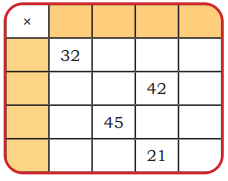
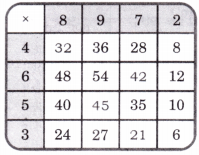
Solution:
The product of the numbers in each row is given in the orange boxes. The product of the numbers in each column is given in the blue boxes. Identify appropriate numbers to fill the blank boxes.
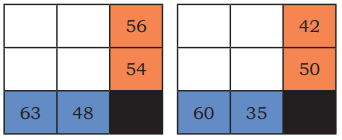
Solution:
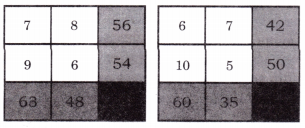
NCERT Textbook Pages 184-185 Times-10
Match each problem with the appropriate pictorial representation and write the answer.
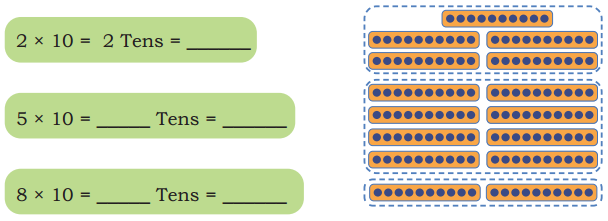
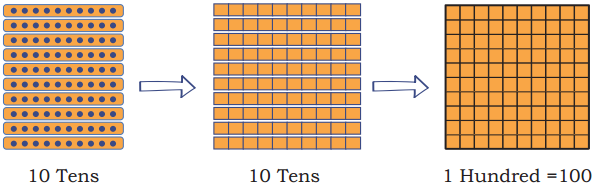
What is 10 × 10 = ____ Tens = _______
Solution:
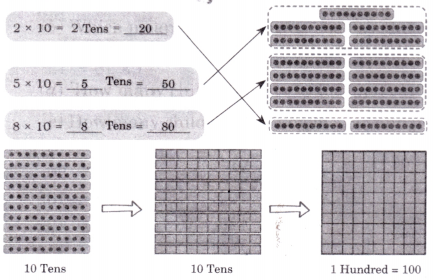
What is 10 × 10 = __10__ Tens = ___1Hundred____

NCERT Textbook Pages 185-187 Constructing Tables
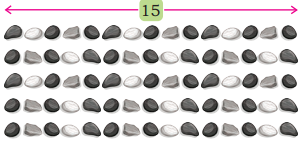
How many pebbles are there in this arrangement?
Solution:
There are 75 pebbles in this arrangement. This is 5 × 15 arrangement. There is an easy way to find this product by splitting the arrangement.
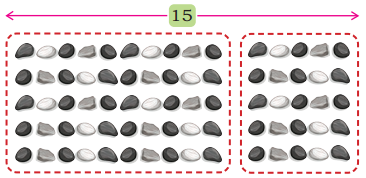
5 × 15 = 5 × 10 and 5 × 5 = 50 + 25 = 75
Recall the times-table that we created in Grade 3. Now construct a times-15 table. You may use the arrangement given below and split the columns into 10 and 5 for ease of counting, as shown on the previous page.
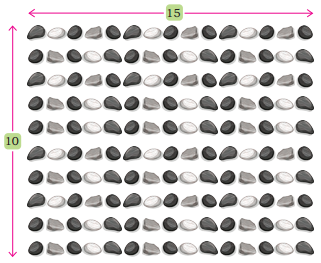
Solution:
1 × 15 = ___
2 × 15 = ___
3 × 15 = ___
4 × 15 = ___
5 × 15 = ___
6 × 15 = ___
7 × 15 = ___
8 × 15 = ___
9 × 15 = ___
10 × 15 = ___
Solution:
1 × 15 = 1 × 10 + 1 × 5 = 10 + 5 = 15
2 × 15 = 2 × 10 + 2 × 5 = 20 + 10 = 30
3 × 15 = 3 × 10 + 3 × 5 = 30 + 15 = 45
4 × 15 = 4 × 10 + 4 × 5 = 40 + 20 = 60
5 × 15 = 5 × 10 + 5 × 5 = 50 + 25 = 75
6 × 15 = 6 × 10 + 6 × 5 = 60 + 30 = 90
7 × 15 = 7 × 10 + 7 × 5 = 70 + 35 = 105
8 × 15 = 8 × 10 + 8 × 5 = 80 + 40 = 120
9 × 15 = 9 × 10 + 9 × 5 = 90 + 45 = 135
10 × 15 = 10 × 10 + 10 × 5 = 100 + 50 = 150
Question 1.
What patterns do you see in this table?
Solution:
1 × 15 = 15, the number of pebbles in the first row.
2 × 15 = 15 + 15 = 30 i.e., the number of pebbles in the both first and second row
3 × 15 = 15 + 15 + 15 = 45, i.e., the number of pebbles in the first three rows
4 × 15 = 15 + 15 + 15 + 15 = 60, i.e., the number of pebbles on the first four rows, and so on.
Thus, the numbers in the times-15 table increase by 15 each time. So, the pattern is 15, 30, 45, 60, and so on.
Question 2.
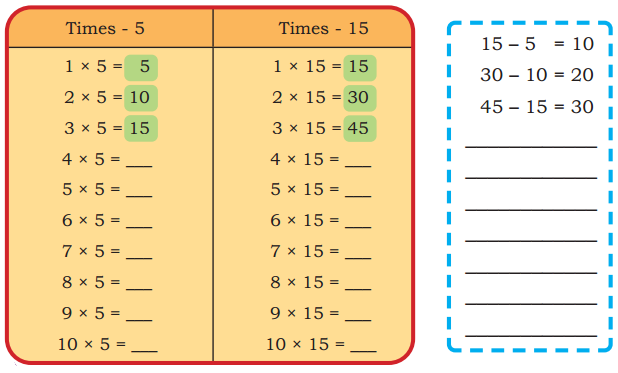
Compare the times-15 table with the times-5 table. What similarities and differences do you notice? It is time-10 table.
Solution:
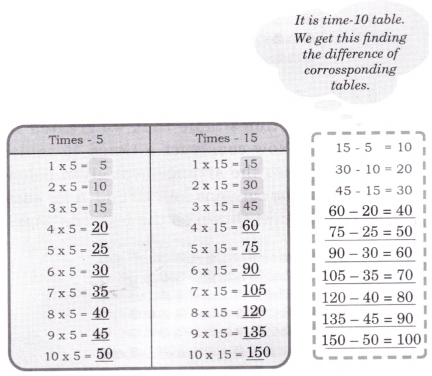
Similarity: The results in both tables alternate between odd and even numbers. For example, 5, 10, 15 (times-5 table) and 15, 30, 45 (times-15 table) are odd and even numbers in alternate place.
Difference: The primary difference is the base number being multiplied. The times-5 table multiplies by 5, while the times-15 table multiplies by 15. Also, each successive number in the times-15 table is three times larger than the corresponding number in the times-5 table.
Question 3.
Construct other times-tables for numbers from 11 to 20, as you did for 15.
Solution:
| Times-11 | Times-12 |
| 1 × 11 = 11 | 1 × 12 = 12 |
| 2 × 11 = 22 | 2 × 12 = 24 |
| 3 × 11 = 33 | 3 × 12 = 36 |
| 4 × 11 = 44 | 4 × 12 = 48 |
| 5×11= 55 | 5 × 12 = 60 |
| 6 × 11 = 66 | 6 × 12 = 72 |
| 7 × 11 = 77 | 7 × 12 = 84 |
| 8×11= 88 | 8 × 12 = 96 |
| 9 × 11 = 99 | 9 × 12 = 108 |
| 10 × 11 = 110 | 10 × 12 = 120 |
| Times-13 | Times-14 |
| 1 × 13 = 13 | 1 × 14 = 14 |
| 2 × 13 = 26 | 2 × 14 = 28 |
| 3 × 13 = 39 | 3 × 14 =s 42 |
| 4 × 13 = 52 | 4 × 14 = 56 |
| 5 × 13 = 65 | 5 × 14 = 70 |
| 6 × 13 = 78 | 6 × 14 = 84 |
| 7 × 13 = 91 | 7 × 14 = 98 |
| 8 × 13 = 104 | 8 × 14 = 112 |
| 9 × 13 = 117 | 9 × 14 = 126 |
| 10 × 13 = 130 | 10 × 14 = 140 |
| Times-15 | Times-16 |
| 1 × 15 = 15 | 1 × 16 = 16 |
| 2 × 15 = 30 | 2 × 16 = 32 |
| 3 × 15 = 45 | 3 × 16 = 48 |
| 4 × 15 = 60 | 4 × 16 = 64 |
| 5 × 15 = 75 | 5 × 16 = 80 |
| 6 × 15 = 90 | 6 × 16 = 96 |
| 7 × 15 = 105 | 7 × 16 = 112 |
| 8 × 15 = 120 | 8 × 16 = 128 |
| 9 × 15 = 135 | 9 × 16 = 144 |
| 10 × 15 = 150 | 10 × 16 = 160 |
| Times-17 | Times-18 |
| 1 × 17 = 17 | 1 × 18= 18 |
| 2 × 17 = 34 | 2 × 18 = 36 |
| 3 × 17 = 51 | 3 × 18 = 54 |
| 4 × 17 = 68 | 4 × 18 = 72 |
| 5 × 17 = 85 | 5 × 18 = 90 |
| 6 × 17 = 102 | 6 × 18 = 108 |
| 7 × 17 = 119 | 7 × 18 = 126 |
| 8 × 17 = 136 | 8 × 18 = 144 |
| 9 × 17 = 153 | 9 × 18 = 162 |
| 10 × 17 = 170 | 10 × 18 = 180 |
| Times-19 | Times-20 |
| 1 × 19 = 19 | 1 × 20 = 20 |
| 2 × 19 = 38 | 2 × 20 = 40 |
| 3 × 19 = 57 | 3×20= 60 |
| 4×19 = 76 | 4×20= 80 |
| 5×19 = 95 | 5×20= 100 |
| 6×19 = 114 | 6 × 20 = 120 |
| 7 × 19 = 133 | 7 × 20 = 140 |
| 8 × 19 = 152 | 8 × 20 = 160 |
| 9 × 19 = 171 | 9 × 20 = 180 |
| 10 × 19 = 190 | 10 × 20 = 200 |
Question 4.
As you compared the times-5 table with the times-15 table, compare the times-1 table with the times-11 table, the times-2 table with the times-12 table, and so on. Share your observations.
Solution:
Each successive number in the times-11 table is eleven times larger than the corresponding number in the times-1 table.
Similarly, each successive number in the times-12 table is six times larger than the corresponding number in the times-2 table, and so on.
NCERT Textbook Pages 187-188
Making tables by splitting into equal groups
Here is an arrangement of wheels. To count the total number of wheels, Tara splits them into two equal groups.
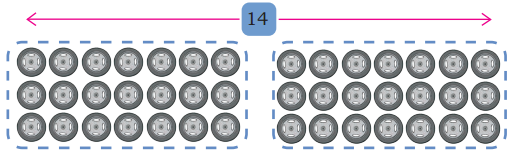
3 × 14 = 3 × 7 and 3 × 7
= 21 + 21 = double of 21
= 42
Similarly, 6 × 14 can be obtained by splitting the arrangement into two equal groups.
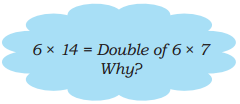
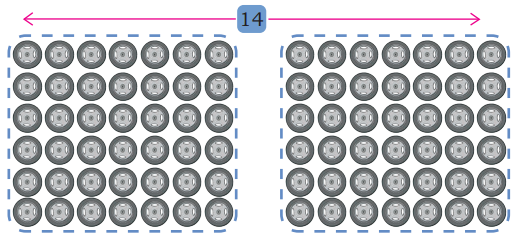
6 × 14 = 6 × 7 and 6 × 7
= 42 + 42 = double of 42
= 84
We have seen how to calculate 3 × 14 and 6 × 14 by splitting and doubling. Can we construct the times-14 table by splitting and doubling? Try!
Solution:
Yes, we can construct the times-14 table by splitting and doubling.
1 × 14 = 1 × , 1 7 and 1 × 7
= 1 × 7 + 1 × 7 = 7 + 7 = 14
2 × 14 = 2 × 7 and 2 × 7
= 2 × 7 + 2 × 7 = 14 + 14 = 28
3 × 14 = 3 × 7 and 3 × 7
= 3 × 7 + 3 × 7 = 21 + 21 = 42
4 × 14 = 4 × 7 and 4 × 7
= 4 × 7 + 4 × 7 = 28 + 28 = 56
5 × 14 = 5 × 7 and 5 × 7
= 5 × 7 + 5 × 7 = 35 + 35 = 70
6 × 14 = 6 × 7 and 6 × 7
= 6 × 7 + 6 × 7 = 42 + 42 = 84
7 × 14 = 7 × 7 and 7 × 7
= 7 × 7 + 7 × 7 = 49 + 49 = 98
8 × 14 = 8 × 7 and 8 × 7
= 8 × 7 + 8 × 7 = 56 + 56 = 112
9 × 14 = 9 × 7 and 9 × 7
= 9 × 7 + 9 × 7 = 63 + 63 = 126
10 × 14 = 10 × 7 and 10 × 7
= 10 × 7 + 10 × 7 = 70 + 70 = 140
What other times tables can be constructed by splitting into equal groups and doubling? Give examples.
Solution:
We can construct 8, 10, 12, 16, 18, 20, etc. times tables by splitting into equal groups and doublings.
NCERT Textbook Page 188 Multiples of 10
Find the answers to the following:
(a) 15 × 10 = ____ Tens = _______.
(b) 16 × 10 = ____ Tens = _______.
(c) 19 × 10 = ____ Tens = _______.
(d) 20 × 10 = ____ Tens = _______.
Solution:
(a) 15 × 10 = 15 Tens = 10 Tens + 5 Tens
= 100 + 50 = 150
(b) 16 × 10 = 16 Tens = 10 Tens + 6 Tens
= 100 + 60 = 160
(c) 19 × 10 = 19 Tens = 10 Tens + 9 Tens
= 100 + 90
= 190
(d) 20 × 10 = 20 Tens = 10 Tens + 10 Tens
= 100 + 100 = 200
10 × 10 = 10 Tens = 100 2 times (double)
10 × 10 = 10 Tens + 10 Tens
= 100 + 100 = 200
Discuss in grade what happens when we take several groups of 10.
Solution:
Do it yourself.
NCERT Textbook Pages 189-190
Now think and answer the following Problems.
30 × 10 = _____
40 × 10 = _____
50 × 10 = _____
60 × 10 = _____
70 × 10 = _____
80 × 10 = _____
Solution:
30 × 10 = 30 Tens = 300
40 × 10 = 40 Tens = 400
50 × 10 = 50 Tens = 500
60 × 10 = 60 Tens = 600
70 × 10 = 70 Tens = 700
80 × 10 = 80 Tens = 800
Answer the following questions. Share your thoughts.
(a) 21 × 10 = _______
Solution:
21 × 10 = 21 Tens = 20 Tens + 1 Ten
= 200 + 10
= 210
(b) 42 × 10 = _______
Solution:
42 × 10 = 42 Tens = 40 Tens + 2 Tens
= 400 + 20
= 420
(c) 65 × 10 = _______
Solution:
65 × 10 = 65 Tens = 60 Tens + 5 Tens
= 600 + 50
= 650
(d) 38 × 10 = _______
Solution:
38 × 10 = 38 Tens = 30 Tens + 8 Tens
= 300 + 80
= 380
(e) 53 × 10 = _______
Solution:
53 × 10 = 53 Tens = 50 Tens + 8 Tens
= 500 + 30
= 530
(f) 87 × 10 = _______
Solution:
87 × 10 = 87 Tens = 80 Tens + 7 Tens
= 800 + 70
= 870
Solve the following problems. Share your thoughts.
24 × 40 = _______
50 × 60 = _______
13 × 30 = _______
43 × 60 = _______
70 × 80 = _______
Solution:
24 × 40 = 20 × 40 and 4 × 40
= 20 × 4 Tens + 4 × 4 Tens
= 800 + 160
= 960
50 × 60 = 50 × 6 Tens
= 300 Tens
= 3000
13 × 30 = 13 × 3 Tens
= 39 Tens
= 390
43 × 60 = 40 × 60 and 3 × 60
= 40 × 6 Tens + 3 × 6 Tens
= 240 Tens + 18 Tens
= 2400 + 180
= 2580
70 × 80 = 8 × 7 × 10 × 10
= 56 × 10 Tens
= 560 Tens
= 5600
NCERT Textbook Pages 190-191 – A Day at the Transport Museum
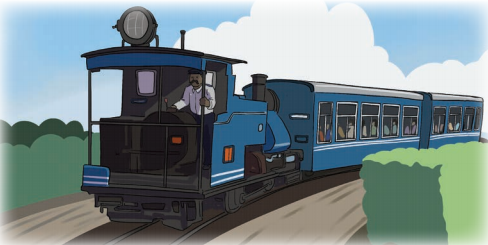
Amala, Raahi and Farzan are visiting the “Transport Museum”. This museum has a collection of different modes of transport used by people in India. It includes several vehicles from the olden days. Raahi spots a toy train. She figures out that each coach can seat 14 children. The toy train has 15 coaches.
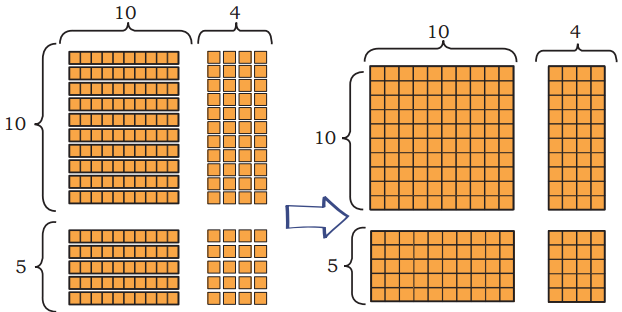
How many children can be seated in the toy train?
We have to find 15 × 14.
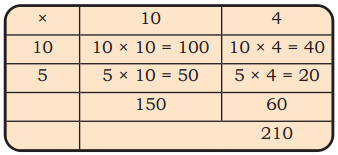
15 × 14 = 100 + 40 + 50 + 20
= 210
In 15 coaches, 210 children can be seated.
She wonders how many coaches will be needed for the 324 children from her school. Remember, each coach can seat only 14 children.
We have to find 324 ÷ 14
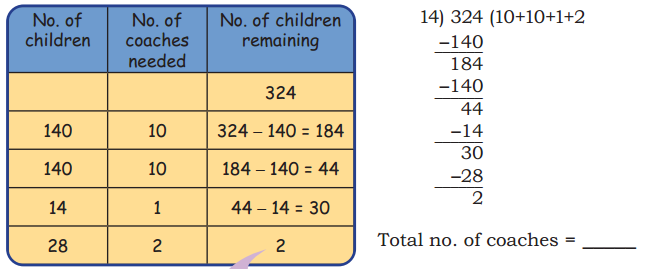
Total no. of coaches: 10 + 10 + 1 + 2 = 23
What do we do with the remaining 2 children? Discuss in grade.
Solution:
Do it yourself.
NCERT Textbook Page 192 Let Us Solve
Also, identify remainder (if any) in the division problems.
(a) 25 × 34
Solution:
| × | 20 | 5 |
| 30 | 30 × 20 = 600 | 30 × 5 = 150 |
| 4 | 4 × 20 = 80 | 4 × 5 = 20 |
| 600 + 80 = 680 | 150 + 20 = 170 | |
| 680 + 170 = 850 | ||
(b) 16 × 43
Solution:
| × | 10 | 6 |
| 40 | 40 × 10 = 400 | 40 × 6 = 240 |
| 3 | 3 × 10 = 30 | 3 × 6 = 18 |
| 400 + 30 = 430 | 240 + 18 = 258 | |
| 430 + 258 = 688 | ||
(c) 68 × 12
Solution:
| × | 60 | 8 |
| 10 | 10 × 60 = 600 | 10 × 8 = 80 |
| 2 | 2 × 60 = 120 | 2 × 8 = 16 |
| 600 + 120 = 720 | 80 + 16 = 96 | |
| 720 + 96 = 816 | ||
(d) 39 × 13
Solution:
| × | 30 | 9 |
| 10 | 10 × 30 = 300 | 10 × 9 = 90 |
| 3 | 3 × 30 = 90 | 3 × 9 = 27 |
| 300 + 90 = 390 | 90 + 27 = 117 | |
| 390 + 117 = 507 | ||
(e) 125 ÷ 15
Solution:
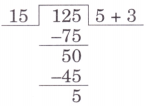
Thus, when 125 is divided by 15, we get (5 + 3) = 8 with remainder 5.
(f) 94 ÷ 11
Solution:
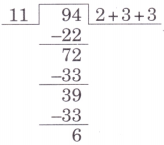
Thus, when 94 is divided by 11, we get (2 + 3 + 3) = 8 with remainder 6.
(g) 440 ÷ 22
Solution:
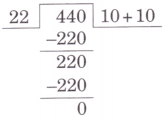
So, 440 ÷ 22 = 10 + 10 = 20
(h) 508 ÷ 18
Solution:
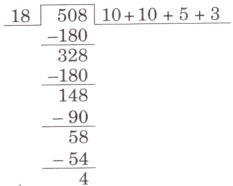
Thus, when 508 is divided by 18, we get (10 + 10 + 5 + 3) = 28 with remainder 4.
NCERT Textbook Pages 192-197 Multiples of 100
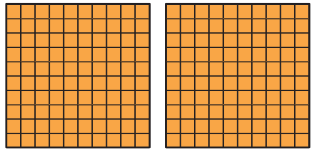
2 × 100 = 2 Hundreds = 200
3 × 100 = _____ Hundreds = ______
5 × 100 = _______ = __________
8 × 100 = ______ = _________
10 × 100 = 10 Hundreds = 1000
Solution:
2 × 100 = 2 Hundreds = 200
3 × 100 = 3 Hundreds = 300
5 × 100 = 5 Hundreds = 500
8 × 100 = 8 Hundreds = 800
What happens when we put 10 hundreds together?

11 × 100 = 11 Hundreds
= 10 Hundreds + 1 Hundred
= 1000+ 100 = 1100
12 × 100 = _______
15 × 100 = _______
20 × 100 = 20 Hundreds = 2000
27 × 100 = _______
70 × 100 = _______
Solution:
10 × 1 Hundred = 1000
12 × 100 = 12 Hundreds
= 10 Hundreds + 2 Hundreds
= 1000 + 200
= 1200
15 × 100 = 15 Hundreds
= 10 Hundreds + 5 Hundreds
= 1000 + 500
= 1500
27 × 100 = 27 Hundreds
= 20 Hundreds + 7 Hundreds
= 2000 + 700
= 2700
70 × 100 = 70 Hundreds
= 7000
Now answer the following questions. Share your thoughts.
30 × 100 = ________
40 × 100 = ________
50 × 100 = ________
24 × 100 = ________
53 × 100 = ________
19 × 100 = ________
We Know
80 × 100 = 8000
Find
80 × 50 = ________
40 × 50 = ______
Solution:
30 × 100 = 3 × 1000 = 3000
40 × 100 = 4 × 1000 = 4000
50 × 100 = 5 × 1000 = 5000
24 × 100 = 24 × 1 Hundred = 2400
53 × 100 = 53 × 1 Hundred = 5300
19 × 100 = 19 × 1 Hundred = 1900
80 × 50 = 4000
40 × 50 = 2000
Share what you notice about the answers to these problems.
11 × 100 = _______
11 × 200 = _______
22 × 100 = _______
22 × 200 = _______
Solution:
11 × 100 = 1100
11 × 200 = 11 × 100 + 11 × 100
= 1100 + 1100
= 2200
22 × 100 = 2200
22 × 200 = 22 × 2 Hundreds
= 44 Hundreds
= 4400
Answer the following questions. Share your thoughts.
18 × 100 = _______
5 × 500 = _______
15 × 200 = _______
14 × 300 = _______
23 × 200 = _______
7 × 800 = _______
Solution:
18 × 100 = 1800
5 × 500 = 5 × 5 Hundreds
= 25 Hundreds
= 2500
15 × 200 = 15 × 2 Hundreds
= 30 Hundreds
= 3000
14 × 300 = 14 × 3 Hundreds
= 42 Hundreds
= 4200
23 × 200 = 23 × 2 Hundreds
= 46 Hundreds
= 4600
7 × 800 = 7 × 8 Hundreds
= 56 Hundreds
= 5600
Find the answers in Set A. Examine the relationships between the problems and the answers in Set A carefully. Then use this understanding to find the answers in Set B.
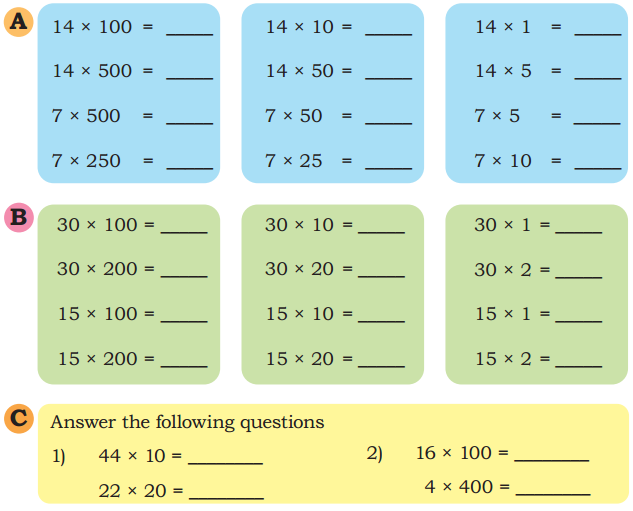
Solution:
| A. | 14 × 100 = 1400 14 × 10 = 140 7 × 500 = 3500 7 × 250 = 1750 |
14 × 500 = 7000 14 × 50 = 700 7 × 50 = 350 7 × 25 = 175 |
14 × 1 = 14 14 × 5 = 70 7 × 5 = 35 7 × 10 = 70 |
| B. | 30 × 100 = 3000 30 × 200 = 6000 15 × 100 = 1500 15 × 200 = 3000 |
30 × 10 = 300 30 × 20 = 600 15 × 10 = 150 15 × 20 = 300 |
30 × 1 = 30 30 × 2 = 60 15 × 1 = 15 15 × 2 = 30 |
C. Answer the following questions:
1. 44 × 10 = 440
22 × 20 = 22 × 10 + 22 × 10
= 220 + 220
= 440
2. 16 × 100 = 1600
4 × 400 = 4 × 100 + 4 × 100 + 4 × 100 + 4 × 100
= 400 + 400 + 400 + 400
= 1600
NCERT Textbook Page 197 – Let Us Solve
Also, identify remainder (if any) in the division problems,
(a) 237 × 28
Solution:
| × | 200 | 30 | 7 |
| 20 | 20 × 200 = 4000 | 20 × 30 = 600 | 20 × 7 = 140 |
| 8 | 8 × 200 = 1600 | 8 × 30 = 240 | 8 × 7 = 56 |
| 4000 + 1600 = 5600 | 600 + 240 = 840 | 140 + 56 = 196 | |
| 5600 + 840 + 196 = 6636 | |||
(b) 140 × 16
Solution:
| × | 100 | 40 | 0 |
| 10 | 10 × 100 = 1000 | 10 × 40 = 400 | 10 × 0 = 0 |
| 6 | 6 × 100 = 600 | 6 × 40 = 240 | 6 × 0 = 0 |
| 1000 + 600 = 1600 | 400 + 240 = 640 | 0 | |
| 1600 + 640 + 0 = 2240 | |||
(c) 389 × 57
Solution:
| × | 300 | 80 | 9 |
| 50 | 50 × 300 = 15000 | 50 × 80 = 4000 | 50 × 9 = 450 |
| 7 | 7 × 300 = 2100 | 7 × 80 = 560 | 7 × 9 = 63 |
| 15000 + 2100 = 17100 | 4000 + 560 = 4560 | 450 + 63 = 513 | |
| 17100 + 4560 + 513 = 22173 | |||
d) 807 ÷ 24
Solution:
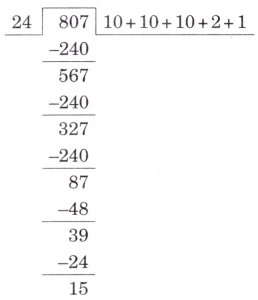
When 807 is divided by 24, we get 10 + 10 + 10 + 2 + 1 = 33, with remainder 15.
e) 692 ÷ 33
Solution:
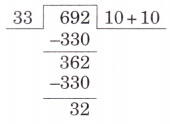
When 692 is divided by 33, we get 10 + 10 = 20, with remainder 32.
f) 996 ÷ 45
Solution:
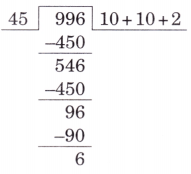
When 996 is divided by 45, we get 10 + 10 + 2 = 22, with remainder 6.
NCERT Textbook Pages 197-198
Dividing by 10 and 100
A farmer packs his rice in sacks of 10 kg each.
(а) If he has 60 kg of rice, how many sacks does he need?
Solution:
Weight of rice to pack in each sack = 10 kg
Total weight of rice = 60 kg
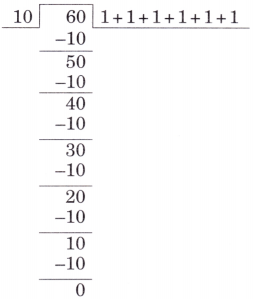
Number of required sacks = 600 + 10 = 60
Thus, the total no. of sacks required is 6.
(b) If he has 600 kg of rice, how many sacks does he need?
Solution:
The weight of rice to pack in each sack = 100 kg
Total weight of rice = 600 kg
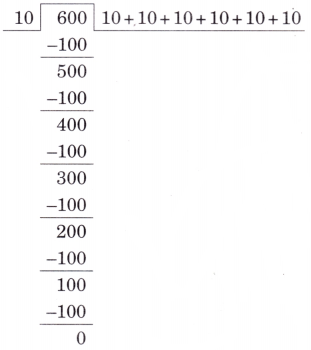
Number of required sacks = 600 ÷ 10 = 60
Thus, the total no. of sacks required is 60.
If a sack of rice weighs loo kg then how many sacks does he need for 600 kg of rice?
Solution:
The weight of rice to pack in each sack = 100 kg
Total weight of rice = 600 kg
Number of required sacks = 600 ÷ 100 = 6
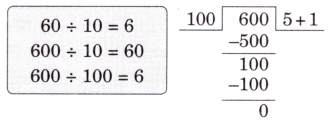
Find the answers to the following questions. Share your thoughts in class.
Solution:
40 ÷ 10 = 4
4 ÷ 2 = 2
400 ÷ 2 = 200
400 ÷ 10 = 40
40 ÷ 20 = 2
400 ÷ 20 = 20
400 ÷ 100 = 4
400 ÷ 200 = 2
400 ÷ 200 = 2
Think and answer. Write the division statement in each case.
Question 1.
Manku the monkey sees 870 bananas in the market. Each bunch has 10 bananas. How many bunches are there in the market?
Solution:
Total bananas in the market = 870
Number of bananas in each bunch = 10
Number of bunches in the market = 870 + 10 = 87
Division statement: 870 + 10 = 87
Question 2.
Rukhma Bi wants to distribute ₹ 1000/- equally among her 10 grandchildren on the occasion of Eid. How much money will each of them get?
Solution:
Number of grandchildren of Rukhma Bi = 10
Amount distributed by Rukhma Bi = ₹ 1000
Amount of money received by each grandchild = ₹ 1000 + 10 = ₹ 100
Division statement: 1000 + 10 = 100
NCERT Textbook Pages 198-200 Let Us Solve
Question 1.
The oldest long-distance train of the Indian Railways is the Punjab Mail which ran between Mumbai and Peshawar. Its first journey was on 12 October 1912. Do you I know how many coaches it had on its first journey? It had 6 coaches: 3 carrying 96 passengers and 3 for goods.
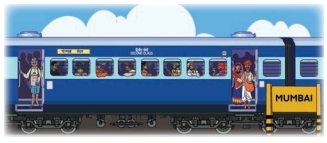
(a) How many people travelled in each coach on the first journey?
(b) This train has been running for 106 years now. It runs between Mumbai, Maharashtra and Ferozepur, Punjab. It has 24 coaches. Each coach can carry 72 passengers. How many people can travel on this train?
Solution:
(a) Number of coaches carrying passengers in train = 3
Number of peoples in train = 96
People travelled in each coach = 96 ÷ 3
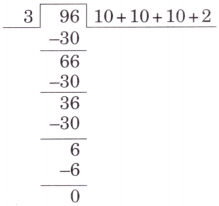
96 ÷ 3 = 10 + 10 + 10 + 2 = 32
Thus, 32 people travelled in each coach.
(b) Number of coaches in train = 24
Number of passengers in each coach = 72
Number of people travel in the train = 24 × 72
| × | 70 | 2 |
| 20 | 20 × 70 = 1400 | 20 × 2 = 40 |
| 4 | 4 × 70 = 280 | 4 × 2 = 8 |
| 1400 + 280 = 1680 | 40 + 8 = 48 | |
| 1680 + 48 =
= 1728 |
||
Thus, 1728 passengers can travel bn this train.
Question 2.
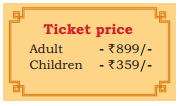
Amala and her 35 classmates, along with 6 teachers, are going on a school trip to Goa. They are using the double-decker “hop on hop off” sightseeing bus to explore the city.
(a) 2 people can sit on every seat of the bus. There are 15 seats in the lower deck and 10 in the upper deck. How many seats will they need to occupy? Are there enough seats for everyone?
(b) Find the total cost of the tickets for all children?
(c) What is the cost of the tickets for all teachers?
Solution:
(a) Total people in the bus = students + teachers = 36 + 6 = 42
Number of people who can sit on each seat = 2
Required number of seats occupied by the people = 42 + 2
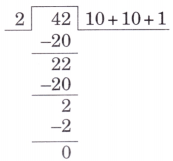
Total no. of seats occupied = 10+ 10+ 1 = 21
Total number of seats in the bus =15 + 10 = 25
Yes, there are enough seats for everyone.
Since, the total number of seats is more than the required number of seats occupied.
(b) Ticket price for each child = ₹ 359
Total cost of the tickets for all children = 36 × ₹ 359
| × | 300 | 50 | 9 |
| 30 | 30 × 300 = 9000 | 30 × 50 = 1500 | 30 × 9 = 270 |
| 6 | 6 × 300 = 1800 | 6 × 50 = 300 | 6 × 9 = 54 |
| 9000 + 1800 = 10800 | 1500 + 300 = 1800 | 270 + 54 = 324 | |
| 10800 + 1800 + 324 = 12924 | |||
Total coat of tickets for all children = ₹ 12924
(c) Ticket price for adult = ₹ 899
Total cost of the tickets for all teachers = 6 × ₹ 899
| × | 800 | 90 | 9 |
| 6 | 6 × 800 = 4800 | 6 × 90 = 540 | 6 × 9 = 54 |
| 4800 + 540 + 54 = 5394 | |||
Total cost of the tickets forn all teachers = ₹ 5394
Question 3.
Kedar works in a brick kiln.
(a) The kiln makes 125 bricks in a day. How many bricks can be made in a month?
(b) Each brick is sold in the market for ₹ 9. How much money can they earn in a month?
Solution:
(a) Number of bricks made in a day = 125
So, number of pricks can be made in a month = 30 × 125
| x | 100 | 20 | 5 |
| 30 | 30 × 100 = 3000 | 30 × 20 = 600 | 30 × 5 = 150 |
| 3000 + 600 + 150 = 3750 | |||
Therefore, 3750 brecks can be made in a month.
(b) Price of each brick = ₹ 9
Money earned in a month = ₹ 9 × 3750
| x | 3000 | 700 | 50 |
| 9 | 9 × 3000 = 27000 | 9 × 700 = 6300 | 9 × 50 = 450 |
| 27000 + 6300 + 450 = 33750 | |||
Money they earn in a month = ₹ 33750
Question 4.
Chilika lake in Odisha is the largest saltwater lake in India. It is famous for the Irrawaddy dolphins. Boats can be hired to go to see the dolphins. The trip from Puri includes a bus ride followed by a boat ride. Eight people will be going on the trip.

- A bus ticket from Puri to Satapada costs ₹ 60.
- A two-hour boat ride for 8 people costs ₹ 1200.
- How much money do we need to spend on each person?
Solution:
Boat ride costs for each person = ₹ 1200 ÷ 8
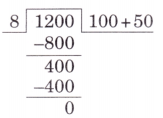
Boat ride cost of each person = 100 + 50 = ₹ 150
The bus ticket price = ₹ 60
Therefore, required money to spend on each person = ₹ 60 + ₹ 150 = ₹ 210
Question 5.
Find the multiplication and division sentences below. Shade the sentences. How many can you find? Some are done for you.
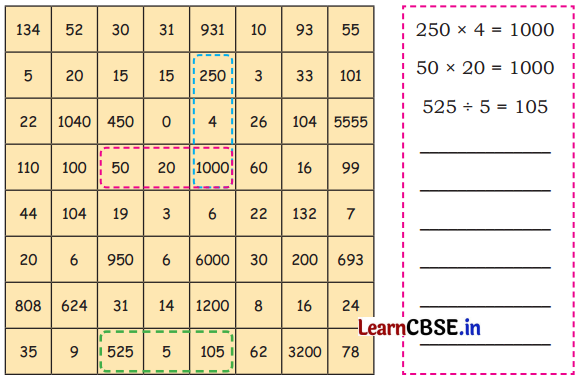
Solution:
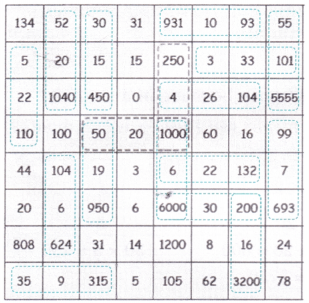
250 × 4 = 1000
50 × 20 = 1000
5 × 22 = 110
52 × 20 = 1040
104 × 6 = 624
30 × 15 = 450
50 × 19 = 950
1000 × 6 = 6000
55 × 101 = 5555
99 × 7 = 693
200 × 16 = 3200
35 × 9 = 315
931 ÷ 10 = 93
4 × 26 = 104
6 × 22 = 132
6000 ÷ 30 = 200
Question 6.
Solve
a) 35 × 76
Solution:
| x | 70 | 6 |
| 30 | 30 x 70 = 2100 | 30 x 6 = 180 |
| 5 | 5 x 70 = 350 | 5 x 6 = 30 |
| 2100 + 350 = 2450 | 180 + 30 = 210 | |
| 2450 + 210 = 2660 | ||
b) 267 × 38
Solution:
| x | 30 | 8 | |
| 200 | 200 x 30 = 6000 | 8010 + 2136 = 10146 | |
| 60 | 60 x 30 = 1800 | 60 x 8 = 480 | |
| 7 | 7 x 30 = 210 | 7 x 8 = 56 | |
| 6000 + 1800 + 210 = 8010 | 1600 + 480 + 56 = 2136 | ||
| 8010 + 2136 = 10146 | |||
c) 498 × 9
Solution:
| x | 9 |
| 400 | 400 x 9 = 3600 |
| 90 | 90 x 9 = 810 |
| 8 | 8 x 9 = 72 |
| 3600 + 810 + 72 = 4482 |
d) 89 × 42
Solution:
| x | 40 | 2 |
| 80 | 80 x 40 = 3200 | 80 x 2 = 160 |
| 9 | 9 x 40 = 360 | 9 x 2 = 18 |
| 3560 + 178 = 3738 | ||
e) 55 × 23
Solution:
| x | 20 | 3 |
| 50 | 50 x 20 = 1000 | 50 x 3 = 150 |
| 5 | 5 x 20 = 100 | 5 x 3 = 15 |
| 1000 + 100 = 1100 | 150 + 15 = 105 | |
| 1100 + 165 = 1265 | ||
f) 345 × 17
Solution:
| 300 | 300 x 10 = 3000 | 300 x 7 = 2100 |
| 40 | 40 x 10 = 400 | 40 x 7 = 280 |
| 5 | 5 x 10 = 50 | 5 x 7 = 35 |
| 3000 + 400 + 50 = 3450 | 2100 + 280 + 35 = 2415 | |
| 3450 + 2415 = 5865 | ||
g) 66 × 22
Solution:
| x | 20 | 2 |
| 60 | 60 x 20 = 1200 | 60 x 2 = 120 |
| 6 | 6 x 20 = 120 | 6 x 2 = 12 |
| 1200 + 120 = 1320 | 120 + 12 = 132 | |
| 1320 + 132 = 1452 | ||
h) 704 × 11
Solution:
| x | 10 | 1 |
| 700 | 700 x 10 = 700 | 700 x 1 = 700 |
| 0 | 0 x 10 = 0 | 0 x 1 = 0 |
| 4 | 4 x 10 = 40 | 4 x 1 = 4 |
| 7000 + 0 + 40 = 7040 | 700 + 0 + 4 = 704 | |
| 7040 + 704 = 7744 | ||
i) 319 × 26
Solution:
| x | 20 | 6 |
| 300 | 300 x 20 = 6000 | 300 x 6 = 1800 |
| 10 | 10 x 20 = 200 | 10 x 6 = 60 |
| 9 | 9 x 20 = 180 | 9 x 6 = 54 |
| 6000 + 200 + 180 = 6380 | 1800 + 60 + 54 = 1914 | |
| 6380 + 1914 = 8294 | ||
j) 459 ÷ 3
Solution:
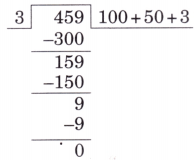
Thus, when 459 is divided by 3, we get 100 + 50 + 3 = 153 with no remainder.
k) 774 ÷ 18
Solution:
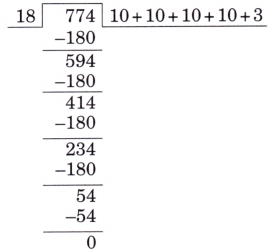
So, 774 + 18 = 10 + 10 + 10 + 10 + 3 = 43
l) 864 ÷ 26
Solution:
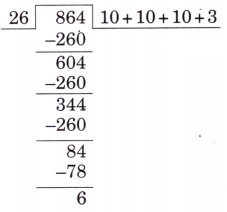
Thus, when 864 is divided by 26, we get (10 + 10 + 10 + 3 = 33) with remainder 6.
m) 304 ÷ 12
Solution:
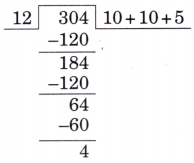
Thus, when 304 is divided by 12, we get (10 + 10 + 5 = 25) with remainder 4.
n) 670 ÷ 9
Solution:
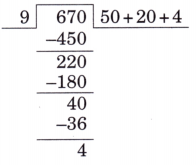
Thus, when 670 is divided by 9, we get (50 + 20 + 4 = 74) with remainder 4.
o) 584 ÷ 25
Solution:
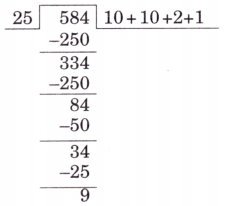
Thus, when 584 is divided by 25, we get (10 + 10 + 2 + 1 = 23) with remainder 9.
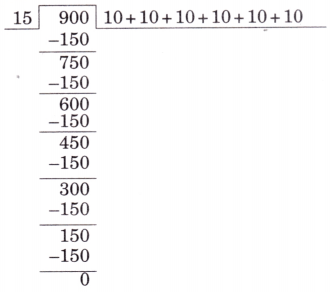
p) 900 ÷ 15
Solution:
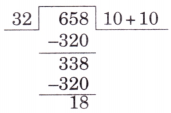
Thus, when 658 is divided by 32, we get (10 + 10 = 20) witli remainder 18.
q) 658 ÷ 32
Solution:
Thus, when 900 is divided by 15, we get (10 + 10 + 10 + 10 + 10)
r) 974 ÷ 9
Solution:
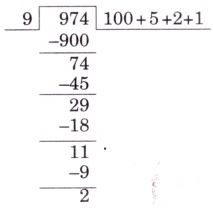
Thus, when 974 is divided by 9, we get (100 + 5 + 2 + 1 = 108) with remainder 2.
NCERT Textbook Pages 201 -202 Chinnu’s Coins
Question 1.
Five friends plan to visit an amusement park nearby. Each of them uses different notes and coins to buy the ticket. The cost of the ticket is ?750.
- Bujji has brought all notes of ₹ 200.
- And Munna has brought all notes of ₹ 50.
- Whereas Balu has brought all notes of ₹ 20.
- And guess what, Chinnu got all coins of ₹ 5.
- And Sansu has all coins of ₹ 2.
(a) Find out how many notes/coins each child has to bring to buy the ticket.
(b) Which of these children will not receive any change from the cashier?
(c) How long would the cashier take to count Chinnu’s coins?
Solution:
(a) Notes brought by Bujji = 750 ÷ 200
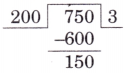
So, Munna brought 10+ 2 + 2 + 1 = 15 notes of ₹ 50 to buy the ticket.
Notes brought by Balu = 750 ÷ 20
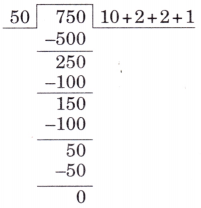
So, Balu brought 10 + 10 + 10 + 5 + 2 = 37 + 1 = 38 notes of ₹ 20 as for remaining ₹ 10, he again gave ₹ 20 note and got back ₹ 10 note back from the cashier.
Coins brought by Chinnu = 750 ÷ 5
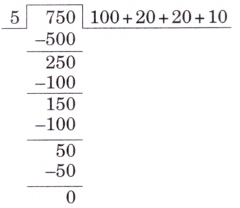
So, Chinnu brought 100 + 20 + 20 + 10 = 150 coins.
Coins brought by Sansu= 750 ÷ 2
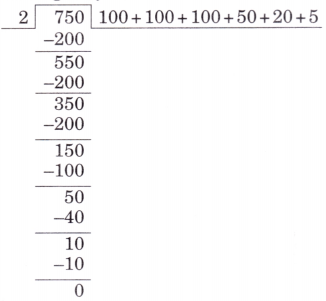
So, Sansu brought 100 + 100 + 100 + 50 + 20 + 5 = 375 coins of ₹ 20.
(b) Munna, Chinnu, and Sansu will not receive any change from the cashier.
(c) Chinnu has all coins of ₹ 5. And 750 + 5 = 150. So, the cashier counted 150 times to count Chinnu’s coins.
Question 2.
Observe the following multiplications. The answers have been provided.
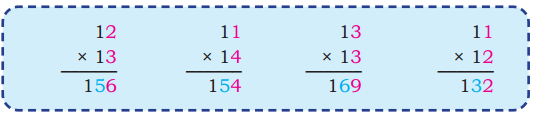
In each case, do you see any pattern in the two numbers and their product? (Hint: Look at the coloured digits!)
For what other multiplication problems will this pattern hold? Find 5 such examples.
Solution:
We observe that, the ones digit of the product is the product of ones digits of the multiplicand and multiplier, and the tens digit of the product is the sum of ones digit of the multiplicand and multiplier.
Other such examples are

Question 3.
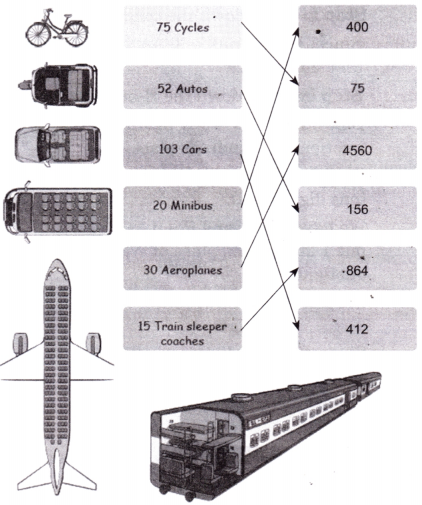
Assume each vehicle is travelling with full capacity. How many people can travel in each of these vehicles? Match them up.
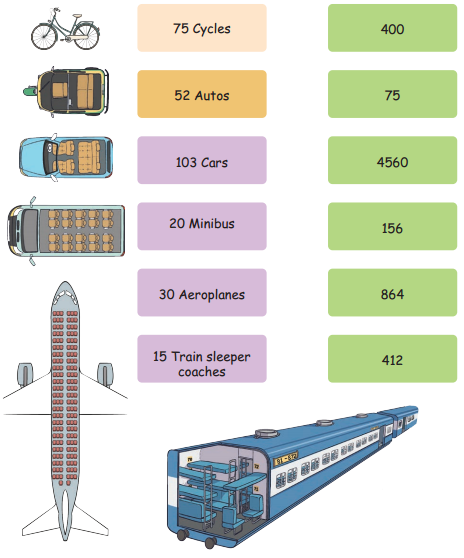
Solution: