.
Class 5 EVS Chapter 1 Water The Essence of Life Question Answer
Water The Essence of Life Class 5 EVS Question Answer
Our Wondrous World Class 5 EVS Chapter 1 Question Answer – Class 5 EVS Water The Essence of Life Question Answer
Discuss (Page 4)
Question 1.
Do you think we can drink the water present in the oceans?
Answer:
No, we cannot drink ocean water because it is salty. The salt in ocean water makes it unfit for drinking. Our bodies need freshwater to stay healthy.

Question 2.
What can ocean water be used for?
Answer:
Ocean water can be used to make salt. It can also be used for washing and cleaning. In some places, people purify ocean water through a process called desalination to make it fit for drinking.
Activity 1 (Page 5)
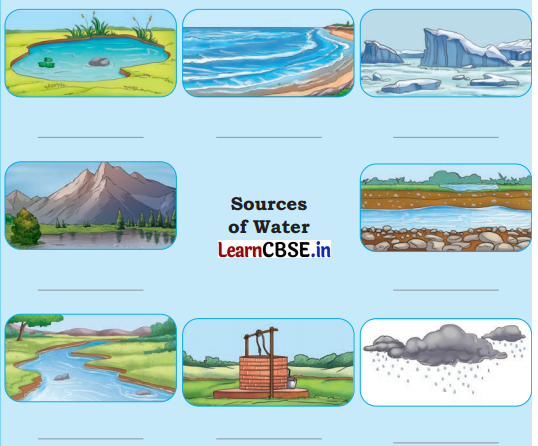
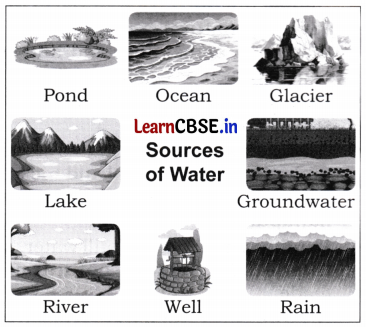
Where can we find freshwater? Identify the different freshwater sources from the images given below and write their names.
Answer:
The sources of freshwater are pond, glacier, lake, river, groundwater, well and rain.
Activity 2 (Page 6)
Take a steel glass. Put some ice cubes in it. Observe the small water droplets forming on the glass.
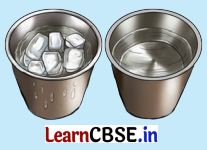
(a) Where do these water droplets come from?
…………………………………………….
(b) What happens to the ice cubes after they are left in the glass for some time?
…………………………………………….
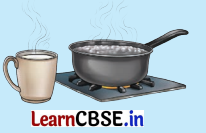
(c) If we heat water, what will happen to it?
…………………………………………….
In the above activity, what forms of water do you see?
Answer:
(a) Water droplets come from the water vapour in the air that cools down.
(b) After some time, the ice cubes melt and turn into liquid water.
(c) If we heat water, it will start to boil and then change into water vapour or steam.
In this activity, we see all three forms of water – solid as ice cubes, liquid as water after the ice melts, and gas as steam or water vapour when the water is heated.
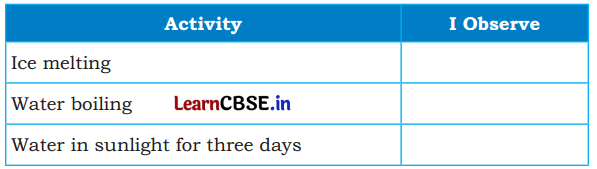
Observing Changes
| Activity | I Observe |
| Ice melting | The ice slowly turns into water. (Solid to liquid) |
| Water boiling | Water turns into water vapour or steam. (Liquid to gas) |
| Water in sunlight for three days | The water level decreases as it evaporates. (Liquid to gas due to sunlight) |
Activity 3 (Page 7)
- Take a transparent bag.
- Use a marker to draw the sun, clouds, trees and arrows on it as shown in the picture.
- Fill one-third of it with coloured water.
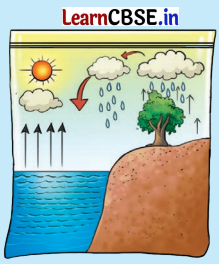
Tip: You can use blue paint or food dye for this.
- Seal the bag tightly to prevent any leaks.
- Place it in the sunlight.
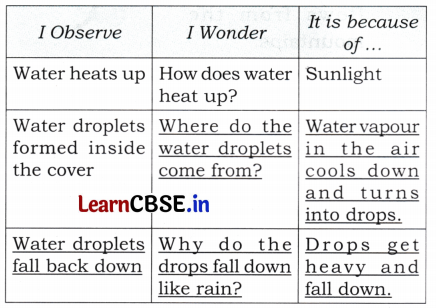
- After a few hours, observe the changes inside the bag.
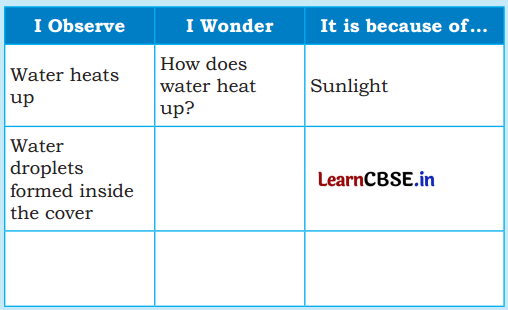
Answer:
Activity 4 (Page 9)
- Take a transparent glass.
- Fill half of it with soil.
- Slowly pour water into the soil using a spoon.
- Observe what happens.
Answer:
When water is poured into the soil, the soil soaks it up. The water moves down through the soil and collects at the bottom of the glass.
Activity 5 (Page 9)
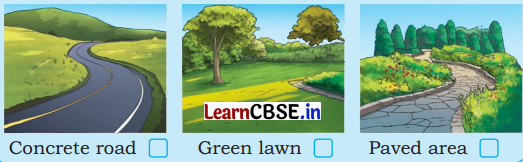
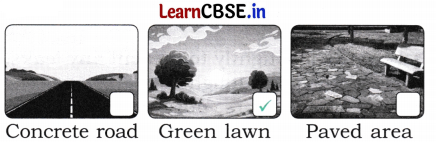
Tick the image that will help in groundwater recharge.
Answer:
Activity 6 (Pages 10-11)
Question 1.
What did you observe about the mustard seeds?
Answer:
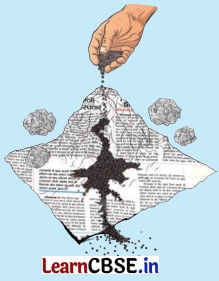
The mustard seeds rolled down the slope from the top, just like water flows from the mountains.
Question 2.
Are they moving in a straight line, or do they spread out in different directions?
Answer:
They spread out in different directions, depending on the shape of the paper.
Question 3.
Are they collecting in some areas? Do they gather like water gathers in lakes, rivers and so on?
Answer:
Yes, the seeds collect in low areas, just like water gathers in rivers, ponds, and lakes.
Discuss (Page 11)
On the basis of Activity 6 with mustard seeds, discuss how some rivers flow towards the Arabian Sea while some flow towards the Bay of Bengal.
Answer:
In Activity 6, we saw that mustard seeds rolled down from high areas to low areas. In the same way, rivers flow from the mountains to lower land.
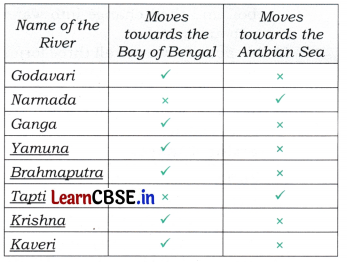
Some rivers in India flow towards the Bay of Bengal (east), and some flow towards the Arabian Sea (west). This happens because rivers follow the slope of the land, just like the mustard seeds did.
Activity 7 (Page 13)
Follow the Flow!
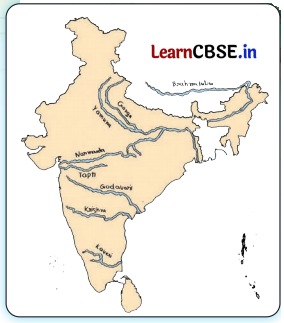
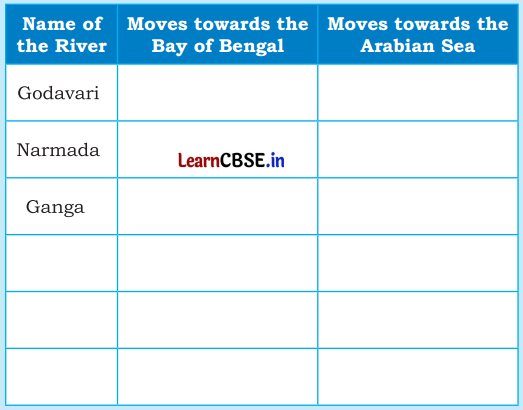
In the map, you can see the rivers flowing in different directions. Some flow into the Bay of Bengal and some into the Arabian Sea. Observe and fill in the table.
Answer:
Intext (Pages 14-15)
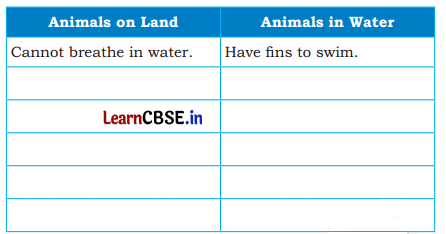
Complete the following table discussing with peers about the characteristics of animals on land and animals in water.
Answer:
| Animals on land | Animals in water |
| Cannot breathe in water. | Have fins to swim. |
| Use legs to walk or run. | Use fins and tails to move. |
| Breathe through lungs. | Breathe through gills or skin. |
| Have fur or hair on their body. | Have scales or smooth skin. |
| Live on land. | Live in ponds, rivers. or oceans. |
| Have strong bones to support weight. | Have lighter bodies to float or swim easily. |
Activity 8 (Pages 17-18)
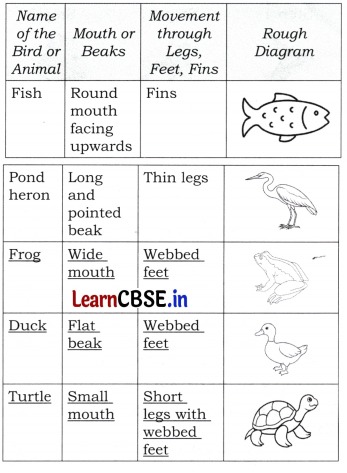
Visit a local water body like a pond, lake or an aquarium with your teacher or parents, and observe life in and around the water body.
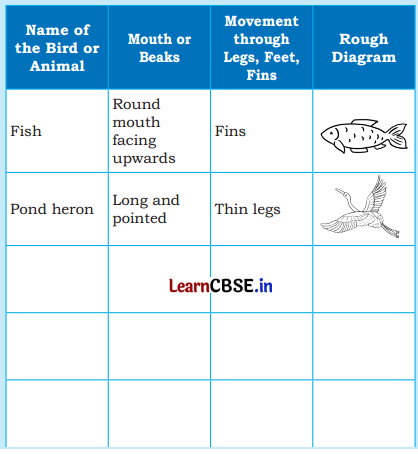
1. Based on your observations, complete the following table.
Answer:
Question 2.
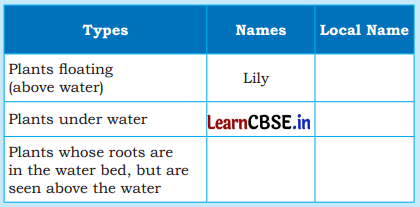
Draw the plants that you saw during the visit and label them with their local name.
Answer:
Draw the plants by yourself.
| Types | Names | Local Name |
| Plants floating (above water) | Lily | Kumudini |
| Plants under water | Tape grass | Suala |
| Plants whose roots are in the water bed, but are seen above the water | Lotus | Kamal |
Activity 9 (page 18)
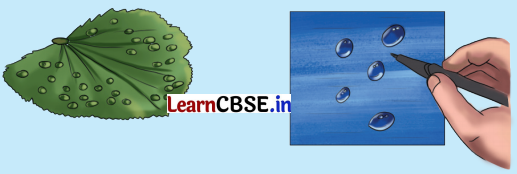
1. Take a piece of paper and put a drop of water on it. Observe.
2. Colour the paper with a wax crayon. Now, put a drop of water on it. Do you observe any change?
Write your observation.
………………………………….
………………………………….
Answer:
When we put a drop of water on plain piece of paper, the paper soaks up the water and may look wet or wrinkled. However, when we colour the paper with a wax crayon and then put a drop of water on it, the water does not soak in. It stays on the surface like a small round drop.
Activity 10 (Page 19)
Who Eats Whom?-A River Food Chain Game
- Distribute slips of paper to students. Each student writes what they choose to be (for example, small fish, big fish, frog, bird, human, crocodile, otter, etc.)
- Ask the students to think about what they eat, and who eats them.
- Use a string to connect the students who depend on each other for food.
- Discuss what would happen if one animal disappears (for example, what if all the fish are gone?).
Answer:
Do it yourself.
Let Us Reflect (Page 20)
Question 1.
Match the following:
| (i) Ocean water | (a) Solid form of water |
| (ii) Snow | (b) Vapour form of water |
| (iii) Steam | (c) Not fit for drinking |
| (iv) Rainwater | (d) Freshwater |
Answer:
| (i) Ocean water | (c) Not fit for drinking |
| (ii) Snow | (a) Solid form of water |
| (iii) Steam | (b) Vapour form of water |
| (iv) Rainwater | (d) Freshwater |
Question 2.
Why do you think most of the water on Earth cannot be used for drinking or farming?
Answer:
Most of the water on Earth is found in oceans and seas, which is salty and therefore cannot be used for drinking or farming.
Question 3.
Large number of living beings live near water bodies. Why?
Answer:
Many living beings live near water bodies because water is essential for life. Water bodies provide drinking water, food (like fish and water plants), and also serve as homes for many animals and birds.
Question 4.
What would happen if it did not rain in your region for two years?
Answer:
If it did not rain for two years:
- Rivers and ponds would dry up.
- Crops would not grow.
- People and animals would face water shortages.
- Groundwater levels would go down.
- There could be drought and food scarcity.
Question 5.
What do you think happens to rainwater in a forest compared to a city?
Answer:
In a forest, rainwater easily soaks into the ground, helping to recharge groundwater and support plant life. In a city, most surfaces like roads and buildings are cemented, so rainwater cannot seep into the ground. It runs off quickly, leading to waterlogging and reduced groundwater recharge.
Question 6.
Can you design a house or school that conserves water wisely? What would it include?
Answer:
Yes, a house or school that conserves water would include:
- A rainwater harvesting system.
- Open garden areas with soil to absorb water.
- Recycling or reuse of water for gardening.
- Water-saving taps and toilets.
- Soak pits for recharging groundwater.
Question 7.
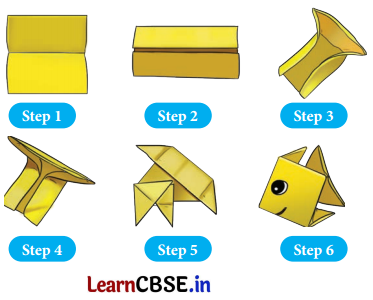
Let us make a fish by folding a piece of paper.
Answer:
Do it yourself