.
Class 5 Maths Chapter 1 We the Travellers 1 Question Answer Solutions
We the Travellers 1 Class 5 Maths Solutions
Class 5 Maths Chapter 1 Solutions
NCERT Textbook Pages 1-4
Reading and Writing Large Numbers
How do you write numbers to show several thousand object?
Let us start with 1,000. What numbers do we get when we keep adding a thousand?
Solution:
( 1,000) ( 2,000) ( 3,000) (4,000) (5,000) (6,000) (7,000) (8,000) (9,000)
Let us see how we write number beyond 10,000 and how we name them. We write them in the same way as numbers below 9,999. You can use the tokens given in the end of the book.
Solution:

NCERT Textbook Pages 5-7
Let Us Do
Question 1.
Fill in the blanks by continuing the pattern in each of the following sequences. Discuss the patterns in class.

Solution:
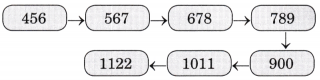
Pattern:
Add 111 to the number to get the next number.

Solution:
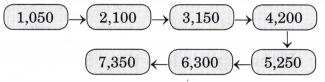
Pattern:
Add 1,050 to the previous number to get the next number.

Solution:
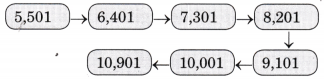
Pattern:
Add 900 to the previous number to get the next number.


Solution:
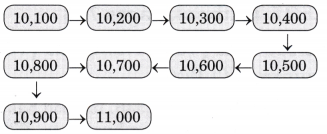
Pattern:
Add 100 to the previous number to get the next number.

Solution:
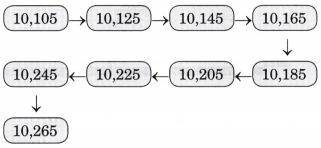
Pattern:
Add 20 to the previous number to get the next number.

Solution:
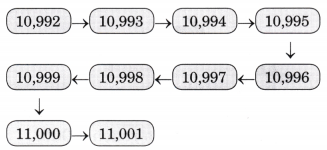
Pattern:
Add 1 to the previous number to get the next number.

Solution:
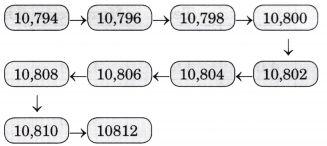
Pattern:
Add 2 to the previous number to get the next number.

Solution:
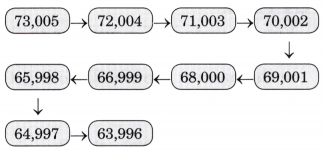
Pattern:
Subtract 1,001 to the previous number to get the next number.

Solution:

Pattern:
Add 1,000 to the previous number to get the next number.
Question 2.
Fill in the blanks appropriately. Use commas as required.
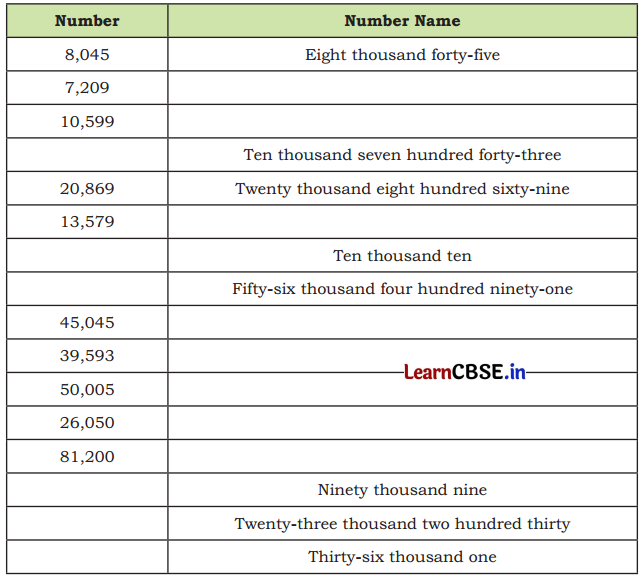
Solution:
| Number | Number Name |
| 8,045 | Eight thousand forty-five |
| 7,209 | Seven thousand two hundred nine |
| 10,599 | Ten thousand five hundred ninety- nine |
| 10,743 | Ten thousand seven hundred forty- three |
| 20,869 | Twenty thousand eight hundred sixty-nine |
| 13,579 | Thirteen thousand five hundred
seventy-nine |
| 10,010 | Ten thousand ten |
| 56,491 | Fifty-six thousand four hundred ninety-one |
| 45,045 | Forty-five thousand forty-five |
| 39,593 | Thirty-nine thousand five hundred
ninety-three |
| 50,005 | Fifty thousand five |
| 26,050 | Twenty-six thousand fifty |
| 81,200 | Eighty-one thousand two hundred |
| 90,009 | Ninety thousand nine |
| 23,230 | Twenty-three thousand two hundred thirty |
| 36,001 | Thirty-six thousand one |
Question 3.
Arrange the numbers below in increasing order. You can use the number line below, if required.
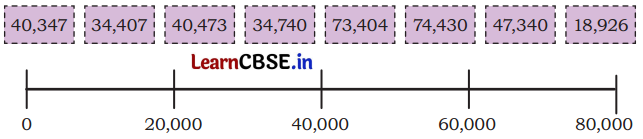
Solution:
We arrange the given numbers in increasing order as:

Question 4.
A student said 9,990 is greater than 49,014 because 9 is greater than 4. Is the student correct? Why or Why Not?
Use the number line below to find the position of the numbers. Fill in the blanks.
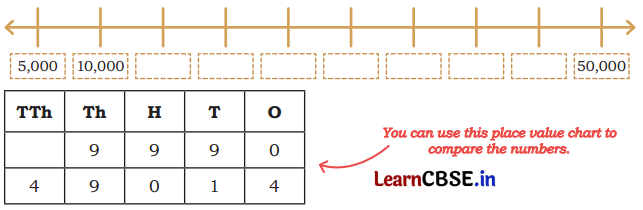
Solution:
Although 9 is greater than 4, we have to compare the number of digits first.
Here, 9,990 has 4 digits and 49,014 has 5 digits.
A number with 5 digits is always bigger than a number with 4 digits.
So, 49,014 is greater than 9,990.

On a number line, the number lying to the right is greater than the number to its left.
∴ 9,990 < 49,014
Question 5.
Digit swap
(a) In the number 1,478, interchanging the digits 7 and 4 gives 1,748. Now, interchange any two digits in the number 1,478 to make a number that is larger than 5,500
Solution:
To make a number larger than 5,500 from 1,478 interchange the digits 1 and 8 to get 8,471.
or
Interchange the digits 1 and 7 to get 7,418.
(b) Interchange two digits of 10,593 to make a number
(i) Between 11,000 and 15,000.
(ii) More than 35,000.
Solution:
(i) Interchange the digits 0 and 3 in 10,593 to get 13,590.
So, 13,590 is between 11,000 and 15,000.
(ii) Interchange the digits 1 and 5 in 10,593 to get 50,193.
or
Interchange digits 1 and 9 in 10,593 to get 90,513.
So, 50,193 and 90,513 both the numbers are more than 35,000.
(c) Interchange two digits of 48,247 to make a number
(i) As small as possible.
(ii) As big as possible.
Solution:
(i) Interchange the digits 2 (hundreds place) and 4 (ten thousands place) in 48,247 to get 28,447.
(ii) Interchange the digits 4 and 8 in 48,247 to get 84,247.
NCERT Textbook Pages 7-8
Nearest Tens (10s), Hundreds (100s), and Thousands (1,000)
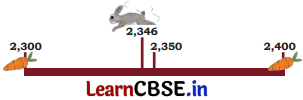
The rabbit is at 2,346. Its food has been kept at its neighbouring hundreds. Which of the two hundreds should the rabbit go to?
_______ is the nearest hundred of 2,346. It will need______ jumps to reach ______.
Solution:
2,300 is the nearest hundred of 2,346. It will need 46 jumps to reach 2,300.
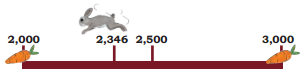
The rabbit is at 2,346. Its food has been kept at its neighbouring thousands. Which number should the rabbit go to?
_________ is the nearest thousand of 2,346. It will need _______ jumps to reach ______.
Solution:
2,000 is the nearest thousand of 2,346. It will need 346 jumps to reach 2,000.
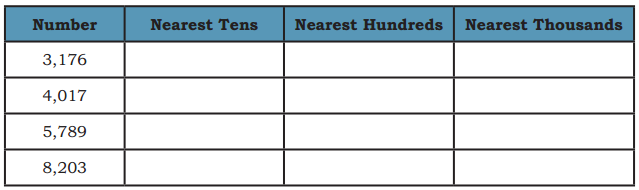
Fill in the boxes appropriately.
Solution:
| Number | Nearest
Tens |
Nearest
Hundreds |
Nearest
Thousands |
| 3,176 | 3,180 | 3,200 | 3,000 |
| 4,017 | 4,020 | 4,000 | 4,000 |
| 5,789 | 5,790 | 5.800 | 6,000 |
| 8,203 | 8,200 | 8.200 | 8,000 |
NCERT Textbook Pages 8-9
Let Us Think
Question 1.
Vijay rounded off a number to the nearest hundred. Suma rounded off the same number to the nearest thousand. Both got the same result. Circle the numbers they might have used.
7,126 7,835 7,030 6,999
Solution:
Analyse the following numbers:
7,126: Rounded to the nearest hundred is 7,100 (since 2 < 5) and rounded to the nearest thousand is 7,000 (since 1 < 5)
7,835: Rounded to the nearest hundred is 7,800 (since 3 < 5) and rounded to the nearest thousand is 8,000 (since 8 > 5)
7,030: Rounded to the nearest hundred is 7,000 (since 3 < 5) and rounded to the nearest thousand is 7,000 (since 0 < 5).
6,999: Rounded to the nearest hundred is 7,0 (since 9 > 5) and rounded to the nearest thousand is 7,000 (since 9 > 5).
Both 7,030 and 6,999 result in the same value 7,000, when rounded to the nearest hundred and the nearest thousand.
Therefore, the numbers they might have used are 7,030 and 6,999.
Question 2.
Think and write two numbers that have the same—
(a) Nearest ten.
(b) Nearest hundred.
(c) Nearest thousand.
Solution:
(a) 28 and 31
(b) 78 and 126
(c) 883 and 1263 (Answers may vary)
Question 3.
Think and write the numbers that have the same—
(a) Nearest ten and nearest hundred.
(b) Nearest hundred and nearest thousand.
(c) Nearest ten, hundred and thousand.
Solution:
(a) Numbers have the same nearest ten and nearest hundred when rounding gives the same result.
This happens when a number is very close to a hundred, either just above or just below it.
If we round off the numbers from 95 to 104 either 10 or 100, we get 100 in all cases.
(b) Numbers have the same nearest hundred and nearest thousand when rounding gives the same result.
This happens when a number is very close to a thousand, either just above or just below it.
If we round off the numbers from 950 to 1049 either 100 or 1000, we get 1000 in all cases,
(c) Numbers have the same nearest ten, hundred and thousand when rounding gives the same result.
This happens when a number is very close to a thousand, either just above or just below it.
If we round off the numbers from 995 to 1004 either 10, 100 or 1000, we get 1000 in all cases.
NCERT Textbook Page 10
Let Us Do
Question 1.
A cyclist can cover 15 km in one hour. How much distance will she cover in 4 hours, if she maintains the same speed?
Solution:
Distance covered by the cyclist in one hour = 15 km
So, the distance covered by the cyclist in 4 hours = 15 km × 4 = 60 km
Question 2.
A school has 461 girls and 439 boys. How many vehicles are needed for all of them to go on a trip using the following modes of travel? The numbers in the bracket indicates the number of people that can travel in one vehicle.
(a) Bicycle (2)
(b) Autorickshaw (3)
(c) Car (4)
(d) Big car (6)
(e) Tempo traveller (10)
(f) Boat (20)
(g) Minibus (25)
(h) Aeroplane (180)
Solution:
Total number of students in school = 461 + 439 = 900
(a) In a bicycle, only 2 people can travel, so the number of bicycles needed for all of
them to go on a trip = \(\frac{1}{2}\) = 450.
(b) In an auto rickshaw, only 3 people can travel, so the number of auto rickshaws needed for all of them to go on a trip = \(\frac{900}{3}\) = 300.
(c) In a car, only 4 people can travel, so the number of cars needed for all of them to go on a trip = \(\frac{900}{4}\) = 225.
(d) In a big car, only 6 people can travel, so the number of big cars needed for all of them to go on a trip = \(\frac{900}{6}\) = 150.
(e) In a tempo traveller, only 10 people can travel, so the number of tempo travellers needed for all of them to go on a trip = \(\frac{900}{10}\) = 90
(f) In a boat, only 20 people can travel, so the number of boats needed for all of them to go on a trip = \(\frac{900}{20}\) = 45.
(g) In a minibus, only 25 people can travel, so the number of minibuses needed for all of them to go on a trip = \(\frac{900}{25}\) = 36
(h) In an aeroplane, 180 people can travel, so the number of aeroplanes needed for all of them to go on a trip = \(\frac{900}{180}\) = 5.
NCERT Textbook Pages 10-11
Finding Large Numbers Around Us
A book has around 200 pages, and each page has about 50 words. The book therefore has about 10,000 words in all.
Find something in the textbook whose count is a 4-digit
Solution:
A book has around 200 pages each page has about 50 words. We can assume that there are about 10 words in a sentence. There would be 50 ÷ 10 = 5 sentences on each page. So, the number of sentences in the book = 200 × 5 = 1,000 which is 4-digit number.
Now, let us try this with our school.
(a) Our school has ______ classrooms.
(b) There are ______ students in my class.
(c) Our classroom has ______ books in total.
Solution:
Do it yourself
Find something in the classroom whose count is a—
(i) 4-digit number
(ii) 5-digit number
Solution:
Do it yourself
List some quantities whose count is a 4-digit or a 5-digit number in the context of—
(i) A tree.
(ii) Your village/town/city, or any other place of your choice.
Solution:
Do it yourself
NCERT Textbook Pages 11-13
Pastime Mathematics
Question 1.
Mira poses the river crossing puzzle to Sanju. A boatman wants to cross a river in a boat. He has to take a lion, a sheep, and a bundle of grass with him. He can take one of them at a time. If the sheep and grass are left on the shore, the sheep will eat the grass. And, if the sheep and lion are left on the shore, the lion will eat the sheep. How can the boatman take the lion, sheep, and grass across the river? Help him so that he can ferry the lion, sheep, and grass across the river safely, and in the minimum number of trips.
Question 2.
Sanju introduces a game called pile of pebbles to Mira. There are two piles of pebbles. Each pile contains 7 pebbles. Each player can pick as many pebbles they want from either of the piles. The player who picks the last pebble wins. Try this game with your friends. Now, how do you play so that you win?
To find a winning strategy, try playing with 1 pebble in each pile, two in each, three in each, and so on.
Question 3.
Now, it’s Mira’s turn. She gives a fun puzzle to Sanju with the following steps —
(a) Take any two different digits. → 3 and 7
(b) Make two 2-digit numbers using them. → 37 and 73
(c) Subtract the smaller number from the bigger number. → 73 – 37 = 36
Solution:
Do it yourself
NCERT Textbook Pages 13-15
Let Us Do
Question 1.
Write 5 numbers between the numbers 23,568 and 24,234.
Solution:
23,569, 23,570, 24,000, 24,100, and 24,200
(Answers may vary)
Question 2.
Write 5 numbers that are more than 38,125 but less than 38,600.
Solution:
38,130, 38,225, 38,250, 38,275, 38,500
(Answers may vary)
Question 3.
Ravi’s car has been driven for 56,987 km till now. Sheetal’s car has been driven 67,543 km. Whose car has been driven more?
Solution:
Distance covered by Ravi’s car = 56,987 km
Distance covered by Sheetal’s car = 67,543 km
Since 67,543 > 56,987,
Sheetal’s car is driven 67,543 – 56,987 = 10,556 km more than Ravi’s car.
Question 4.
The following are the prices of different electric bikes. Arrange the prices in ascending (increasing) order.
₹ 90,000 ₹ 89,999 ₹ 94,983
₹ 49,900 ₹ 93,743 ₹ 39,999
Solution:
Prices of electric bikes in ascending order are:
₹ 39,999 → ₹ 49,900 → ₹ 89,999 → ₹ 90,000 → ₹ 93,743 → ₹ 94,983
Question 5.
The following table shows the population of some towns. Arrange them in a descending (decreasing) order.
| Town | Population |
| Town 1 | 65,232 |
| Town 2 | 53,231 |
| Town 3 | 56,380 |
| Town 4 | 51,336 |
| Town 5 | 45,858 |
| Town 6 | 66,540 |
Solution:
The population of the town in descending order are: 66,540; 65,232; 56,380; 53,231; 51,336; 45,858.
Question 6.
Find numbers between 42,750 and 53,500 such that the ones, tens, and hundreds digits are all 0?
Solution:
The numbers between 42,750 and 53,500 in which the ones, tens, and hundreds digits are all 0 are as follows:
43,000; 44,000; 45,000; 46,000; 47,000; 48,000; 49,000; 50,000; 51,000; 52,000 and 53,000.
Question 7.
Write the following numbers in the expanded form. One has been done for you.
(a) 783 = 700 + 80 + 3
(b) 8,062 = ______.
(c) 9,980 = ______.
(d) 10,304 = ______.
(e) 23,004 = ______.
(f) 70,405 = ______.
Solution:
(a) 783 = 700 + 80 + 3
(b) 8,062 = 8,000 + 60 + 2
(c) 9,980 = 9,000 + 900 + 80
(d) 10,304 = 10,000 + 300 + 4
(e) 23,004 = 20,000 + 3,000 + 4
(f) 70,405 = 70,000 + 400 + 5
Question 8.
Fill in the blanks with the correct answer. Share your thoughts in class.
Solution:
(a) 983 = 90 Tens + 83 Ones

90 Tens is 900, so remaining 83 will be ones
(b) 68 = 5 Tens + 18 Ones
68 Ones – 18 Ones = 50 which is 5 Tens
(c) 607 = 4 Hundred + 207 Ones
4 Hundred is 400, so the remaining 207 will be ones.
(d) 5,621 = 4 Thousands + 16 Hundreds + 2 Tens + 1 One
4 Thousand is 4,000 and 2 Tens means 20, so the remaining 1601 will be divided into Hundreds and Ones 1601 = 16 Hundreds and 1 One
(Answer may vary)
(e) 7,069 = 5 Thousands + 20 Hundreds + 69 Ones
20 Hundreds is 2,000, so the remaining 5,069 will be divided into Thousands and Ones
5,069 = 5 Thousands and 69 ones
(Answer may vary)
(f) 37,608 = 2 Ten Thousands + 17 Thousands + 6 Hundreds + 8 Ones
17 Thousands is 17,000 and 8 Ones is 8, ‘ so the remaining 20,600 will be divided into Ten Thousands and Hundreds. 20,600 = 2 Ten thousands and 6 Hundreds
(Answer may vary)
(g) 43,001 = 3 Ten Thousands + 13 Thousands + 0 Hundreds + 1 One
3 Ten Thousands is 30,000 and 1 One is 1, so the remaining 13,000 will be divided into Thousand and Hundreds.
13,0 = 13 Thousands and 0 Hundreds (Answer may vary)
Question 9.
Fill in the blanks with the correct answers.
(b) How many notes of ₹ 100 are there in ₹ 7,934?
(c) How many thousands are there in ₹ 7,934?
(d) How many ₹ 500 notes are there in ₹ 7,934?
(Hint: Observe the answer of (iii))
(e) How many notes of ₹ 10 are there in ₹ 65,342?
(f) How many notes of ₹ 100 are there in ₹ 65,342?
(g) How many thousands are there in ₹ 65,342?
id) How many ₹ 500 notes are there in ₹ 65,342?
Solution:
(b) Write 7,934 in expanded form
7,934 = 7,000 + 900 + 30 + 4 Here, the number of hundreds in 900 is 9, the number of hundreds in 7,000 is 70, so the total number of ₹ 100 notes in ₹ 7,934 is 70 + 9 = 79.
(c) Write 7,934 in expanded form
7,934 = 7,000 + 900 + 30 + 4.
Here, the number of thousands in 7,000 is 7.
So, the number of thousands in ₹ 7,934 is 7.
(d) Write 7,934 in expanded form
7,934 = 7,000 + 900 + 30 + 4.
Here, the number of 500s in 900 is 1, and the number of 500s in 7,000 is 14.
So, the number of ^500 notes in ₹ 7,934 is 1 + 14 = 15.
(e) Write 65,342 in expanded form
65,342 = 60,000 + 5,000 + 300 + 40 + 2
Here, the number of tens in 40 is 4, the number of tens in 300 is 30, the number of tens in 5,000 is 500, and the number of tens in 60,000 is 6,000.
So, the total number of ^10 notes in ₹ 65,342 is 6,000 + 500 + 30 + 4 = 6,534.
(f) Write 65,342 in expanded form
65,342 = 60,000 + 5,000 + 300 + 40 + 2
Here, the number of 100s in 300 is 3, the number of 100s in 5,000 is 50, and the number of 100s in 60,000 is 600.
So, the total number of ₹ 100 notes in ₹ 65,342 is 600 + 50 + 3 = 653.
(g) Write 65,342 in expanded form
65,342 = 60,000 + 5,000 + 300 + 40 + 2
Here, the number of thousands in 5,000 is 5, and the number of thousands in 60,000 is 60.
So, the total number of thousands in ₹ 65,342 is 60 + 5 = 65.
(h) Write 65,342 in expanded form
65,342 = 60,000 + 5,000 + 300 + 40 + 2
Here, the number of 500s in 5,000 is 10, and the number of 500s in 60,000’is 120.
So the number of ₹ 500 notes in ₹ 65,342 is 120 + 10 = 130.
NCERT Textbook Pages 15-16
King’s Horses
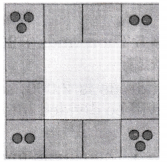
Once upon a time, there was a king who was very fond of horses. He had 20 horses of the best breed. The horses were kept in the royal stable, and cared for by a caretaker. One night, a thief stole one of the horses. Fearing punishment, the caretaker arranged the horses in the stable as shown in the picture here. The next day, when the king came to check on the horses, the caretaker led him around the square stable. “Please count the number of horses along each side, your majesty,” he said. King’s Horses
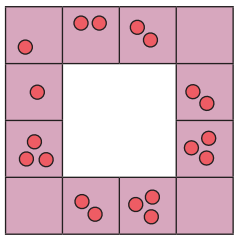
The king counted 5 horses along each side. “We have 5 horses along each side and there are 4 sides. So there are a total of 20 horses, your majesty,” the caretaker explained.
Satisfid with the explanation, the king returned to his palace.
But wait, were there really 20 horses in the stable? Count the horses one by one and check! What was the mistake in the caretaker’s explanation?
Solution:
Caretaker counted corner horses twice, making it look like there were 20 horses when there were fewer.
The following night, the thief stole another horse from the stable. Now, only 18 horses remained. The caretaker once again cleverly arranged the 18 horses, so that there were 5 horses on each side of the square stable. How do you think he was able to do it? Arrange the 18 horses in the stable with 5 on each side.
Solution:
2 horses + 2 horses in middle on each sides and 1 horses on top left corner and on bottom right corner.
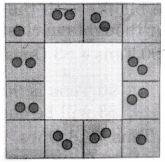
How many more horses can the thief steal before the king notices something is wrong? Try making the arrangements yourself.
Solution:
Hence, caretaker can arrange 10 horses in such a way that it appears 5 horses on each sides.
Therefore, the thief can steal upto 10 horses bringing the total down to 10.